Mood Tracker Journal: How Weekly Notes Reveal Patterns
Learn what a mood tracker journal is, which mood scale to use, how to log in two minutes, and how to keep your weekly records private.
In this article
- What a Mood Tracker Journal Records Each Week
- Why the Week Is the Right Unit
- Weekly Layout Fields and What to Enter
- The Two Fields Readers Skip
- Paper or App
- Picking a Mood Scale That Keeps the Detail
- How to Choose in Practice
- Keeping Your Mood Records Private
- Protections You Can Check Yourself
- The Household Risk
- Sharing With a Clinician Safely
- How to Log Your Mood in Under Two Minutes
- Why Brevity Protects Quality
- Reading Weekly Summaries Without Overreacting
- A Pattern That Deserves a Closer Look
- Coverage Before Conclusions
- Start Your First Weekly Entry Today
What if the number you record for your mood is the least useful part of the entry? Most trackers ask you to score a day, then leave you with a column of scores and no way to tell why Tuesday differed from Thursday. A mood tracker journal works differently when you store the feeling next to its context, review it by the week, and protect it like the private record it is.
What a Mood Tracker Journal Records Each Week
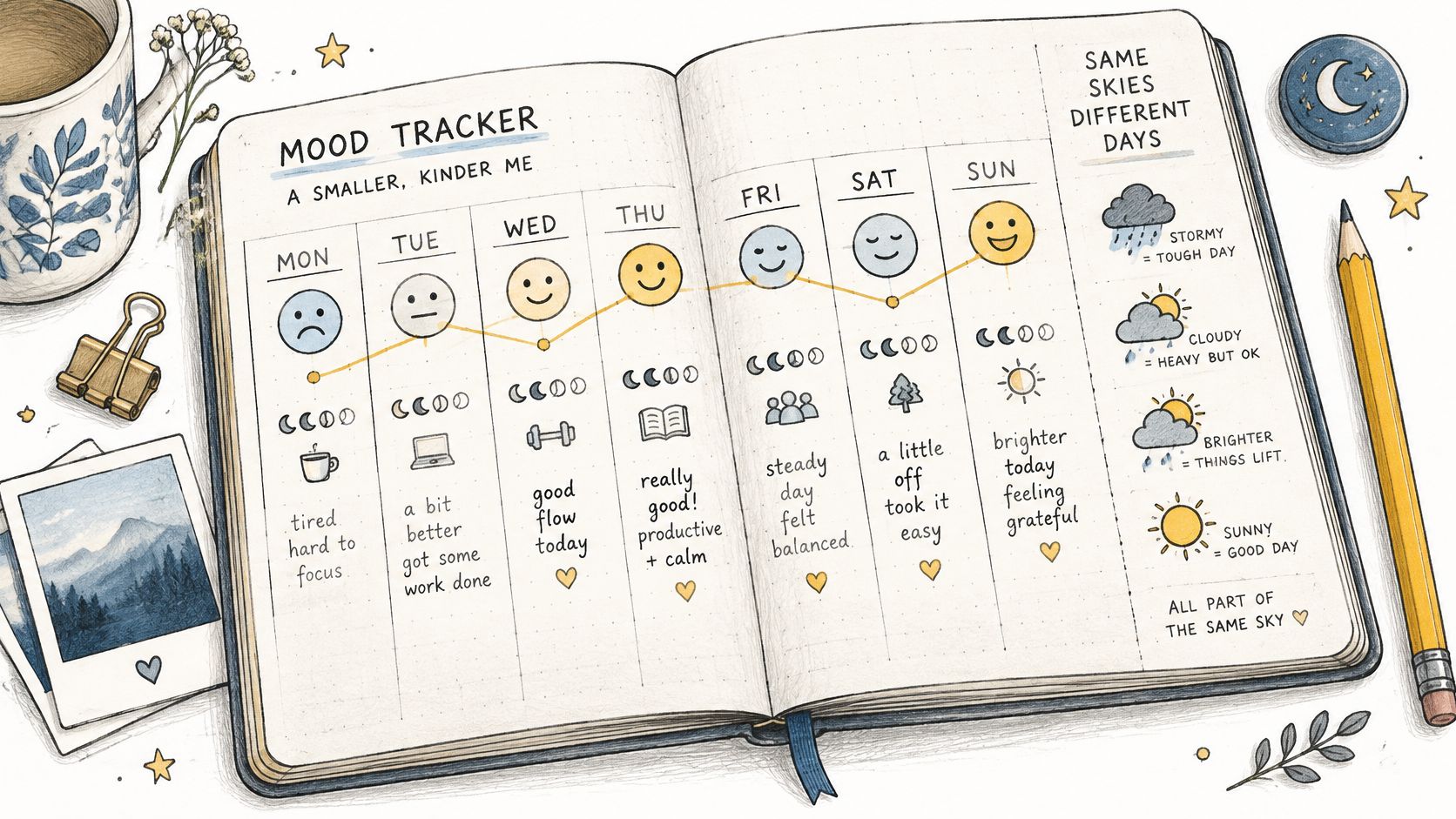
How is this different from a diary you write when something happens, or an app that asks for one tap and shows a chart? Say you had a draining Wednesday. A diary entry might describe the meeting in detail. An app might store a 3 out of 10. A mood tracker journal stores both sides, a rating for how you felt and a short note, tags, and an optional image that show what the day held.
Think of a daily diary as a camera. It captures one moment well, but a single photo can't tell you whether it rained all week. A weekly mood record is closer to a weather station. It logs readings across seven days, so you can tell a passing shower from a storm that settled in.
Why the Week Is the Right Unit
Day-to-day swings are normal. Poor sleep, a hard conversation, or a delayed train can pull one day down without meaning anything lasting. A week gives you enough entries to ask a better question. Was that one rough day, or did low ratings collect around the same tag, such as work, health, or money, for most of the week?
That weekly frame also makes gaps visible. If you logged six days, your average rests on most of the week. If you logged two, it rests on very little. If you want a simple starting point for the daily habit itself, you can track your mood each day with a brief rating and note, then let the weekly view do the harder work of showing patterns.
Journaling is already a common self-support tool for younger people. A 2023 Statista survey found that 20% of U.S. participants aged 14–25 used journaling to help manage their mental health, as reported by Psychology Today in 2026. The weekly structure builds on that habit without asking for long essays.
Our own app grew from a weekly way of seeing time. Life Calendar was inspired by a popular post by Tim Urban titled 'Your Life in Weeks', and that same unit, one week at a time, is what makes mood records readable. You'll set up a weekly layout, choose a scale, check privacy, build a two-minute routine, learn to read summaries calmly, and finish with a first-week plan.
Weekly Layout Fields and What to Enter
Start with six fields and resist adding more until the habit holds for a few weeks.
| Field | What to Record | Example Entry | Time to Log |
|---|---|---|---|
| Mood rating | Positive and negative affect, each rated 1-5 | Positive 4, negative 2 | Under 10 seconds |
| Energy and sleep | Hours slept and energy level 1-5 | 6 hours, energy 2 | About 20 seconds |
| Context tags | Work, family, health, money, travel | work, deadline | About 15 seconds |
| Short note | One sentence on the main event | Presented plan to the team | About 1 minute |
| Image card | One photo that captures the week | Sunset walk on Sunday | Optional |
| Weekly summary | Average ratings and days logged | 6 of 7 days logged | About 2 minutes per week |
The Two Fields Readers Skip
Context tags look minor, so they're often the first thing dropped. They're also what makes the numbers usable later. A low rating tagged deadline suggests pressure at work. The same rating with no tag tells you almost nothing when you read it back a month later.
The short note gets skipped for the opposite reason. People treat it like a diary entry and put it off. Keep it to one sentence about the main event, such as "Presented plan to the team" or "Argument at home, resolved by evening." You're writing a caption for the rating, not an account of the whole day.
Minimum viable entry: the two mood ratings, one tag, and one line. If a day allows nothing more, that entry still counts.
Paper or App
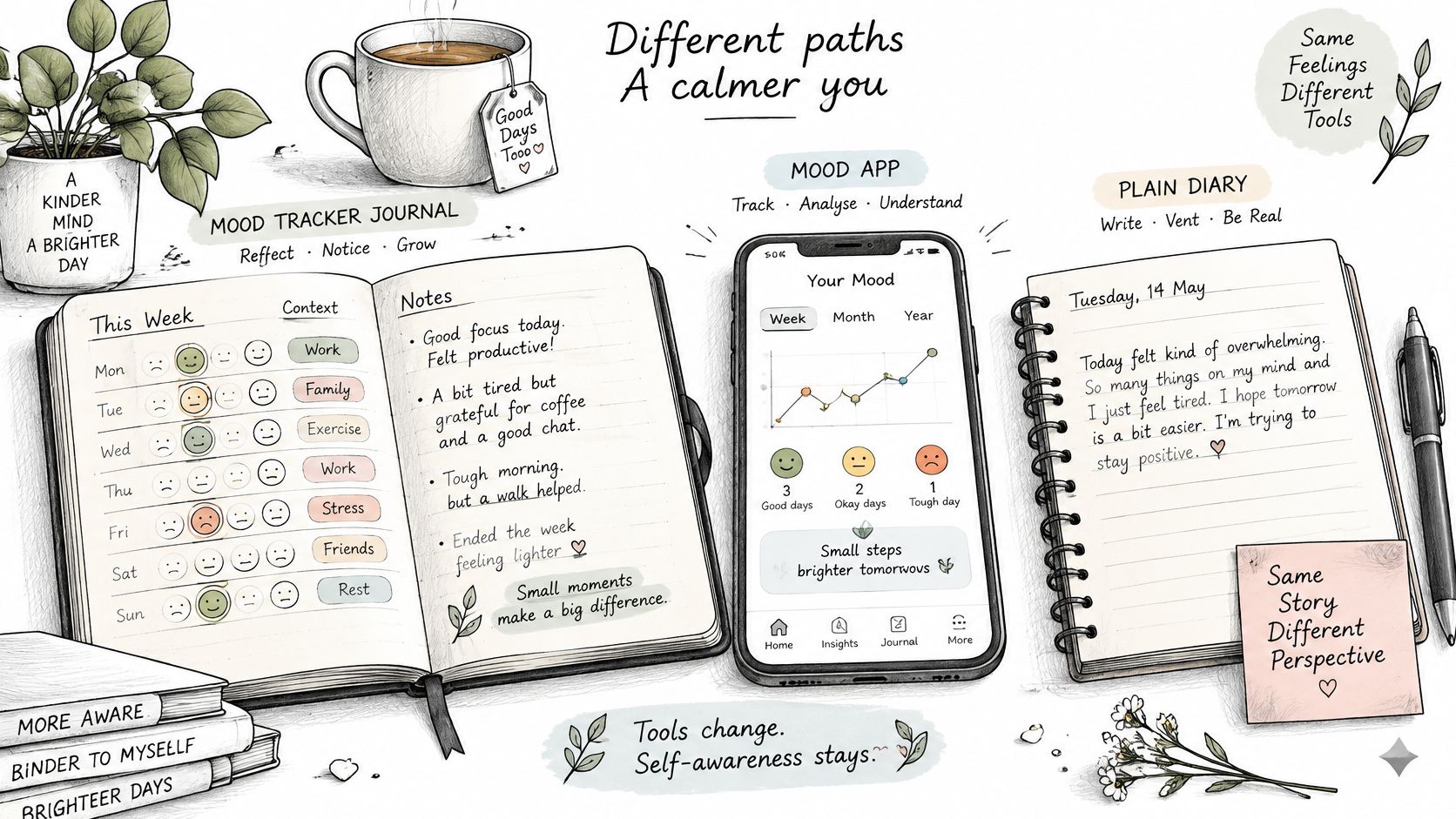
The same fields work in a notebook with one page per week. Rule columns for the ratings, leave room for tags and the one-sentence note, and write your summary at the bottom on your review day. Paper has no notifications and no account, which some people prefer.
An app adds reminders, timestamps, and automatic weekly averages, which removes the small maths task that kills paper systems. If you want a ready-made structure for the written part, a weekly notes template gives you the same fields in a repeatable layout. Choose the format you'll open every day. The medium matters far less than whether the entries exist at the end of the week.
One caution on the summary row. Always write days logged next to the averages, as in "6 of 7 days logged." That small number tells you how much weight the averages can bear, and it stops a two-day week from looking as solid as a full one.
Picking a Mood Scale That Keeps the Detail
Use two separate 1-5 ratings, one for positive feelings and one for negative feelings. That verdict comes first because it's the design choice everything else rests on.
In a mobile ecological momentary assessment study of 171 young adults, participants completed a five-item mood measure four times daily for two weeks, and two components, positive and negative affect, explained 75.8% of the variance, according to the University of Bristol research record. In plain terms, positive and negative feelings behaved as two separate dimensions, not as opposite ends of one line.
That matters because real days are mixed. You can feel proud of a presentation and anxious about feedback at the same time. A single slider forces you to average those into one lukewarm number, and the detail you most need later is gone.
| Scale | What It Captures | Main Weakness | Best Use |
|---|---|---|---|
| Single 1-10 score | One overall rating | Mixed days collapse into one number | Quick daily check |
| Single good-bad slider | One bipolar rating | Discards separate positive and negative feelings | Simple habit start |
| Two 1-5 ratings (positive and negative) | Positive and negative affect separately | Takes one extra tap | Weekly pattern review |
| Five-point face scale | Coarse overall mood | Limited nuance | Low-effort entries on busy days |
| Free-text mood word | A named emotion such as tense or calm | Hard to compare across weeks | Adding texture to a summary |
How to Choose in Practice
If you're starting from zero and any friction will stop you, a single 1-10 score or face scale is a reasonable first step. A rough record you keep beats a precise one you abandon. Once the daily habit feels automatic, move to the two-rating design for your weekly reviews.
A free-text mood word works best as a supplement, not a replacement. Words like tense, flat, or steady add texture beside the numbers. On their own, they're hard to compare across weeks because your vocabulary shifts with your mood.
Keep the same scale for the whole journal. A scale you change midstream produces two records that cannot be compared, not one longer record.
Whatever you pick, write down what your numbers mean at the top of your journal or in a fixed note. Decide what a 2 and a 4 look like on each rating. That short definition keeps a score in your first month meaning the same thing as the same score months later.
Keeping Your Mood Records Private
Who can read your entries? Are they shared with anyone? Can you export or delete them? Most journaling guides skip these questions, yet they're the ones that decide whether you'll write openly. A record you expect someone else to see becomes a performance, and a performance isn't useful data.
Protections You Can Check Yourself
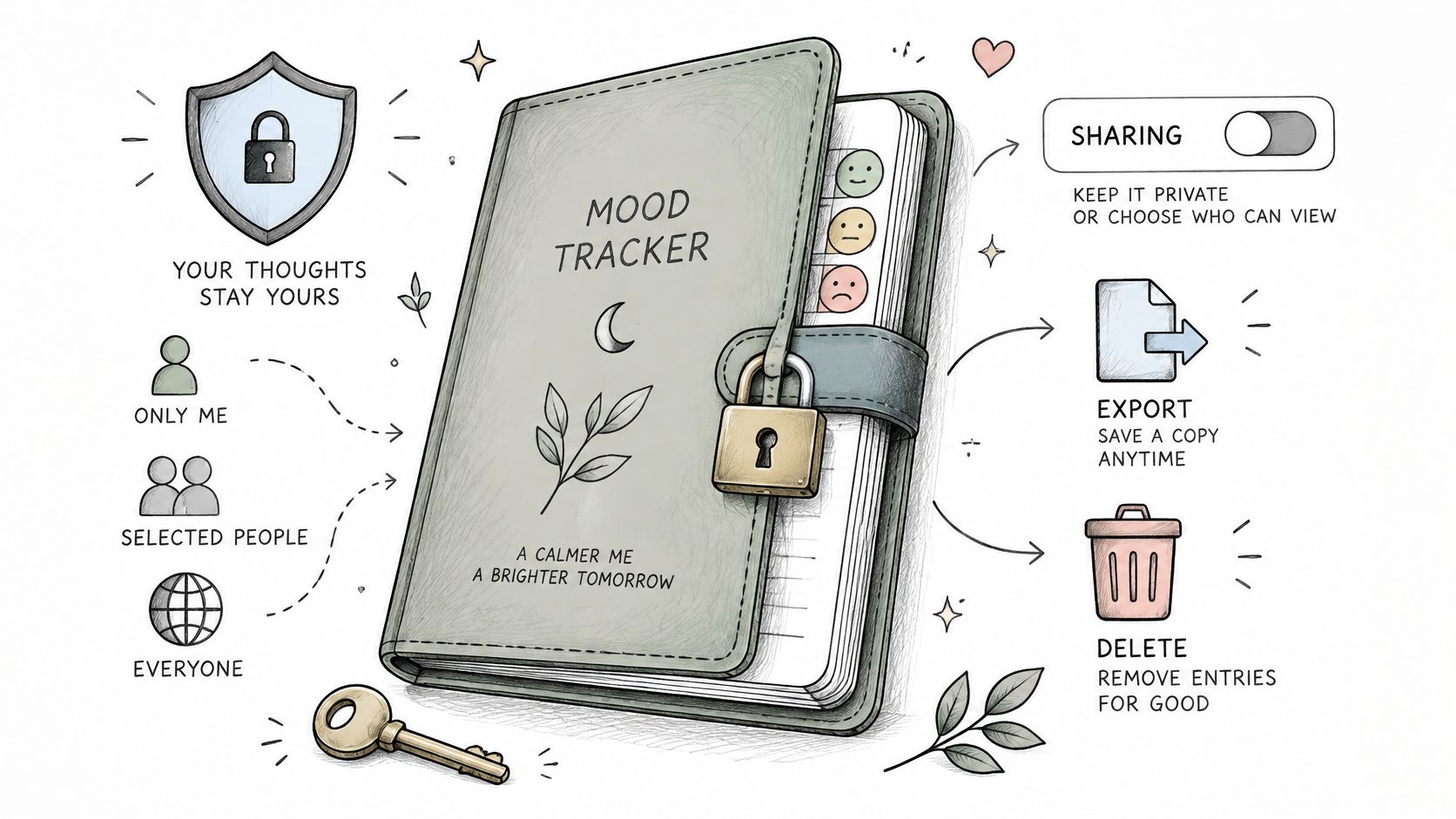
- Device and app lock: Use your phone's passcode, and add a separate app passcode where the tool offers one.
- Storage location: Prefer storage that stays on your device or is encrypted, and check what leaves the device.
- Retention and deletion: Confirm you can delete single entries and your whole record, not just hide them.
- Granular permissions: Deny access the journal doesn't need, such as contacts or precise location.
- Export control: Know what an export contains before you create one, since an exported file can be copied freely.
Don't assume these basics are in place. A review reported in JMIR Human Factors found that 15.4% of assessed mental-health apps did not mention a data-sharing policy, and 65.1% did not report involvement from mental-health professionals. If a tracker can't tell you where your data goes, that's an answer in itself.
The Household Risk
The likeliest reader isn't a hacker. It's a partner, parent, or employer who picks up an unattended phone, or a family member who knows your device passcode. If that worries you, use a separate app passcode, turn off notification previews that quote your notes, and keep sensitive detail in the summary rather than in the daily note.
For our part, we state our policy plainly. Life Calendar does not use cookies for tracking purposes, and we do not sell, trade, or transfer personally identifiable information to outside parties unless users are given advance notice. Privacy questions can be sent to support@lifecal.me.
Sharing With a Clinician Safely
If you work with a therapist or doctor, share the weekly summary and a few chosen notes rather than handing over the full journal. Averages, days logged, frequent tags, and two or three relevant notes answer most clinical questions without exposing everything you wrote. If cost is part of your decision about seeking that support, understanding private psychiatric assessment costs can help you plan before you book.
Run any tracker through three questions before your first entry. Who can access this, where is it stored, and how do I delete it? If you can't answer all three in a minute, keep looking.
How to Log Your Mood in Under Two Minutes
A routine you can finish while a kettle boils will outlast a thorough one you dread. Here's the full sequence.
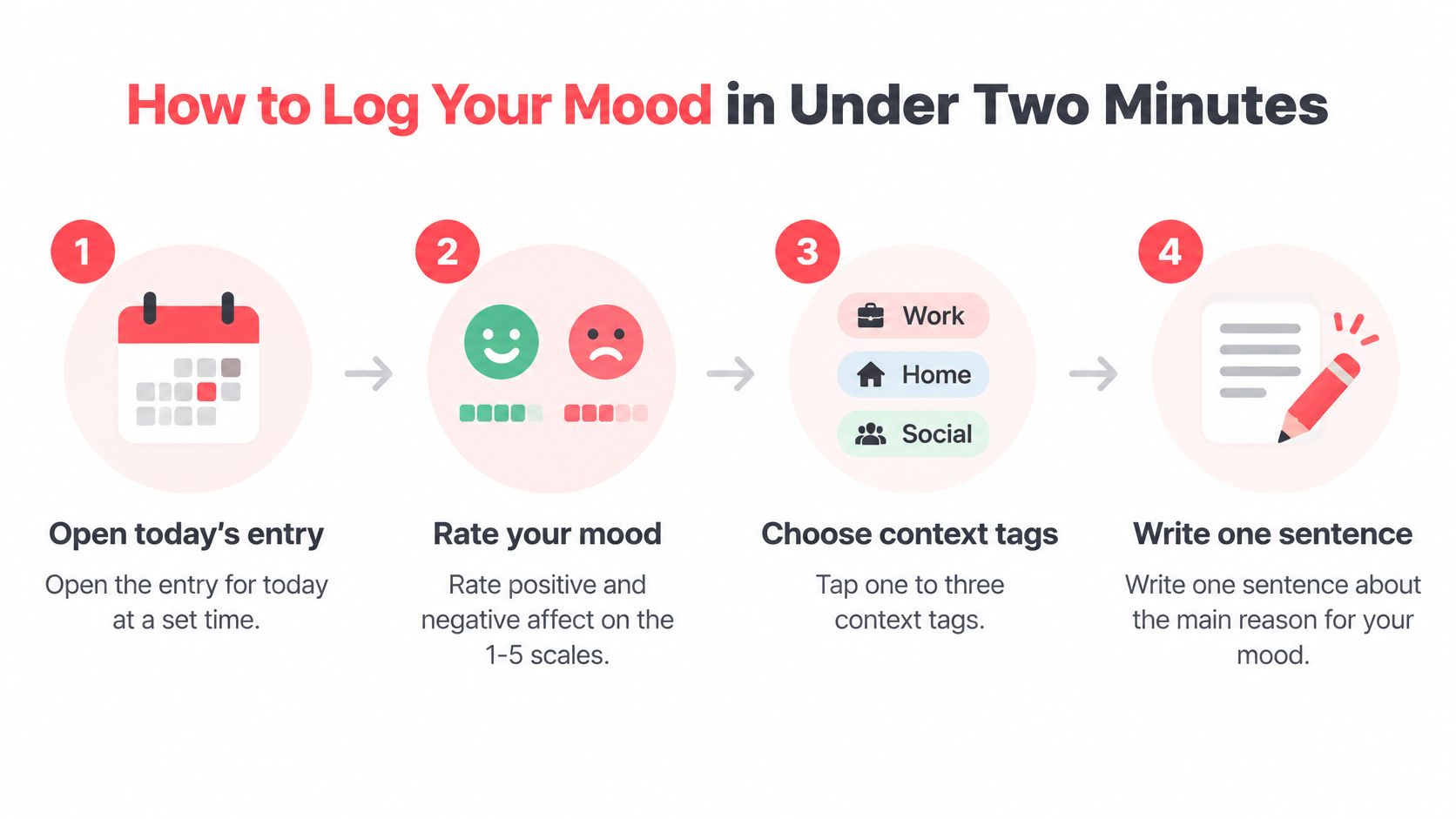
- Open today's entry at a set time. Attach it to something you already do, such as brushing your teeth or plugging in your phone. A fixed cue removes the daily decision about when to log.
- Rate positive and negative affect on the 1-5 scales. Answer for the day as a whole, not just the last hour. Don't wait for a strong feeling, because rating only on dramatic days biases the whole record.
- Tap one to three context tags. Pick the tags that shaped the day most, such as work or family. More than three usually means you're tagging everything, which tells you nothing.
- Write one sentence about the main event. Keep it factual, such as "Deadline moved up, worked late." You can add hours slept and energy here if you track them.
- Mark missed days as missed. If you skipped yesterday, record it as missed rather than reconstructing a rating from memory. A delayed entry written the next morning is acceptable, a week of backfilled guesses isn't.
- On your weekly review day, read the summary and note one change. Pick a single small adjustment, such as an earlier bedtime on work nights. One change at a time keeps the next week's data readable.
Why Brevity Protects Quality
Burden is the main reason these records fall apart. A systematic review and meta-analysis covering 77 mood-monitoring or ambulatory-assessment studies identified time consumption and technical problems as the most common reported barriers, appearing in 9 of 24 studies that documented barriers or facilitators (38%), according to JMIR Mental Health. A separate feasibility study using repeated mobile assessments reported an average response rate of 75.1%, ranging from 61% to 91%, with push notifications, progress indicators, and lightweight feedback supporting engagement.
That evidence points to a clear design. One-tap ratings, optional context fields, and no required long text keep the cost of each entry low. If you're unsure how to phrase the written part, examples of how to structure short journal entries can help you keep the sentence short and specific.
A day with no entry is not a neutral day. Missing means missing, and recording it that way keeps your averages honest.
Set a reminder, but make it easy to act on late. An entry completed an hour after the prompt carries almost the same value. An entry skipped because the moment passed carries none.
Reading Weekly Summaries Without Overreacting
Say your summary shows three days with high negative ratings, all tagged deadline, and a note that reads "Presented plan to the team." Your positive ratings stayed mid-range, you logged six of seven days, and the weekend entries look ordinary. The honest reading is narrow. Work pressure made for a rough week, and the pressure had a name and an end date.
That is not evidence of decline. It's evidence that a demanding week felt demanding, which you already knew. The value of the record is that you'll be able to check next week whether the pattern lifted when the deadline passed.
A Pattern That Deserves a Closer Look
Contrast that with a different picture. Positive ratings sit low across several weeks, not just a few days. Sleep hours fall alongside mood, and health or money tags appear more often each week. No single week looks dramatic, but the direction repeats.
That combination justifies attention because it has three qualities a bad week lacks. It persists across weeks, it shows up in more than one field, and it isn't explained by one tagged event. That's the point where reviewing your notes with a professional becomes a sensible step.
| Signal | What It Suggests | Next Step |
|---|---|---|
| Three low-negative days tagged deadline in one week | Work pressure linked to a rough week | Watch the next week before drawing conclusions |
| Low positive ratings across several weeks | Possible lasting pattern | Review sleep and tags, then consider a professional if it persists |
| Sleep falling alongside mood | Link worth questioning, not proof of cause | Keep logging sleep and note changes |
| Rising health or money tags | Pressure building outside mood | Read the notes to find the cause |
| Two days logged in a week | Weak evidence | Log more days before trusting the averages |
Coverage Before Conclusions
Always read days logged before you read any average. An average built on two days can swing wildly based on which two days you happened to record. Treat thin weeks as incomplete rather than alarming, and don't compare them directly with full weeks.
Expect your own logging to thin out over time, too. The Psychological Medicine systematic review reports that providers see engagement commonly decline after initial use, so a tracker can produce incomplete and misleading patterns rather than a representative picture of wellbeing. The same review notes that evidence for the psychometric quality of mobile mood-monitoring applications is sparse, with reported reliability ranging from questionable to excellent.
So hold your conclusions lightly. Tags and mood moving together is a prompt for a question, not proof that one caused the other. Poor sleep might lower mood, low mood might disrupt sleep, or a third pressure might drive both.
Your journal shows when your mood changed and what else was happening at the time. It cannot prove why it changed, and it isn't a diagnosis. A pattern that persists or worsens is a reason to talk to a professional, with your dated summaries in hand.
Start Your First Weekly Entry Today
You don't need a perfect system to begin. You need four decisions made once, then repeated.
- Choose your scale. Use two 1-5 ratings, one for positive affect and one for negative affect, and write down what each number means to you.
- Set one daily time. Pick the same two minutes each day, tied to a habit you already have, and set a reminder for it.
- Pick three context tags. Start with the three areas that shape most of your weeks, such as work, family, and health, and use them consistently so weeks stay comparable.
- Write your first weekly summary after seven days. Record the averages, the days logged, your most frequent tag, and one sentence on what you'd change.
Test the system after two weeks. Ask whether you logged at least five of every seven days and whether the summary still makes sense when you read it cold. If either answer is no, simplify the entry. Drop the energy field or shorten the note rather than adding anything new. A step-by-step journaling guide can help if the writing itself feels like the obstacle.
Life Calendar can hold this structure for you, since you can mark each week with colors and add notes, images, mood, and tags to it, with up to three cards per week on Free and Premium plans, and it's available on the App Store and the Play Store. Choose your two rating scales and set tomorrow's two-minute entry time before you close this page.
Start your first week in Life Calendar, where each week can hold your mood ratings alongside notes, images, and tags in one view of your life in weeks. Set up your two 1-5 scales today, log your first entry tonight, and read your first honest weekly summary seven days from now.