How to Do Journal Entries That Stay Useful
Learn how to do journal entries with a four-part structure, specific details, and a clear stop when writing raises distress.

In this article
- How to Write One Journal Entry
- Set up a bounded writing session
- Four fields every journal entry should include
- Entry Shapes for Gratitude Problems and Ordinary Weeks
- Which journal shape to use this week
- Finish decisions with a control check
- Habits That Keep Entries Specific
- Protect the scene and the ending
- Keep the rough version
- When to Stop a Distressing Entry
- Continue, switch, or stop the entry
- Separate documentation from trauma processing
- Store the First Entries and Start This Week
- Check access before adding detail
- Save an entry you can reopen
You open a notebook or a blank note on your phone, then struggle to decide what belongs on the page. The day feels too ordinary to describe, or too tangled to summarize. You write that you were busy, add a mood, and stop.
Learning how to do journal entries is mostly learning what to record and what to leave out. A useful personal entry gives your future self enough context to understand an experience without requiring polished prose, a dramatic event, or a positive ending.
How to Write One Journal Entry
Name the period and summarize the event. Put the date or week at the top so a later reader can locate the memory. For a hypothetical work entry, you might write: This week, the project review moved to Friday. The team was asked to update its timeline. Keep this opening neutral. The schedule changed is an observable fact; nobody respects my time is an interpretation.
Add the details that identify the scene. Record the place, the people involved, and what someone said or did, because these details distinguish this event from similar ones. You might add: I read the scheduling email at my kitchen table before leaving for work. My coffee had gone cold while I compared the new review date with the delivery schedule. Choose details that help reconstruct the moment, not an inventory of everything nearby.
Separate thoughts, emotions, and bodily reactions. Use labeled lines so your future self won't confuse an inference with an event. In the same example, write Thought: I expected us to miss the deadline. Emotion: Irritable and worried. Body: Tight chest. You don't need to justify the feeling or prove that the thought was correct. You're recording your response, not issuing a verdict on someone else's intentions.
Close with meaning, a lesson, and a controllable action. Explain why the event mattered, then identify what you can do. For example: The change mattered because I hadn't allowed time for another review. I need to confirm review dates before promising delivery. Next I will send the revised timeline on Wednesday morning. Avoid endings that depend on another person behaving differently.
Add labels after the narrative exists. A mood word, tag, or image can help you find the entry later, but it shouldn't carry the whole account. A tag such as work won't tell you which project changed or why you were concerned. Write the sentences first, then add the organizing details.
Read once for completeness, not style. Ask whether a later reader could identify what happened, how it felt, why it mattered, and what follows. Add missing context, but leave awkward wording alone. You're making a usable record, not preparing an essay for publication.
Set up a bounded writing session
Start on a blank page in an unrushed setting, without correcting grammar as you go; a 10–15 minute session is a practical starting point described in HelpGuide's journaling guide. Treat the timer as a boundary, not a target you must fill. A weekly entry of a few paragraphs can document ordinary life without requiring daily writing.
Consistency matters more than literary ambition. Samuel Pepys maintained more than nine years of near-daily documentation, according to the JAMA Ophthalmology account of his diary. You don't need his volume of writing to borrow the useful principle: date observations and keep a recognizable structure.
Four fields every journal entry should include
| Field | What to record | Example | Later-reader test |
|---|---|---|---|
| Time unit | Date or week being documented | This week's date range | Can place the memory on a timeline |
| Event summary | Neutral facts only | Review date moved to Friday | Can say what happened without guessing mood |
| Thoughts and feelings | Emotions, thoughts, and body reactions labeled apart from facts | Emotion: Irritable. Body: Tight chest. Thought: The deadline would be missed. | Can tell feeling from interpretation |
| Meaning and next action | Why it mattered and one controllable step | Send the revised timeline Wednesday morning | Can see what follows, not only what happened |
Watch for vague summaries, guesses in the fact line, and unnecessary polishing. An entry that says the day was fine needs a scene. An entry that records only bad days needs a broader selection of experiences. Neither problem requires more elegant sentences.
Entry Shapes for Gratitude Problems and Ordinary Weeks
Choose the entry's shape before writing. Use gratitude when something specific helped, problem-solving when a decision is available, planning when the coming week needs direction, and neutral observation when nothing needs resolving.
Which journal shape to use this week
| Shape | Start with | Best week for it | Stop when |
|---|---|---|---|
| Gratitude | Specific person, event, or object and the benefit | A week with a concrete help or pleasure | The thanks stays generic |
| Problem-solving | The fact, the obstacle, and two options | A decision is actually available | Writing replaces the next step |
| Future planning | Next week, one priority, first small step | The coming week needs a plan | The plan has more than one priority |
| Neutral observation | Place, people, and what happened | An ordinary or mixed week | A moral is being forced onto the facts |
Consider a parent whose train was delayed. The circumstances stay the same in these examples; only the purpose of the entry changes.
Gratitude: My neighbor watched my child when the train delay kept me from getting home. Her help meant I didn't have to arrange unfamiliar care while stuck on the platform. Having someone nearby who could step in made the disruption easier to manage.
Problem-solving: The delay exposed a gap in my pickup arrangements. I could ask my neighbor about occasional backup care or investigate a later collection option. I'll ask about the collection option first because it wouldn't depend on my neighbor being available.
Future planning: Next week's priority is a workable backup for pickup. I'll start by contacting the childcare office about its late-collection procedure. I don't need to solve every possible travel disruption in the same entry.
Neutral observation: I waited on the platform beside commuters checking the departure board. When I arrived home, my child and my neighbor were finishing a puzzle at the kitchen table. I put down my bag and joined them.
Finish decisions with a control check
Mark concerns controllable, influenceable, or outside control. Sending an inquiry is controllable; negotiating an arrangement is influenceable; preventing every train delay is outside control. Assign a next step only to the first categories.
Reflection isn't a substitute for sending the message, making the appointment, or choosing between available options.
Gratitude doesn't require pretending the delay was welcome. A 2025 gratitude meta-analysis estimated a small well-being improvement, Hedges' g = 0.19, not a dramatic transformation. Avoid forced positivity, comparing your circumstances with someone else's, or treating a passing mood as a judgment on the whole week.
If no topic stands out, describe the most recent event with a clear person or place. These visual journal ideas offer alternatives when an object or photograph provides a better starting point than a written prompt.
Habits That Keep Entries Specific
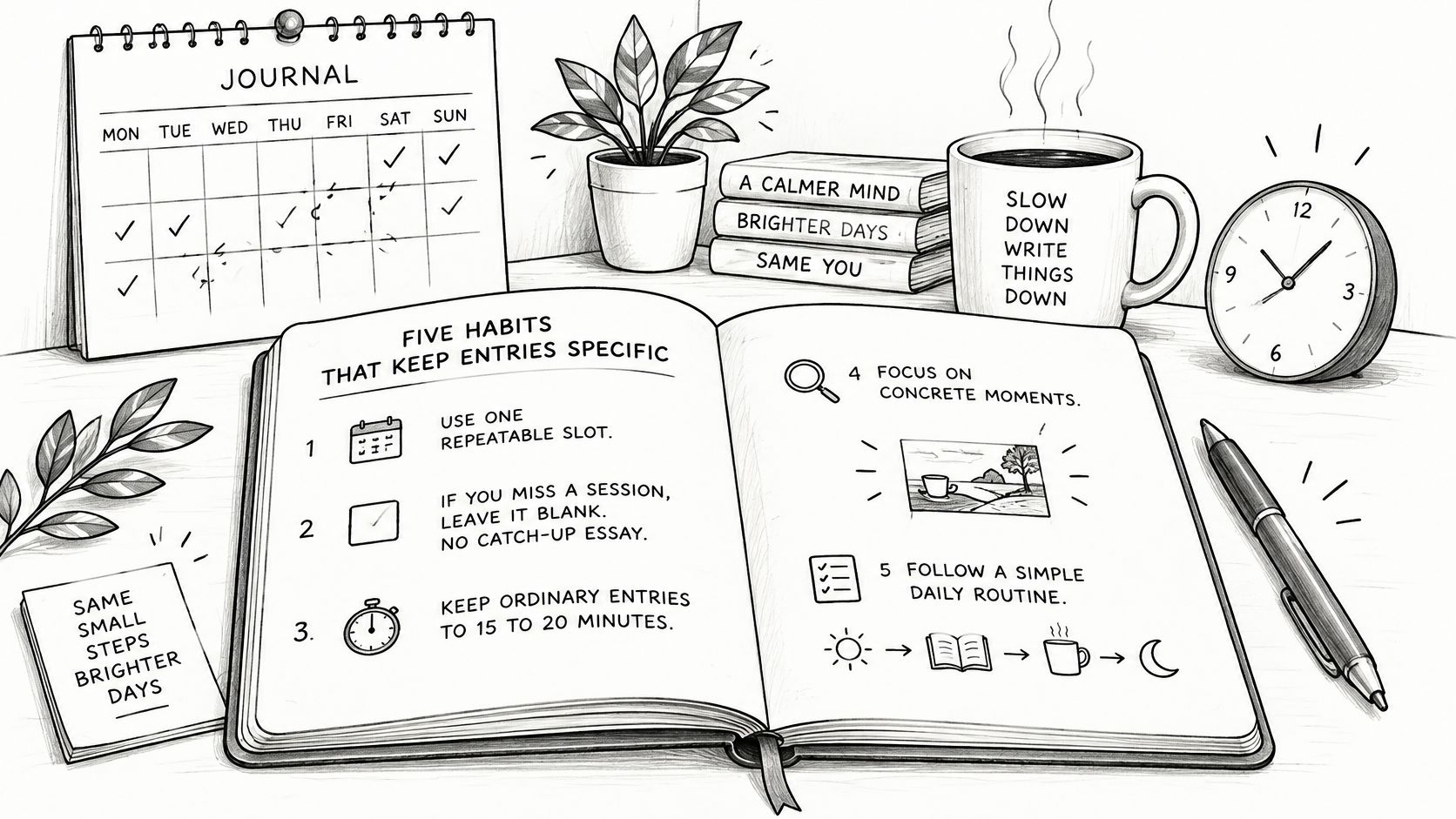
A writing routine should remove decisions, not create extra homework. Keep the conditions predictable enough that you can spend your attention on the event you're documenting.
Protect the scene and the ending
- Choose a repeatable slot. Sunday evening or the commute home can serve as a cue. If you miss it, resume with the current period instead of assigning yourself a catch-up essay.
- Keep ordinary entries bounded. Use the shorter session as your default. If an entry runs longer, a 15–20 minute cap or a few paragraphs is a reasonable boundary consistent with the entry guidance and evidence summarized in the 2022 systematic review of journaling interventions, which found an average 5% reduction in patient mental-health measure scores compared with controls.
- Prefer a scene to a daily inventory. Describe the conversation at the doorway rather than listing breakfast, work, shopping, and dinner. Include what changed during that conversation.
- Use a recognizable closing line. Finish with Next I will… when an action is appropriate. For an observational entry, the ending can identify what you want to remember.
- Review for clarity, not achievement. At a monthly check-in, open a small selection of recent entries. Check whether the dates, events, and actions still make sense without reconstructing them from memory.
The review's average isn't a forecast for your own mood, and a personal diary isn't a treatment with guaranteed results. Don't turn the entry into a test of whether you're becoming happier.
Keep the rough version
Say you spend the end of a session replacing upset with increasingly precise adjectives. Unless that distinction changes your understanding, keep the original word and finish. More editing won't explain who was present or what happened next.
Practical rule: Add missing context before improving the wording.
Don't chase a positive ending either. I'm disappointed, and I haven't decided what to do can be an accurate conclusion. You can identify an unresolved question without manufacturing a lesson.
Try the routine for a week using short entries or a weekly account. Then reread what you saved: can you tell what happened without relying on today's memory? Keep the parts of the habit that preserve that answer, and simplify anything that merely makes the page look finished.
When to Stop a Distressing Entry
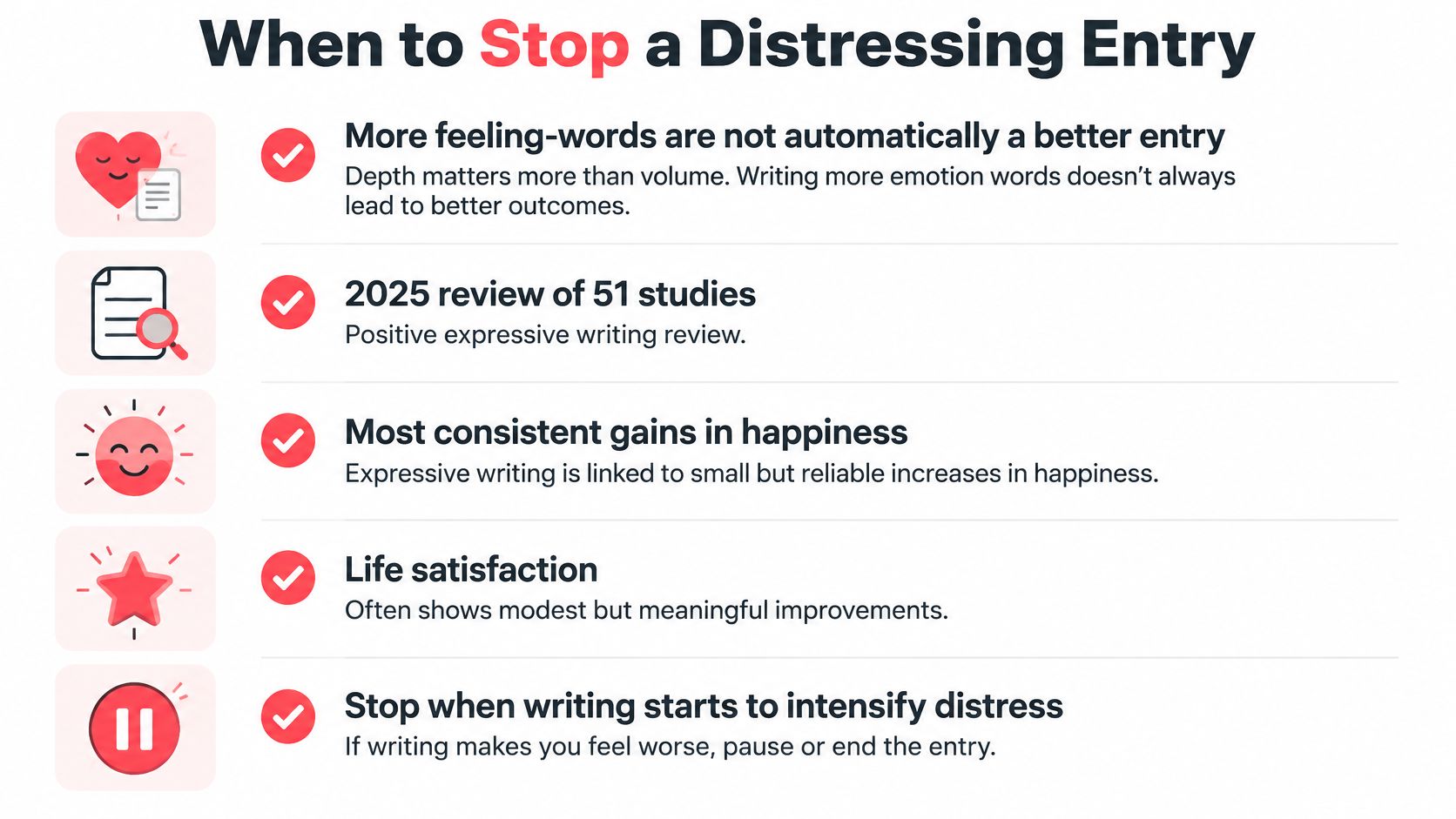
Decide your stop rule before the session starts. A difficult subject can pull you further in exactly when your judgment is least steady, so pick the limits with a clear head: a time cap, the topics you'll approach, and the signals that end the session. Then use your response during and after writing to decide whether to continue, change the subject, or stop.
Continue, switch, or stop the entry
| What you notice | What it suggests | What to do next |
|---|---|---|
| You can name the event and one next step | Ordinary reflection | Finish and leave it until the next planned entry |
| Mood dips and then settles | Short-term arousal, not a reason to push harder | Stop at the time cap and return to a neutral topic next time |
| The same painful scene is rewritten in more detail | Re-exposure rather than documentation | Switch to what happened and what helped, without a full retelling |
| Panic, hours of rumination, self-harm thoughts, or impaired sleep or work | Writing may be worsening distress | Stop, use grounding, and seek professional or emergency support |
Run a short control check when the entry ends: do you feel roughly as steady as when you started, or noticeably worse? One rough session is ordinary. If the same subject leaves you worse twice in a row, retire it from the journal. These signals work as a practical checklist, and pausing doesn't require proof that writing caused the problem.
Separate documentation from trauma processing
For general personal documentation, stay with the event, a brief emotion label, what you needed, and what helped. Those four fields are what a later reader needs to understand the week, and a weekly note can acknowledge a difficult experience without reconstructing every exchange or sensation. Detailed trauma processing shouldn't be treated as a casual journaling exercise.
For example, a hard-week entry might say: A family argument left me unsettled. Walking outside helped me settle enough to eat dinner. I need some space before deciding whether to discuss it again. That records the experience without requiring a full retelling.
If distress climbs mid-entry, merely shortening the session won't fix it. Change the topic or pause writing. Put the page aside, notice your surroundings, feel your feet against the floor, or contact someone you trust.
You don't owe the journal a complete account of a painful event.
Seek professional support if distress persists or interferes with daily life. If you have self-harm thoughts, contact a clinician or crisis service; if you might act on them or can't stay safe, seek immediate local emergency support. A short factual entry on a hard week is a complete entry.
Store the First Entries and Start This Week
A useful journal must remain private, recoverable, and readable, not merely easy to write. Before storing sensitive material, decide who could access your device, account, backups, or exported files. A shared tablet and a private notebook present different access problems.
A 2025 evaluation of mental-health apps examined 115 apps and found uneven privacy protections, including weak safeguards and poor transparency around information destruction. Don't assume that an accessible privacy policy means you've answered the practical questions about your entries.
Check access before adding detail
- Minimize identification. Use initials or relationship labels where full names, addresses, or workplace details aren't necessary.
- Protect the device. Enable a strong passcode and consider whether notification previews could expose private text.
- Inspect storage and sharing. Establish whether entries stay on the device or synchronize elsewhere. Check backup destinations and sharing settings before attaching photographs.
- Test recovery. Save an export where appropriate, protect that copy, and confirm you can open it. Find out what account deletion removes and whether separate backups remain.
Accessibility matters just as much as storage. Before committing to an app, test the actions you need: enlarging text, using a screen reader, dictating a note, or retrieving an entry with unreliable connectivity. If typing is difficult, a brief voice record or an image with a descriptive caption can be more usable than an unfinished page.
Save an entry you can reopen
For a weekly option, our Life Calendar app guide explains the format: we use your birthday to generate a life grid, with each week shown as a box, and let you mark weeks with colors and add notes, images, mood, and tags. We don't sell, trade, or transfer personally identifiable information to outside parties unless users are given advance notice. That policy doesn't replace checking your own device access and storage choices.
Create the current week's entry in the place you've chosen. Give it the time unit, event summary, labeled thoughts and feelings, and a meaningful ending, then close it and reopen it to check that it saved correctly.
Keep the first record plain. A recognizable date, an identifiable event, and words you can still access next Sunday are more useful than an elaborate setup you haven't tested.
Life Calendar offers a weekly life grid where you can keep notes, images, moods, and tags alongside the periods they describe. Visit Life Calendar and create a card for this week using the entry fields, then check that you can reopen it at your next writing session.
Prepared with Outrank tool