Visual Journal Ideas: 8 Creative Ways to Record Your Life
Discover 8 visual journal ideas to record your life with photos, sketches, layouts, and notes. Practical methods, examples, and tips for starting today.
In this article
- 1. Life in Weeks Calendar
- What to Put in One Week
- 2. Mood Tracker Visual Journal
- 3. Photo-a-Day (365 Project) Journal
- Make the Choice the Same Day
- 4. Bullet Journal Visual Method
- 5. Project Life Memory Album Journal
- A Repeatable Weekly Workflow
- 6. Illustrated Sketch Diary
- 7. Keepsake Ephemera Journal
- Preserve It Without Turning It Into Storage
- 8. Creative Prompt Visual Journal
- How the eight visual journal methods compare on medium, effort, and best use
- Pick One Method and Start This Week
You scroll back through a year of phone photos trying to work out what happened in March. There's a blurred meal, three screenshots, a sunset you can't place, and nothing that explains why that month felt so heavy or so good. The images are there. The sequence isn't.
That's the gap a visual journal closes. It doesn't ask you to write pages every night. It asks you to pair one image, color, sketch, layout, or object with the week or day where it belongs, plus a few honest words before the details fade. A caption written while you still remember who laughed first will do more work later than a perfect page made months afterward.
The eight visual journal ideas below all record life, but they don't record the same thing. Some preserve how a period looked, some preserve how it felt, and some preserve where it sits in the longer story of your year or your life. A photo method is fast but easy to let pile up. A sketch diary slows you down in a useful way but won't suit every busy week. A grid gives you perspective, while prompts give you momentum when a blank page gives you nothing.
Pick by the memory you keep losing, not by the prettiest example you find online. If your camera roll feels like storage rather than a record, start with structure. If your days blur together, start with a weekly anchor.
1. Life in Weeks Calendar
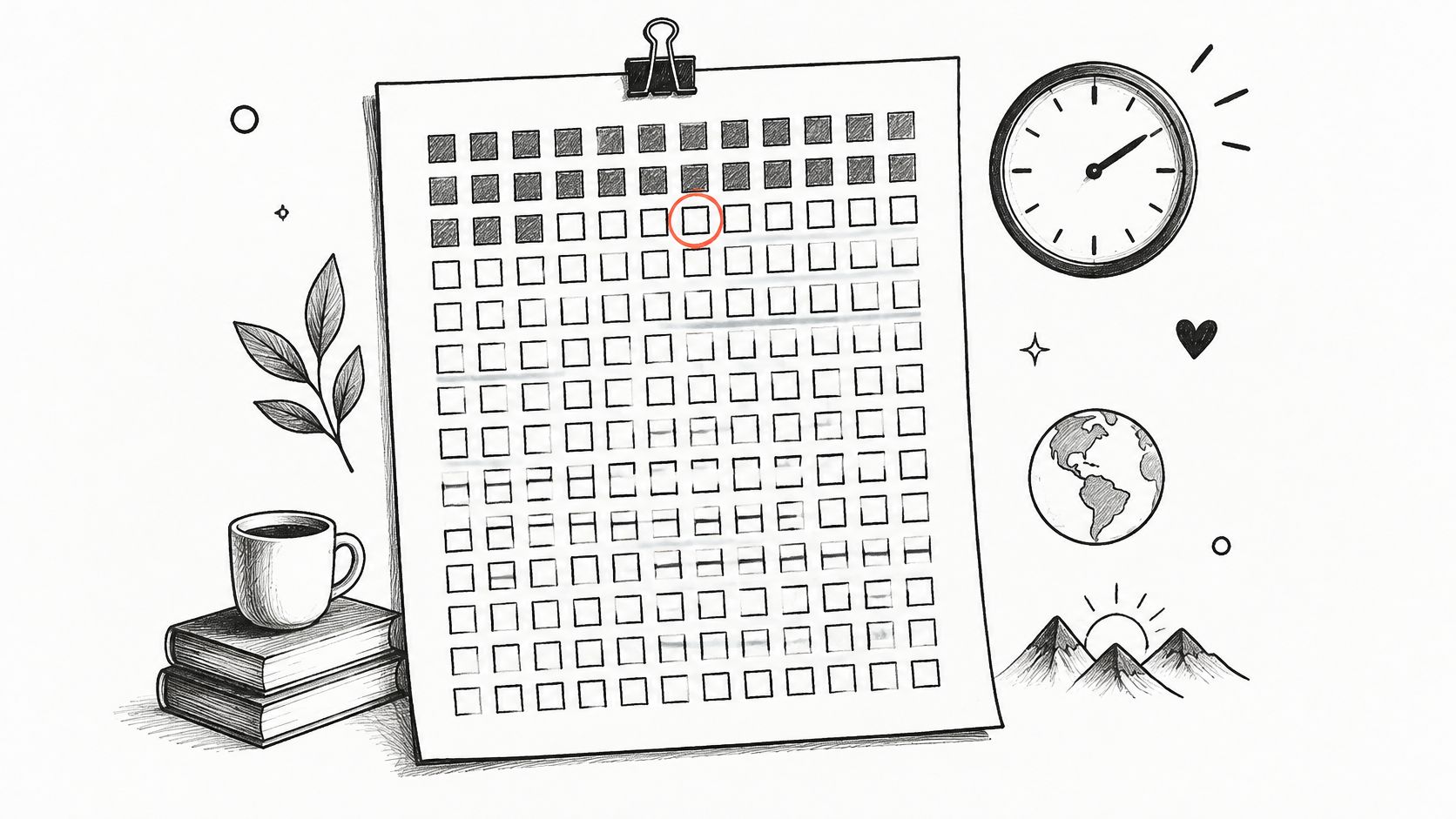
A life in weeks journal turns your whole life into a grid, with one box for each week. Past weeks are filled, the current week is where you are now, and the empty boxes ahead stay visibly finite. That hard edge is the point. It makes time feel physical in a way a scrolling diary never quite does.
Tim Urban's "Your Life in Weeks" graphic, published on Wait But Why in 2014, popularized this view, and printable versions have spread widely through reflection and productivity communities since. You can draw the grid on paper, print a large poster version, or use a digital life calendar app that generates the grid from your birthday and lets you attach a record to each box.
What to Put in One Week
Keep the unit small enough that you'll finish it. One sentence is enough for an ordinary week. "Dad visited, work deadline slipped, slept badly until Thursday" tells future you far more than a blank box you meant to complete properly. Add a photo only when one image carries the week. Add a color or tag such as travel, health, family, or work if you want to spot patterns later.
Say you change jobs in the spring, move in the summer, and spend the autumn caring for a parent. In a normal notebook those chapters sit in separate entries. On the grid you see them as a stretch of life, with quiet weeks before and after. That context is what this method captures best.
The trade-off is scale. A grid rewards consistency over detail, so it won't hold a full account of a complicated day. I recommend treating each box as an index card for your life, not a replacement for longer writing. Fill it weekly, every Sunday if you can, and review the pattern at the start of a new year. Don't backfill a whole decade in one sitting. You'll invent a tidier past than the one you lived.
2. Mood Tracker Visual Journal
Color Tuesday dark blue, Wednesday pale yellow, Thursday dark blue again. After a month, you don't need to reread every entry to see that midweek kept dipping. That's the strength of a mood tracker. It turns a feeling you'd normally describe vaguely into a pattern you can scan in seconds.
The setup is deliberately simple. Choose a color, symbol, or icon for a small range of states, write the key once, and don't keep redesigning it. Five levels is usually enough. More than that and you'll waste time deciding whether today was a six or a seven instead of recording anything. A year shown as a grid of colored squares, one per day, works well on paper. Digital trackers often do the same job as a heatmap.
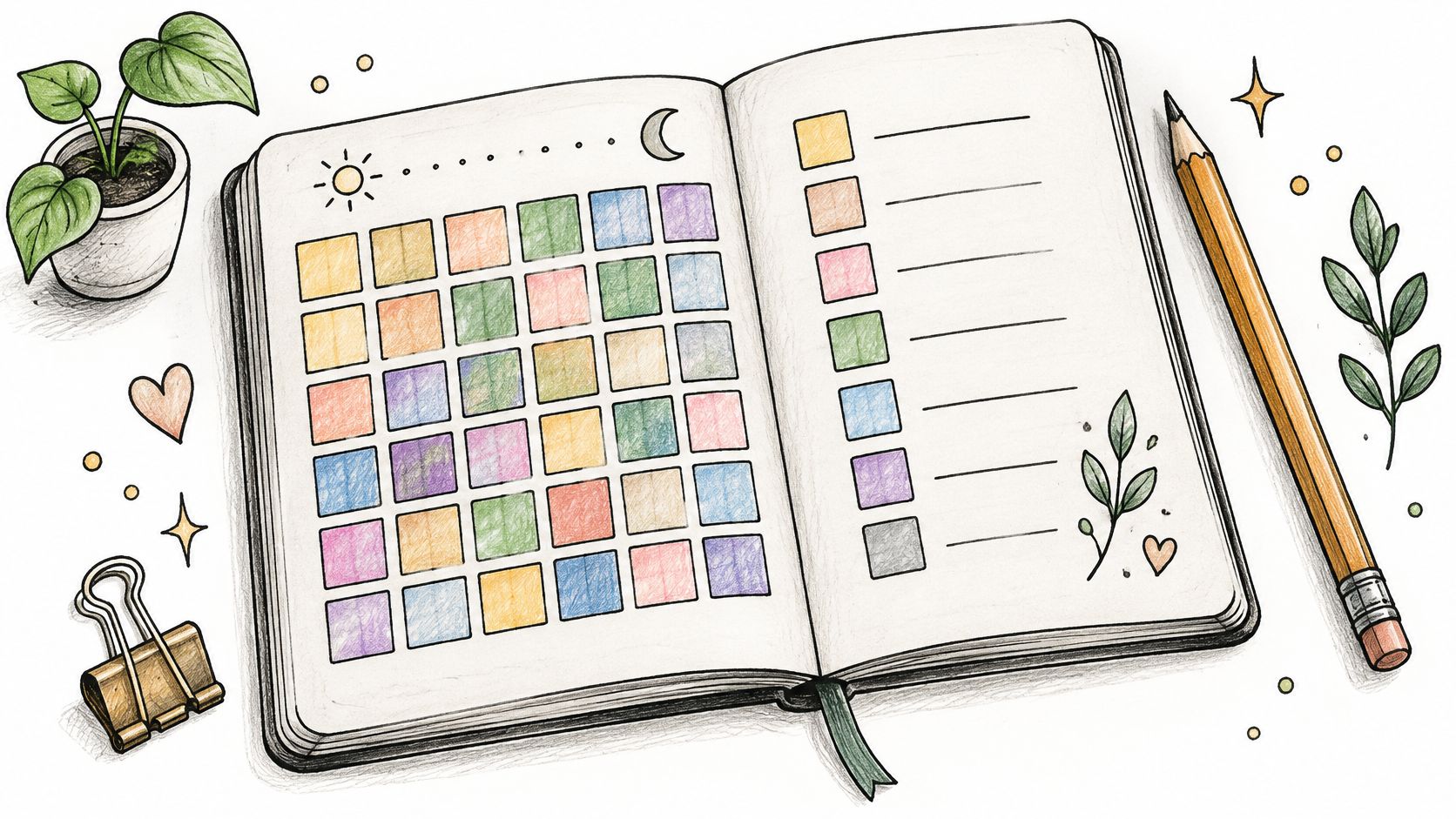
Log at the same time each day if you can. Mood recorded after a difficult meeting reads differently from mood recorded before bed, and that timing drift makes comparisons messy. Add one word for the main cause beside the color. Sleep. Pain. News. Noise. Friend. That single word stops a blue square from becoming a mystery three months later.
Practical rule: Rate the day you had, not the mood you wish the tracker showed. A tracker you edit to look healthier is decoration, not evidence.
A visual-journaling intervention involving medical students described in an Old Dominion University dissertation record found a general decrease in anxiety and negative affect from pretest to posttest, although the sample was too small to establish statistical significance. Participants perceived improvements in mood and stress, but scores returned close to baseline during the following two weeks. Treat that as a warning about cadence, not a promise of treatment. A tracker helps you notice and repeat a check-in. It isn't a diagnosis.
Use a weekly mood mark if daily logging feels oppressive. Say work stress peaks every launch week. You'll see that clearly enough from one honest color per week, paired with a short note on what drove it. What this method captures is emotional weather over time. What it misses, unless you add words, is why the weather changed.
3. Photo-a-Day (365 Project) Journal
One photo a day sounds easy until day 19, when it's raining, you've worked late, and the only honest picture is your shoes by the door. Keep it anyway. A photo-a-day journal works because ordinary evidence often matters more later than the birthday cake and the holiday view.
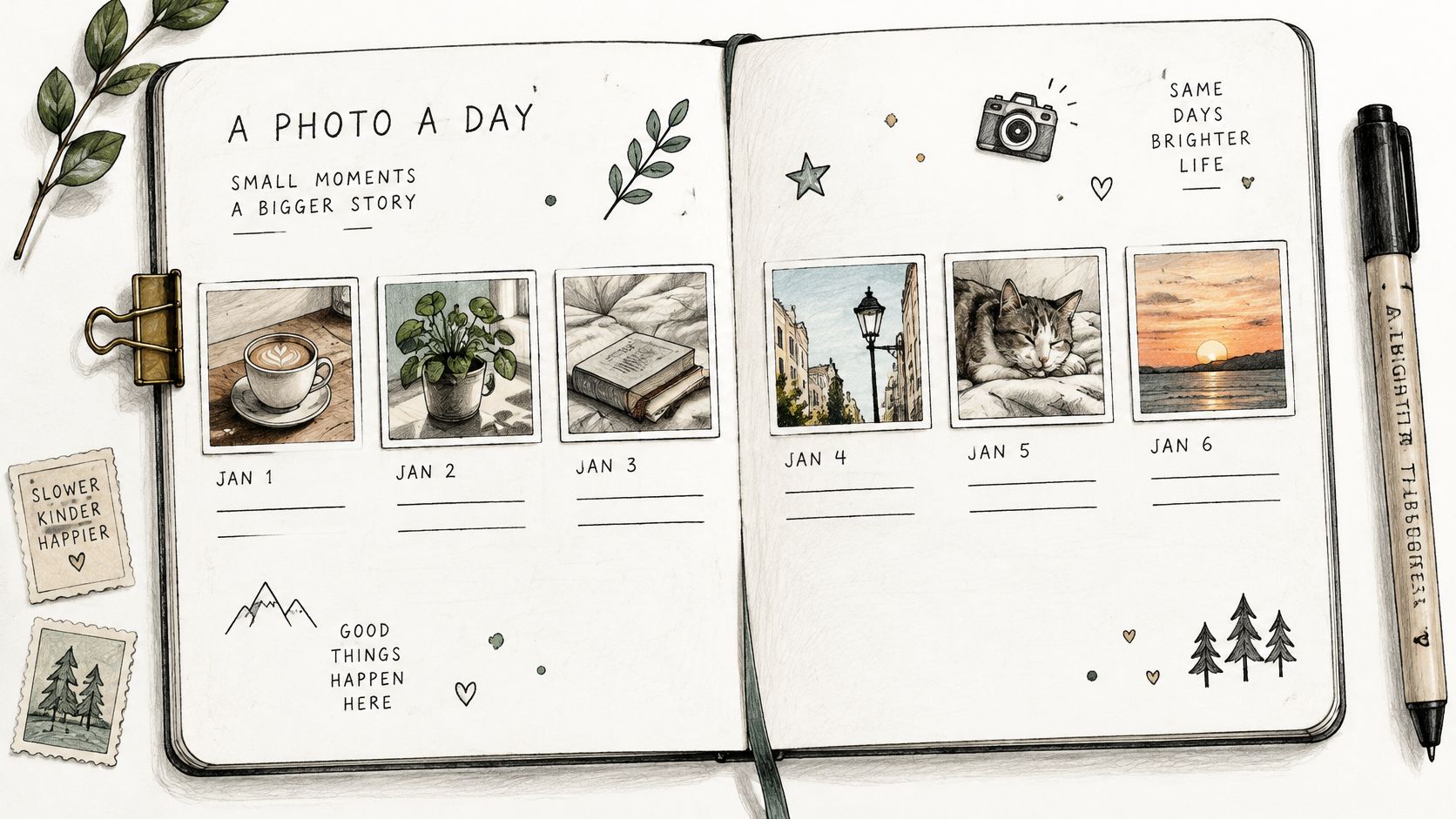
The 365 Project format, shared widely by photography communities and online challenge groups, asks you to take or select one photograph each day for a year. Some people print annual photo books from the set. Others keep a captioned album they can review month by month. Either way, the discipline isn't photography skill. It's choosing which single frame stands for the day.
Make the Choice the Same Day
Write a one-line caption the same day, while names, places, and small details are fresh. "First meal cooked properly since the move" will age better than a timestamp. Use a consistent crop if you plan to print the series. A square format makes mismatched days sit together cleanly, though it can cut out context from wide scenes.
There's real volume behind this habit. A 2025 Mixbook consumer survey found that 48% of Americans have more than 1,000 photos stored on their phones. A daily project gives some of that mass a job. You're not saving everything. You're promoting one image into the record and telling it why it earned its place.
Be strict about consent and privacy. A funny photo of someone else, a visible address, or a screenshot from a private conversation can make an entry you later regret sharing or even keeping. Keep the journal private by default, ask before including identifiable people, and delete or crop what exposes more than the memory needs.
If daily becomes a chore, switch to photo-a-week before you quit altogether. Say you're caring for a newborn. Seven rushed images may blur together, while one chosen Sunday photo with a caption will show real change. This method captures visual recall and daily texture. It fails when selecting and captioning pile up into a backlog, so small and current beats complete and late.
4. Bullet Journal Visual Method
Start ugly. An index, a date, a few short lines, and symbols you can understand tomorrow. The bullet journal becomes useful when it helps you run the week while recording it, not when every header looks ready to photograph.
Ryder Carroll's method spread through online communities after 2013 because it's modular. You build the parts you need inside one notebook, including an index, future log, monthly spread, daily rapid logging, and custom collections. That flexibility lets tasks, appointments, habits, moods, and memories share a time structure. A weekly tracker can sit beside the events that explain it.
Leave decoration until the system survives a bad week. Begin with these basics and add nothing for seven days.
- Index first: Number your pages and list each collection so you can find it later.
- Daily log: Write tasks, events, and notes in short lines using a consistent set of symbols.
- Memory collection: Keep one page per month for weekly highlights you'd otherwise bury under errands.
- Weekly migration: Review unfinished items and deliberately move, schedule, or delete them.
Say your week includes a hospital appointment, two deadlines, and a friend's visit. The daily log holds the mechanics. Your memory page can hold three lines that matter in a different way, such as the joke at lunch, the symptom that improved, and the evening walk after bad news. That separation is the visual journal value here. The page layout tells you what kind of information you're reading.
The downside is maintenance. A bullet journal asks you to keep building the container while you're using it, and elaborate trackers can turn recording into another task. Use pre-drawn simple grids if drawing spreads drains you. Skip a tracker you keep forgetting to fill. It isn't giving you insight. It's giving you evidence that the format asks too much.
This method captures plans alongside lived experience, anchored by day, week, and month. I recommend it for people who already live by lists and want their record where their attention already goes.
5. Project Life Memory Album Journal
A Project Life page gives a week fixed pockets, and that constraint solves the blank scrapbook page problem. You slot in printed photos, journaling cards, and small pieces of the week itself. The layout is decided before you start, so your energy goes into choosing and labeling rather than composing from nothing.
Weekly Project Life layouts commonly pair several printed photos with dated cards. Family albums often use the same standardized spreads to document a full year without redesigning every page. Tickets, receipts, school notes, and small labels can go into pockets if they're flat enough and worth keeping.
A Repeatable Weekly Workflow
Pick a fixed time, perhaps Sunday evening, and process only that week. Select three to seven photos, write one card that summarizes the week, and add shorter captions where a picture needs names or context. Keep a small stash of blank cards ready so a missing supply doesn't become a reason to postpone. Store loose ephemera in dated pockets until you place it.
Say your child starts school. One spread might hold the front-door photo, the bus ticket, a note about the lost water bottle, and a card describing who cried and who pretended not to. You don't need artistic filler. The relationship between the objects carries the story.
Combined formats aren't as common in formal diary research as everyday memory keeping might suggest. In a 2024 scoping review summarized by the American Psychological Association, 48 papers used qualitative diary methods, but only 4 used combined photo-and-written diaries and 2 used drawing-and-writing diaries. For a personal album, that gap is an opportunity rather than a warning. Pairing pictures with words gives later readers, including future you, more than one route back into the week.
The trade-off is physical backlog. Unprinted photos and unsorted tickets accumulate fast, and albums need storage. If printing is your bottleneck, build the same weekly layout digitally. This method captures a week's visible storyline with consistent pacing. It's strongest for family life, travel, and any period changing quickly enough that "someday I'll sort it" means you won't.
6. Illustrated Sketch Diary
Draw the mug badly. That sentence will save this method more often than any supply list. An illustrated sketch diary isn't an art portfolio. It's a dated record of what you noticed closely enough to turn into lines, shapes, color, or symbols.
Danny Gregory's illustrated journaling approach in An Illustrated Life from 2007 helped popularize the idea that everyday drawing can document a life without polish. Travel sketchbooks use the same principle on the move. You draw the train window, the market stall, the key that wouldn't turn, then add one sentence that ties the image to the day.
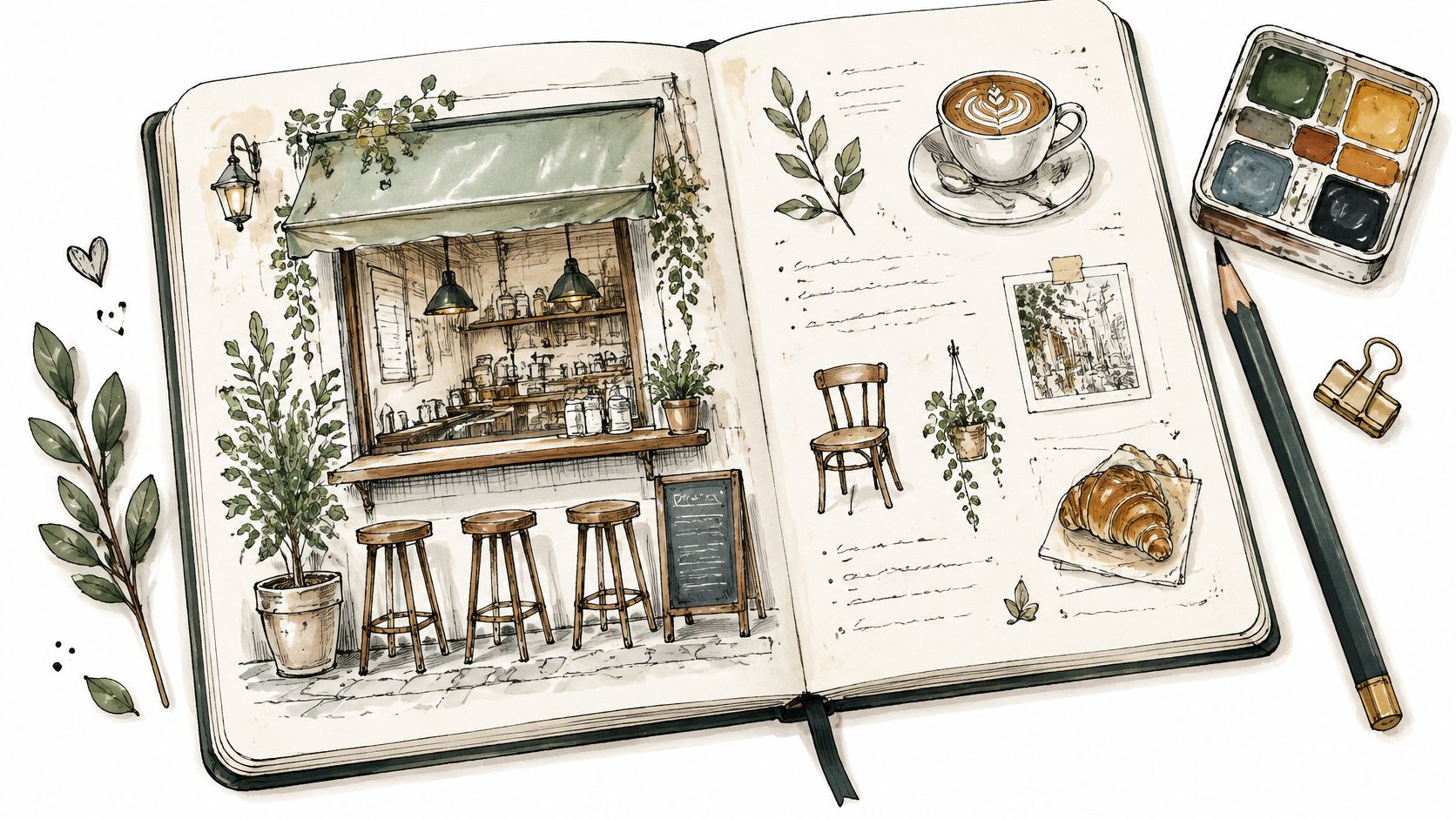
Drawing does more than decorate a note. In a 2018 study published in Psychonomic Bulletin & Review, drawing produced a 0.235 accuracy advantage over writing, while merely preparing to draw produced an approximately 0.107 increase in accuracy over writing. Drawing forces you to decide what features matter, make a physical representation, and encode the experience through visual, semantic, and motor processes at once.
A summary from Edutopia on visual note-taking reports another comparison in which students recalled 45% of drawn terms versus 20% of written terms. That doesn't mean every rough sketch becomes unforgettable. It means active meaning-making matters. Drawing your mood as weather, for example, asks you to interpret it rather than copy a generic happy face.
Draw the strongest image from the week, not the prettiest subject you can find. The leaking tap you finally fixed may hold more memory than the sunset.
Set a timer for 10 to 15 minutes, date every page, and pair each sketch with one sentence about the mood or event. Stick figures count. A map with three labels counts. A color patch beside the words "relief after scan results" counts. This method captures attention and interpretation, not just appearance. It demands more active time than choosing a photo, and that's exactly why it can fix a moment in memory.
7. Keepsake Ephemera Journal
A train ticket doesn't explain the journey, but it can bring back the platform announcement faster than a paragraph can. A keepsake ephemera journal builds pages around physical leftovers from real days: tickets, postcards, receipts, wrappers, maps, pressed leaves, labels, and notes from other people's pockets.
Travel journals have used this approach for generations because trips generate paper automatically. It also works at home. A weekly keepsake page might combine a cinema ticket, a seed packet, a photo strip, and two lines about who was there. The object gives the memory texture. Your note gives it meaning.
Keep collection stupidly easy. Put a small envelope or pouch where you empty your bag, and drop candidates into it during the week. On your journaling day, sort ruthlessly. Keep the item that triggers a specific scene and recycle the rest without guilt. If you preserve every receipt, you're building an archive of shopping, not a journal.
Preserve It Without Turning It Into Storage
- Use acid-free adhesive and paper: Ordinary tape can yellow, dry out, and damage thin printed items over time.
- Photograph bulky objects: Keep the image in the journal and let the oversized menu, wristband, or shell live elsewhere.
- Label immediately: Write the date and one trigger detail beside the item, because a blank ticket stub loses context fast.
- Test fragile pieces: Some thermal receipts fade, so photograph or copy any text you need to read later.
Say you spend a weekend visiting markets in another city. One bus pass, a bakery bag, a hand-drawn directions card, and a note about getting lost near the river will reconstruct the trip better than 40 similar street photos. The objects prove you were physically there. They also preserve design, prices, handwriting, wear, and other details your camera tends to flatten.
The trade-off is bulk and decision fatigue. Pages thicken, bindings strain, and sentimental clutter hides the good material. Set a limit, such as one spread per week or one envelope per trip. This method captures evidence you can touch, anchored by date and place. It's best when the object itself is part of what you want to remember.
8. Creative Prompt Visual Journal
Some days you have something to record and no idea how to begin. A creative prompt journal solves the starting problem by telling you what to make, while still letting the answer come from your actual week.
Keri Smith's Wreck This Journal from 2007 uses prompts that provoke physical, messy, and often funny responses. Art journaling communities also circulate prompt lists for drawing, collage, mixed media, and written reflection. For personal documentation, the trick is to avoid prompts that produce generic art exercises. Tie each one to real time and real experience.
Try prompts such as "represent your mood as a shape," "map a route you took this week," or "make a page from three colors you kept seeing." Those still leave creative room, but they preserve something specific. If a prompt asks only for a dream house or a favorite season, it may be enjoyable without helping you remember this period of your life.
Evidence from educational settings points toward offering choice rather than forcing one format. An ERIC record on a visual-journaling program with adolescents and with 26 southeastern tribal elders describes students reporting reduced tension, worry, and stress, with some preferring prompts as starting points and others wanting open-ended choices. The elder program recorded a 95% response rate over two months. For your own practice, the lesson is practical. Keep a guided option and a blank-canvas option side by side.
My recommendation: Cap each prompt at 15 minutes. Momentum matters more than finishing the page beautifully.
Keep a short prompt list in the front of the notebook and mark the date whenever you use one. Say the prompt is "draw what was on the table." In January it's medication and unpaid bills. In June it's strawberries and a library book. Repeating one prompt across time can show change more clearly than chasing a new challenge every day.
This method captures interpretation, play, and inner responses that a factual log may miss. It can also drift away from memory if the prompt stays abstract. Add one sentence naming the event behind the page. That small anchor keeps creativity attached to your life rather than floating beside it.
How the eight visual journal methods compare on medium, effort, and best use
| Item | Core Medium | Best For | Time Per Entry | Main Drawback |
|---|---|---|---|---|
| Life in Weeks Calendar | Week-grid timeline with notes or tags | Reflecting on life patterns over time | Brief weekly update | Weekly view may feel too coarse or confronting |
| Mood Tracker Visual Journal | Color- or icon-coded mood grid | Spotting emotional patterns | Quick daily or weekly check-in | Simple ratings can miss nuance |
| Photo-a-Day (365 Project) Journal | Daily photographs with optional captions | Building a visual memory archive | One photo and optional caption daily | Can become burdensome and require long-term storage |
| Bullet Journal Visual Method | Custom notebook logs, trackers, and collections | Combining planning, reflection, and creative records | Varies by layout and entry | Setup can be time-consuming |
| Project Life Memory Album Journal | Photo pockets, cards, and short notes | Organized weekly or event-based memory keeping | Quick weekly page or spread | Supplies, printing, and storage add up |
| Illustrated Sketch Diary | Drawings or paintings with short notes | Recording scenes through observation and art | Often 10–15 minutes or more | Time-intensive and harder to search |
| Keepsake Ephemera Journal | Physical mementos with notes or photos | Preserving tangible reminders of experiences | Varies by item and page | Can become bulky and difficult to back up |
| Creative Prompt Visual Journal | Prompt-led drawing, collage, or mixed media | Guided creative exploration | Flexible; often a short session | Prompts may feel forced or distract from real events |
Pick One Method and Start This Week
Choose by asking what you most regret forgetting. If you can't picture ordinary days later, choose photos and caption them while they're still warm. If you remember events but not how they felt, choose a mood tracker and add one word for the cause. If your weeks vanish into tasks, choose a bullet journal memory collection or a standardized weekly album that forces a short record before the next week crowds it out.
If you want to notice your surroundings more closely, choose sketches, even ugly ones. If physical evidence moves you more than images on a screen, keep the ticket and write beside it. If blank pages stall you, use a prompt that points back at a real event. If your problem is bigger than a single week, and whole seasons seem to disappear, choose a life in weeks grid so every entry lands in a visible place on your timeline.
Don't combine all eight. That's the fastest way to build a system so rich it collapses by Thursday. Start with one format for one week. Give it a boundary you'll respect, such as one photo, one box, one spread, one color, or one timed sketch. Recent qualitative research described in an ACM paper on constrained journaling found that constrained notebook space reduced fear of starting, limited excessive venting, shortened sessions, and made the practice easier to sustain. That finding points in a useful direction. A minimum viable entry is not a lesser entry. It's the entry you'll still be making during a busy, sad, boring, or disorganized week.
During that difficult week, shrink without quitting. Write "hard week, no details yet" and mark the color. Photograph the front door. Save the appointment card. Draw a single line that goes downhill and date it. A visual journal that only works when you're inspired and rested will have suspiciously beautiful gaps exactly where the story got complicated.
Privacy deserves the same practical treatment as supplies. Before a page includes other people, locations, screenshots, voice notes, or intimate mood notes, decide who could ever see it and what you'd want deleted. A study on social media-based diary design hosted by Solent University stresses platform privacy settings, participant safety, anonymity, and confidentiality, while also describing the value of combining text, images, photos, voice recordings, and video. Richer records carry higher disclosure costs. Keep sensitive entries separate from shareable images when that boundary matters.
Once the habit holds for a few weeks, you can add a stronger time anchor. Life Calendar shows each week as a box and supports notes, images, moods, and tags against individual weeks, so a photo, a color, or a sentence can sit inside a broader life view rather than floating in a folder. Add that structure after you know what you naturally record. Tools work better when they organize an existing habit instead of trying to create one by force.
Your goal this week is one honest entry, dated, placed, and finished. Not a beautiful system. Not a recovered year. One record that future you can find and understand. Make that, then make another next week.
Start with the week you're living now, whether it deserves one sentence, one photo, one color, or one rough sketch. Life Calendar gives that entry a place in a grid of your life in weeks, with room for notes, images, mood, and tags on the individual week where it happened. Add this week's box today, then let the next one arrive on schedule.
Produced via the Outrank tool