Journal How to Start and Keep a Journal in 2026
Journal How to guide for beginners: set up your first entry, pick a format, build a routine you can keep, and fix the common problems that stop most people.

In this article
- Choose a Format That Fits Your Life
- Match the Format to the Entry You Want
- When a Weekly Grid Helps
- How to Write Your First Journal Entry
- Write It in This Order
- What a Finished First Entry Looks Like
- Build a Minimum Entry You Can Keep Up
- The Five-Part Minimum
- A Worked Example for a Hard Week
- Write Useful Entries and Fix a Stalled Journal
- A Bounded Way to Reflect
- Diagnose the Stall Before You Quit
- Keep Your Entries Private Without Losing Them
- Choose Protections for Your Situation
- Set Your First Weekly Review Date
You bought a notebook, or downloaded an app, and wrote three good entries. Then work ran late, the page stayed blank, and the gap made restarting feel harder than starting did. That's the normal failure point, and it isn't a discipline problem. Most journals die because the setup assumes a calm week, a private room, and something interesting to say every day.
A survivable journal how to approach plans for the opposite. You choose a format you can open when you're tired, define a minimum entry before you need it, decide who could read it, and expect a missed week. Build those answers in now, and the journal can keep going through ordinary life.
Choose a Format That Fits Your Life
Start with where you'll write, not the format that looks most serious. A notebook left at home won't help on a train, and a phone app you dislike opening won't help at your desk.
| Format | Best For | Main Risk | Easiest Way to Review |
|---|---|---|---|
| Paper notebook | Handwritten reflection without screens | Loss, damage or other people reading it | Flip back by date |
| Phone notes app with a passcode | Writing in the moment, short entries | Shared devices and cloud sync | Search by date or tag |
| Weekly grid app such as Life Calendar | Seeing life in weeks with notes, images, moods and tags | Account and stored data | Scroll the weekly overview |
| Document in a password-protected folder | Long entries and easy export | Backups and syncing copies | Search by keyword |
Match the Format to the Entry You Want
Paper suits slow, handwritten reflection and keeps you away from notifications. Its weakness is retrieval, since you'll rely on dates, bookmarks, or memory to find an old entry. A phone notes app is better for short entries written in the moment, but only if the phone is yours and you understand where synced copies go.
A plain document in a password-protected folder works well for long entries you may want to export or search by keyword. Its risk is quiet duplication through backups and syncing, so check those settings before you write anything sensitive. If you're comparing phone options, KeenVerdict's note-taking app rankings can help you weigh general note tools against a dedicated journal setup.
When a Weekly Grid Helps
A weekly grid changes the unit from a day to a week. That lowers pressure on uneventful days and makes patterns easier to see across a month. Some users keep Life Calendar as a personal diary, while others use it to keep their past and future in perspective, and either use works for a beginner who wants a visual timeline.
Android users comparing dedicated options can also check this roundup of the best journal app for Android before committing. Don't pick based on a feature list alone. Check search, export, locking, and how fast you can add a note, image, mood, or tag on a bad day.
Decision rule: Choose the format you'll open when you're tired, rushed, or in a bad mood, not the one that looks best on a shelf.
If two formats still look equal, test each for a week with the same tiny entry. Keep the one that creates less friction. I would choose speed and privacy over beautiful pages every time, because a plain entry you finished is worth more than a perfect system you avoid.
How to Write Your First Journal Entry
The blank page feels large because you're imagining the journal you're supposed to keep for years. Ignore that. Your only job is one short, dated block you could reread in under thirty seconds.
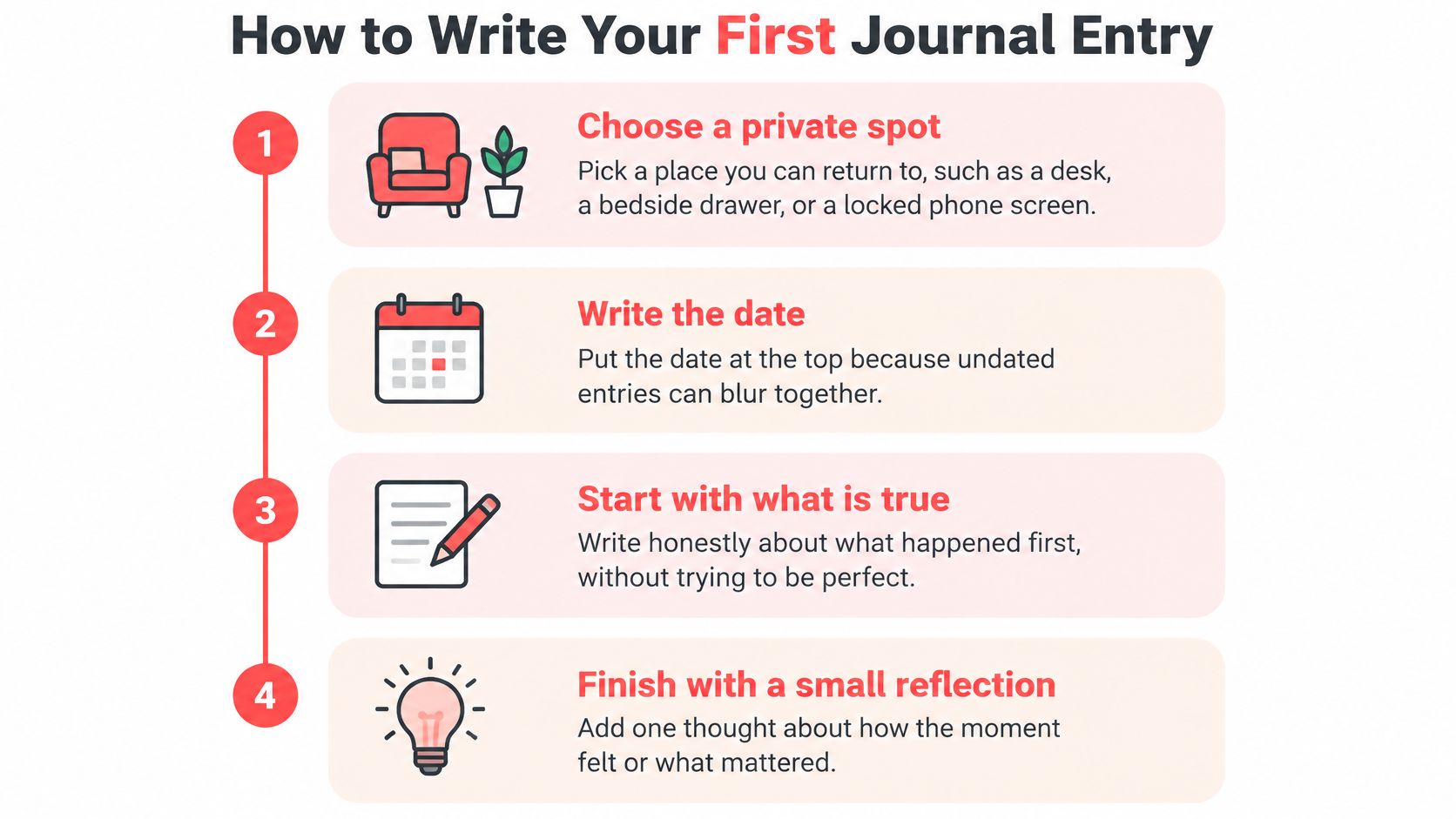
Write It in This Order
- Choose a private spot: Pick a place you can return to, such as a desk, a bedside drawer, or a locked phone screen. A repeatable spot becomes part of the cue, and privacy makes honesty easier.
- Write the date: Put the date at the top before anything else. Undated entries blur together within months and lose much of their value as a record.
- Name one event: Write one sentence about something that happened today. Don't summarize the whole day, since that turns the entry into a list you'll dread repeating.
- Add one concrete detail: Note a place, person, smell, phrase, or price paid. These small specifics are what you'll want back in ten years, long after a general mood has faded.
- Note your mood: Use one or two words, such as tired, relieved, or flat. A short label is enough to reveal patterns later without turning the entry into analysis.
- Add an optional tag: Choose a simple category like work, family, or health. Tags make old entries findable when you remember the topic but not the date.
- Stop: Quit after about ten minutes or when the list runs out. Stopping on purpose protects the habit from becoming a writing assignment.
What a Finished First Entry Looks Like
Say today's entry reads, "Tuesday, May 12. Walked to the station with Ana after work. Her umbrella kept flipping inside out. Mood, tired but amused. Tag, friends." That's complete. It has a date, an event, a detail you'll picture later, and a way to find it again.
If you want to add a photo, ticket, screenshot, or sketch later, these visual journal ideas show simple ways to do it without turning each page into a craft project. Keep the first version plain, though. Visual extras help memory, but they shouldn't raise the cost of writing.
Many first entries are brief, and that's normal, not a failure. A short entry proves the system works. Length can grow on days when you have more to say, but the first entry only needs to exist, be dated, and be honest enough that future you recognizes the day.
Build a Minimum Entry You Can Keep Up
Busy weeks don't test your motivation. They test whether your entry has a floor low enough to finish when you're tired, traveling, or annoyed. Without that floor, one skipped day becomes a gap, and the gap becomes a reason to quit.
Attach writing to a cue that already exists, such as a Sunday evening calendar review or morning coffee. A stable trigger beats a vague intention to write more often, because you don't have to decide when each time. Put the notebook or app where that cue happens.
The Five-Part Minimum
- Date: Write it first so the entry anchors to a real week.
- One event: Choose a single thing that happened, not the whole schedule.
- One image or concrete detail: Add a photo or a specific fact that brings the event back.
- Mood: Use a word or two, even if it's mixed.
- Optional tag: Add work, family, health, or another label only if it helps future search.
That structure follows practical diary guidance on consistency, and the WikiHow diary guide reflects the common recommendation of roughly 15 to 20 minutes daily for habit formation, while other writing guidance supports sessions as short as five minutes. I read that range as permission to prioritize low friction over a fixed length. A finished five-minute entry protects the routine better than a planned twenty-minute entry you skip.
A Worked Example for a Hard Week
A Tuesday entry might read, "Date, Tuesday. Forty-minute call with my sibling about moving. Photo of the boxes by the door. Mood, anxious then relieved. Tag, family." Nothing in that entry is polished, and it doesn't need to be. It still records who, what, how it felt, and where to find it later.
Set a busy-week rule now: write two lines and move on. A reminder, a saved template, and autosave help because they remove small points of failure. Treat mood trends as self-observation, not diagnosis, and don't use completion alone as proof that journaling is improving your health.
A minimum entry isn't a lesser entry. It's the version that keeps the journal alive until a better week returns.
Write Useful Entries and Fix a Stalled Journal
A useful entry does two separate jobs. First, it captures facts: what happened, who was there, and what you did. Then, only if you want, it adds a short reflection on how one event felt.
Keep those jobs apart. Facts give you a reliable record you can trust later. Reflection helps you notice what mattered, but it's optional, and it shouldn't contaminate the record with a neat story you invented after the fact.
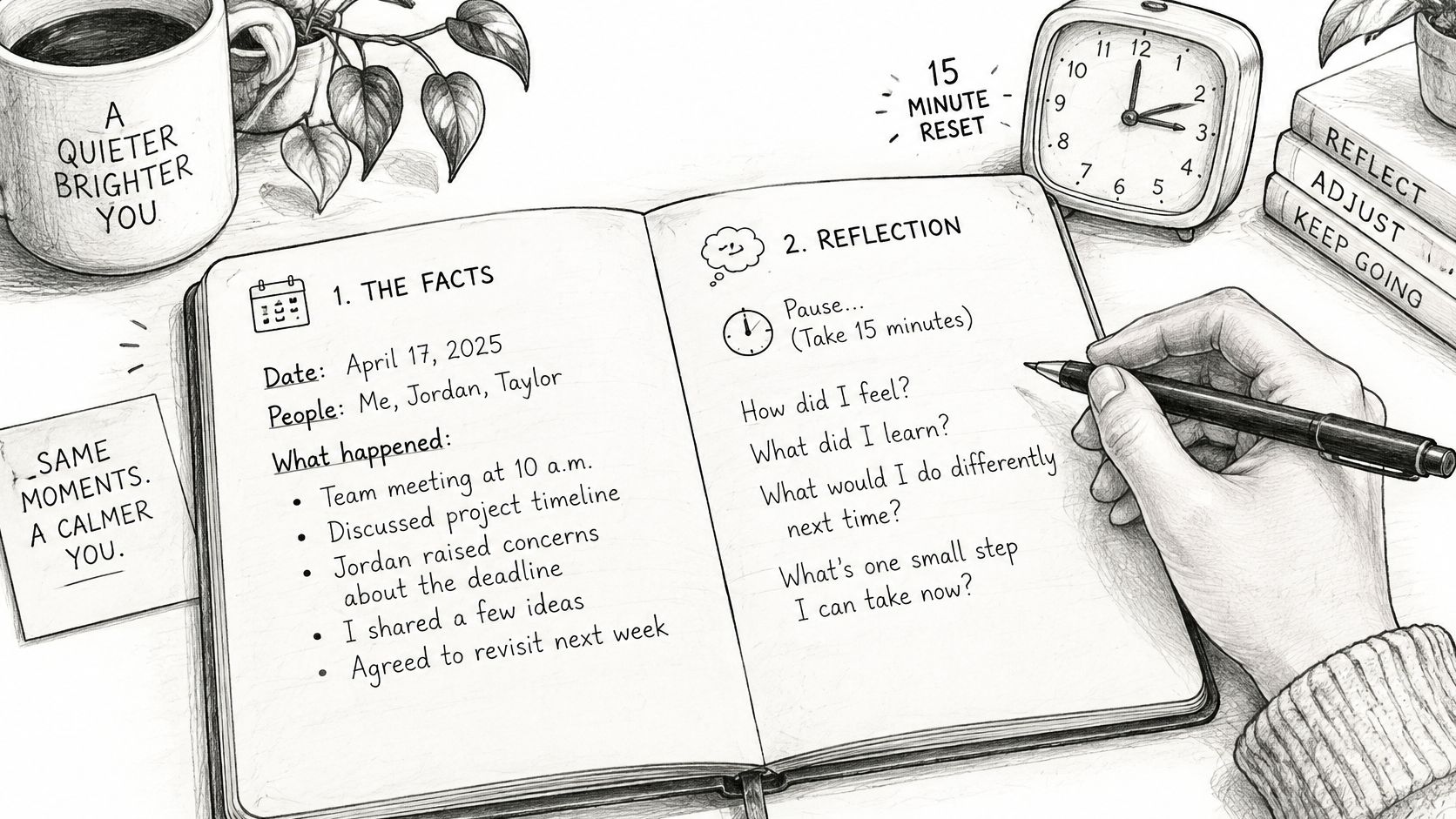
A Bounded Way to Reflect
When you do reflect, pick one event and write continuously for about fifteen minutes. Don't edit spelling, polish sentences, or force the entry into chronological order. You're exploring the feeling tied to that event, not producing a memoir.
Three prompts work well because they're specific without demanding a life review:
- What did I not say today: Use this when a conversation keeps replaying.
- What am I most worried about this week: Name the worry and what part of it you can influence.
- What went better than I expected: Record the evidence, since memory often keeps failures in sharper detail.
That bounded structure has a research basis, but it needs honest limits. The Cambridge review of expressive writing research describes a meta-analysis of 13 studies involving healthy participants that found a statistically significant overall benefit, with Cohen's d = 0.47 and p < 0.0001, across physical health, psychological well-being, physiological functioning, and general functioning. Those studies generally used writing for approximately 15 to 20 minutes across 3 to 5 sessions about traumatic, stressful, or emotional experiences.
That is evidence about structured expressive writing, not a promise that every personal journal improves health. Prompt, frequency, emotional intensity, and the person writing all matter. I would use the findings to justify short, defined, repeated sessions, not long daily entries or medical claims.
The caution gets clearer in individual trials. A randomized controlled trial published through Taylor and Francis followed 116 healthy adults through four 20-minute expressive-writing sessions and found no significant overall improvement in anxiety, depression, or physical symptoms. Highly expressive participants experienced reduced anxiety at three-month follow-up, whereas less expressive participants experienced increased anxiety.
Turn that into a safety rule. Record date, key events, images, mood, and tags first, then add reflection only if it leaves you steadier. If writing raises distress, switch to facts only, shorten the session, stop for the day, or talk to a clinician rather than pushing through.
Diagnose the Stall Before You Quit
| Symptom | Likely Cause | Fix |
|---|---|---|
| Skipping days after the first week | Entries feel too long to start | Cut the minimum to date plus one line |
| Writing only good news | Fear that someone will read it | Use coded shorthand or a separate private file |
| Entries feel like a chore | No fixed cue attached | Tie writing to the weekly calendar review |
| Entries turn into summaries of the day | Chronology habit | Write about one event and how it felt |
| Reading back brings distress | Intense emotional prompts | Write facts only and pause the reflective part |
Change one thing at a time and test it for about a week. If the page stays blank, list food, people, and work, then write one line under each. If perfectionism is the problem, set a timer, write without editing, and don't reread entries for ten days.
Use this test at the end: you should finish steadier, not more keyed up. A journal that repeatedly leaves you worse isn't a discipline challenge. It's a signal to make the entry smaller, safer, or purely factual.
Keep Your Entries Private Without Losing Them
Privacy isn't about paper or digital. It's about who could read the entry, whether your phone is shared, whether your account syncs to cloud storage, and who can enter the room where the journal sits. Answer those questions before you decide how detailed an entry should be.
Recent qualitative work on journaling covered in the ACM journaling research reports that having a private space can increase freedom, while fear of family members reading journals can constrain what people write. Privacy is context-specific, especially in homes, schools, clinics, and other places where you may feel watched or lack a secure place to disclose. That's why one universal format recommendation fails.
Choose Protections for Your Situation
- Use coded shorthand: Write initials or "the meeting" instead of full names and places you'll still recognize later.
- Store paper out of sight: Keep a notebook in a drawer or bag that isn't casually opened by others.
- Lock the device: Use a phone passcode and check whether previews appear on the lock screen.
- Prefer a local-only backup: Limit synced copies when cloud access creates more risk than convenience.
- Omit identifying details: Leave out addresses, schedules, or names that don't need to be recorded.
- Set a deletion rule: Decide which entries you'll delete after a week, a month, or a specific event passes.
If you use Life Calendar, we don't sell, trade, or transfer personally identifiable information to outside parties unless users are given advance notice. You can also visit our website anonymously. Those policies matter, but they don't replace your own device and account choices.
A beautiful, detailed archive isn't always the best outcome. For some people, a minimal, reversible, or deliberately incomplete record protects safety and autonomy better than a complete one.
If safety comes first, a minimal record is a successful journal entry, not a compromised one.
Set Your First Weekly Review Date
Put your first weekly review on the calendar today and treat it as an appointment, not a vague intention. Choose a time you'll already be sitting down, such as Sunday evening or Monday morning coffee. Fifteen minutes is enough.
Read the past week's entries without editing them. Mark one entry worth keeping, write one sentence about what you'd change next week, and shrink your minimum entry if the routine felt heavy. If mood labels are part of your record, a simple mood tracking chart can help you spot patterns without pretending the pattern is a diagnosis.
Keep expectations modest. A 2022 systematic review and meta-analysis of journaling interventions reported an average 5% greater reduction in patient health-measure scores compared with control groups, with anxiety-related outcomes at approximately 9%, post-traumatic-stress outcomes at about 6%, and depression outcomes at about 2%. That supports journaling as a complementary reflective habit, not a replacement for professional care.
If you want a weekly-grid format, Life Calendar is available to download on the App Store and the Play Store. Whatever format you choose, judge it after a month of real use, not after one perfect page. A journal kept for three months beats a perfect one abandoned in a week.
If a weekly view would make your entries easier to keep and review, Life Calendar lets you record notes, images, moods, and tags against each week of your life. Start with this week's minimum entry, set your first review date, and let the record build one ordinary week at a time.