Calendar and Journal: Organizing Memories by Week
Learn how calendar and journal entries work together. Organize notes, photos and moods by week to build a clear, searchable record of your life.

In this article
- How Calendar and Journal Setups Compare
- Choose by what you need to retrieve
- Building a Week-by-Week Grid, Step by Step
- A filled sample box
- Attaching Notes, Photos and Tags to Each Week
- Give each record a distinct job
- Tracking Moods Without Distorting the Week
- Keep the observations beside the summary
- Reading Your Timeline Across Years
- Read the entries behind the pattern
- When Reflection Helps and When It Hurts
- What the evidence supports
- Protecting a Life Archive Over Time
- Evaluate the archive, not just the login
- Start Your Week-Based Record This Month
Ten calendar dates disappeared when Thursday, October 4, 1582, was followed by Friday, October 15, as part of the Gregorian calendar reform, according to NASA's calendar history. It's a striking reminder that dates are an organizing system, not the experiences themselves. For personal memories, you need both a reliable place on the timeline and a record of what happened there.
A calendar and journal serve those different purposes. The calendar becomes your retrieval index, the route back to an experience, while the journal preserves the details and meaning. Putting them together by week can make memories easier to locate without turning every day into a writing assignment.
How Calendar and Journal Setups Compare
| Setup | Time unit | Strongest for | Main limit |
|---|---|---|---|
| Separate calendar and diary | Day or none | Appointments kept apart from reflection | Entries drift away from dates |
| Dated daily journal | Day | Detailed daily reflection | Long patterns are hard to see |
| Bullet journal with monthly logs | Month | Tasks and trackers in one place | Weeks blur inside a month |
| Week-grid calendar journal | Week | Notes, photos and moods per week across a whole life | Needs setup and steady check-ins |
A calendar entry tells you when you moved. A journal entry explains why the move mattered. If those records live apart, finding the full story means searching both.
Separate tools can still work well when you deliberately cross-reference them. A daily journal suits someone who enjoys writing at length, especially with a consistent reflective journal format. Monthly bullet-journal logs keep planning compact, but a busy spread may leave little room for the character of individual weeks.
Choose by what you need to retrieve
The habit is common enough to deserve thoughtful organization: 28% of U.S. adults in a 2022 YouGov poll reported writing personal thoughts in a diary or journal at least sometimes, as summarized in Memoiri's journaling statistics. The useful question isn't whether you write enough. It's whether you can find what you wrote when you need it.
Some users keep our app as a personal diary, while others use it to keep their past and future in perspective. Neither purpose requires sharing the underlying reflections.
That distinction matters when a calendar also coordinates care. Guiding Growth's resource on caregiver calendar sharing for autistic children addresses a different need from private journaling: helping caregivers coordinate. Keep shared appointments and confidential reflections separate, even when they describe the same week.
The week-grid method suits readers who want a broad overview with details attached. Keep a daily diary instead if that's the routine you'll maintain.
Building a Week-by-Week Grid, Step by Step
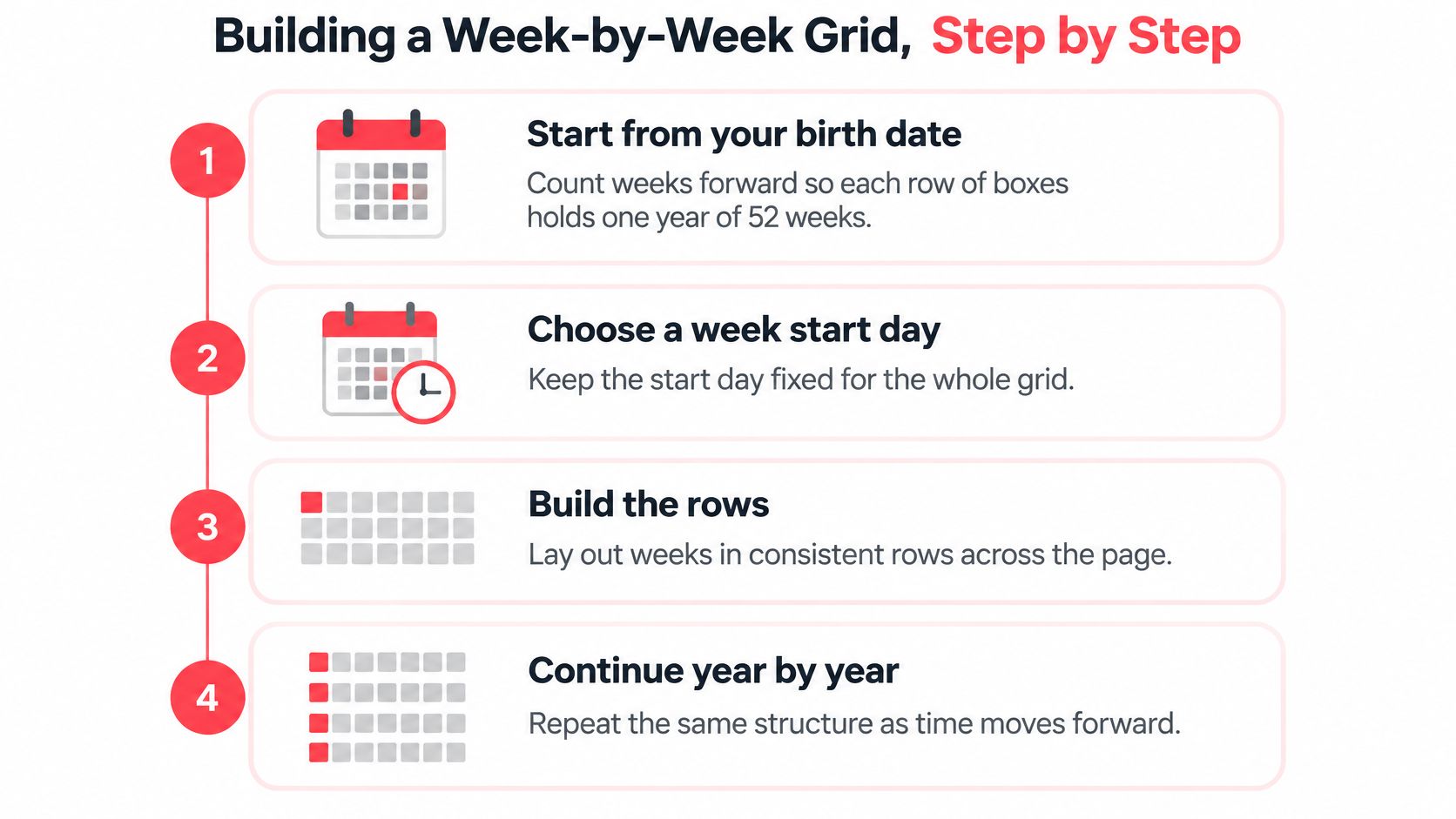
Build the structure before adding old memories. Use a notebook, spreadsheet, or printable grid, and write down your date convention so you won't have to reconstruct it later.
Anchor the record to your birth date. Count consecutive weeks forward from that starting point if you want an age-based timeline. Starting at the beginning of a calendar year instead creates a calendar-year record, which is useful but different.
Choose a consistent week boundary. For a manual grid, decide whether you're using birthday-anchored weeks or ordinary calendar weeks, then label the opening interval clearly. Don't switch conventions midway through the archive.
Lay out the boxes with dates attached. Let each box represent a consecutive weekly interval, wrapping onto another row when the page fills. Treat row length as a layout choice, not proof that every row ends exactly on your birthday.
Mark the current week visibly. A contrasting outline or pointer lets you distinguish completed weeks from future space. Without it, you may read the grid as an archive rather than an ongoing record.
Begin with a short title and sentence. Add an image or tag when it gives you a useful retrieval cue. Don't turn every box into a miniature scrapbook before you know what you'll want to revisit.
Set a repeatable check-in. Sunday evening is a practical option if it matches your chosen boundary. If you miss it, record what you remember and mark uncertainty rather than inventing detail.
A filled sample box
Title: Settling into the new apartment
Note: We unpacked the kitchen and ate our first proper dinner at the table.
Attachment: Kitchen photo
Tag: move
Practical rule: A decorative grid is optional. Clearly defined weekly intervals aren't.
Attaching Notes, Photos and Tags to Each Week
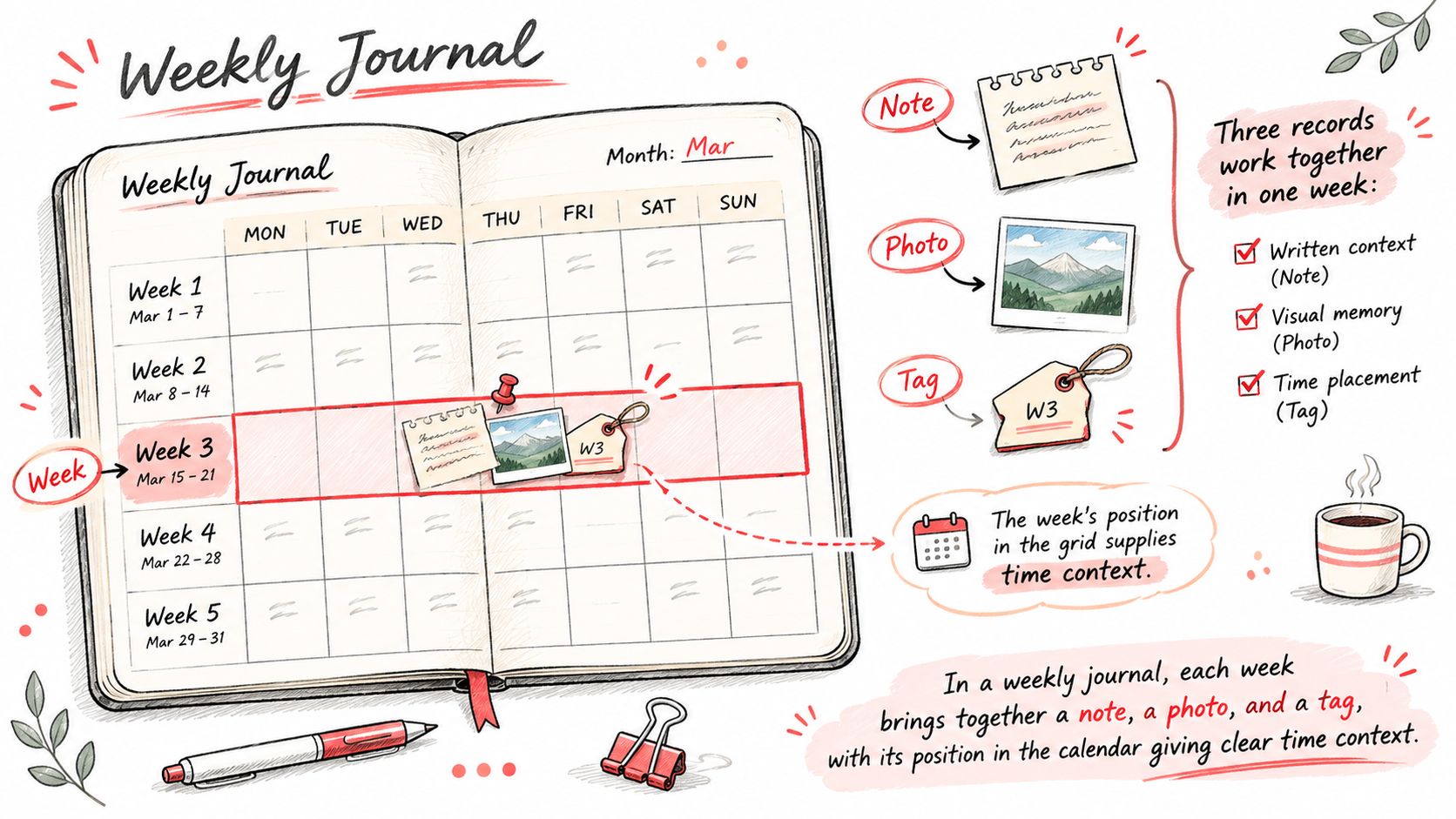
A useful weekly record preserves different kinds of information without asking any attachment to do every job. The note explains the experience, the image preserves visual circumstances, and the tag provides a route back by topic.
In a controlled diary study indexed by PubMed, participants who recorded memories through drawings later achieved significantly higher matching accuracy during reminiscence than those who used text. That finding concerns drawings, not a guarantee that attaching photographs will improve recall. It does offer a reason to preserve relevant visual cues rather than relying exclusively on prose.
Give each record a distinct job
- The note captures interpretation. For an apartment move, write that the unfamiliar kitchen finally felt like home after cooking dinner. A generic entry saying you were busy won't distinguish this week from another.
- The photo captures circumstances. Choose the kitchen with unpacked boxes still visible, rather than an unrelated attractive image. Keep the selection small enough that you can recognize the event without browsing an album.
- The tag supports retrieval. Use move consistently instead of alternating among moving, relocation, and new place. Maintain a short reusable vocabulary, adding a tag only when you expect to search for it again.
Preserve date integrity when importing material. Keep the original photo timestamp, the week you deliberately assigned, and any explanation for a mismatch. A scanned photograph's file date may describe the scan, not the event.
An import shouldn't overwrite your chosen week without notice. If you're unsure when something happened, label the date as approximate rather than making the archive appear more precise than your memory.
For a quick test, open an older week without browsing surrounding entries. If the note, image, and tag let you identify the event and its significance, the record has enough detail.
Tracking Moods Without Distorting the Week
A Sunday judgment about the entire week can give too much weight to whatever happened most recently. Instead, capture brief observations during the week using consistent affect labels or a simple ordered scale.
A review of electronic mood monitoring explains how repeated measurements in everyday settings can reduce recall bias and aggregation error, while also noting limitations involving self-report and compliance. Keep prompts lightweight, but don't mistake convenient entry for objective measurement.
Keep the observations beside the summary
For a hypothetical week, suppose you record low, neutral, good, neutral, and low, with no entries on the remaining days. The summary should make that incomplete coverage visible.
| Mood field | What it shows | Example from one week |
|---|---|---|
| Average mood | Overall tone of the recorded check-ins | Near neutral, if labels use evenly spaced scores |
| Low-mood count | Frequency of hard days, separate from intensity | Two low observations, each on a different day |
| Check-in count | How many observations the average uses | 5 |
| Missing days | Gaps that make averages non-comparable | Two days without observations |
That example is an illustration, not a recommended medical scale. An average from sparse entries shouldn't be compared uncritically with a fully recorded week, and an ordinal score isn't a precise measurement of emotional distance.
For practical capture options, consider these mood tracker ideas. If sleep timing is a question you want to explore, a separate daily bedtime routine log from SleepHabits can provide context without making the mood entry longer.
A mood summary describes the observations you recorded, not every moment you lived.
Keep timestamps and missing days available. Use the result for personal reflection, not clinical diagnosis, and don't interpret an association with sleep or another routine as proof of cause.
Reading Your Timeline Across Years
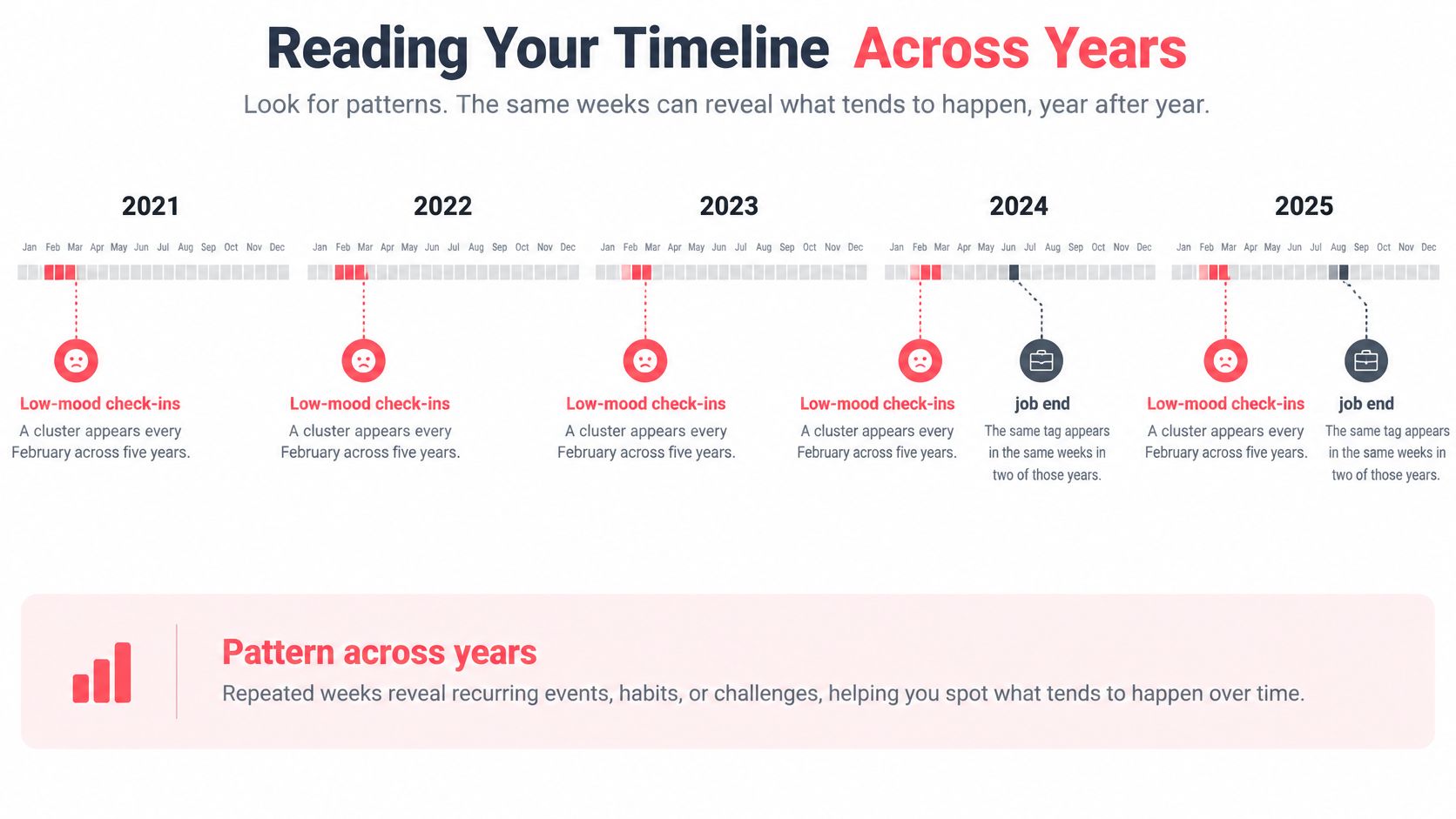
Say you review a hypothetical five-year archive and notice low-mood check-ins clustered around February. The tag job end appears near those clusters in two of the years. You now have something worth examining, but not yet an explanation.
Look at the actual date labels before comparing boxes. An age-based grid doesn't necessarily place a calendar month in precisely the same column every year, so visual proximity alone isn't enough.
Read the entries behind the pattern
Start with the relevant weeks, then inspect their notes, observation counts, and gaps. Perhaps one February contains detailed daily observations while another contains only a difficult evening. Those aren't equivalent records.
A manageable review routine might include:
- Read a bounded period. Choose a year or a particular season rather than opening your whole archive without a question.
- Compare matching date ranges. Inspect the surrounding weeks as well as the apparent cluster.
- Count repeated tags carefully. Distinguish separate events from repeated mentions of the same event.
- Note missing records. An empty box means unrecorded, not necessarily uneventful.
Use color bands for phases such as a new job, a move, or a period of study. Keep a legend, and avoid using the same color to mean both life phase and mood.
A timeline shows co-occurrence, not cause. Instead of concluding that a job ending caused the difficult period, ask what else changed around it and what the entries support.
The same approach works for reflection for the new year, without requiring a verdict on the year. Pick a repeated tag and write a tentative sentence about what it might mean, including what you still don't know.
When Reflection Helps and When It Hurts
More journaling isn't automatically better. Distinguish documenting, processing, and ruminating by what you're doing with the entry, not by how long you write.
For a week when a job ends, documenting means recording the event and practical circumstances. Processing might mean identifying a feeling and choosing a manageable next action. Rumination looks more like repeatedly rehearsing the same grievance without adding a fact, perspective, or decision.
What the evidence supports
A 2025 systematic review of positive expressive writing found its most consistent benefits for wellbeing and positive affect, while effects on stress, anxiety, psychological health, and physical health were less consistent; it rated the underlying study quality as poor or fair. That's a narrower conclusion than saying journaling treats mental-health difficulties.
A weekly memory archive also isn't the same intervention as a structured expressive-writing exercise. Don't assume that adding mood fields or writing more frequently gives your calendar therapeutic effects.
Permission to stop: You don't owe the archive a complete account of a painful week.
Watch for these practical stop signals:
- You feel worse after reviewing. Close the record rather than forcing yourself to finish.
- You repeatedly reopen the same entry. If nothing new is being added, try a different activity instead.
- The prompt feels like pressure. Disable it, skip mood capture, or record only neutral facts.
Use optional prompts and neutral wording, such as what happened and what needs attention. Review difficult material privately, with enough control to stop rather than being pushed into an automatic retrospective.
If distress persists, seek professional support rather than treating another entry as the next required step. Your record can help you describe experiences, but it doesn't replace assessment or care.
Protecting a Life Archive Over Time
Before committing years of memories to a system, consider the failure cases: a lost phone, a compromised account, an ended subscription, or a change in service ownership. Decide how you'd retrieve the archive and prevent someone else from reading it.
Straits Research's digital journal market analysis identifies privacy and personal-information security as barriers to adoption. A life-in-weeks archive deserves particular care: years of notes, photos, moods, and place-linked entries can reveal relationships, routines, health changes, travel, and vulnerable periods that an isolated entry wouldn't expose.
Evaluate the archive, not just the login
- Check encryption and key control. Ask whether protection applies in transit and storage, and who can decrypt the records. A screen lock alone doesn't answer that.
- Confirm export coverage. Test whether readable notes, attachments, dates, and tags leave together, rather than assuming a grid image is a complete backup.
- Understand deletion. Establish what happens to deleted entries in backups and how long retained copies remain accessible.
- Test recovery safely. Make sure losing the device or an authentication method won't also mean losing your only archive.
- Read secondary-use terms. Determine whether private entries or metadata are used for analytics or AI training.
Our policy is that we don't sell, trade, or transfer personally identifiable information to outside parties unless users receive advance notice. That statement isn't a substitute for evaluating access, recovery, and storage protection.
Our transactions are processed through a gateway provider, not stored or processed on our servers. Payment handling is separate from journal storage.
Local storage or user-controlled encryption may complicate synchronization and recovery. Choose that trade-off deliberately, and protect backup copies as carefully as the original.
Start Your Week-Based Record This Month
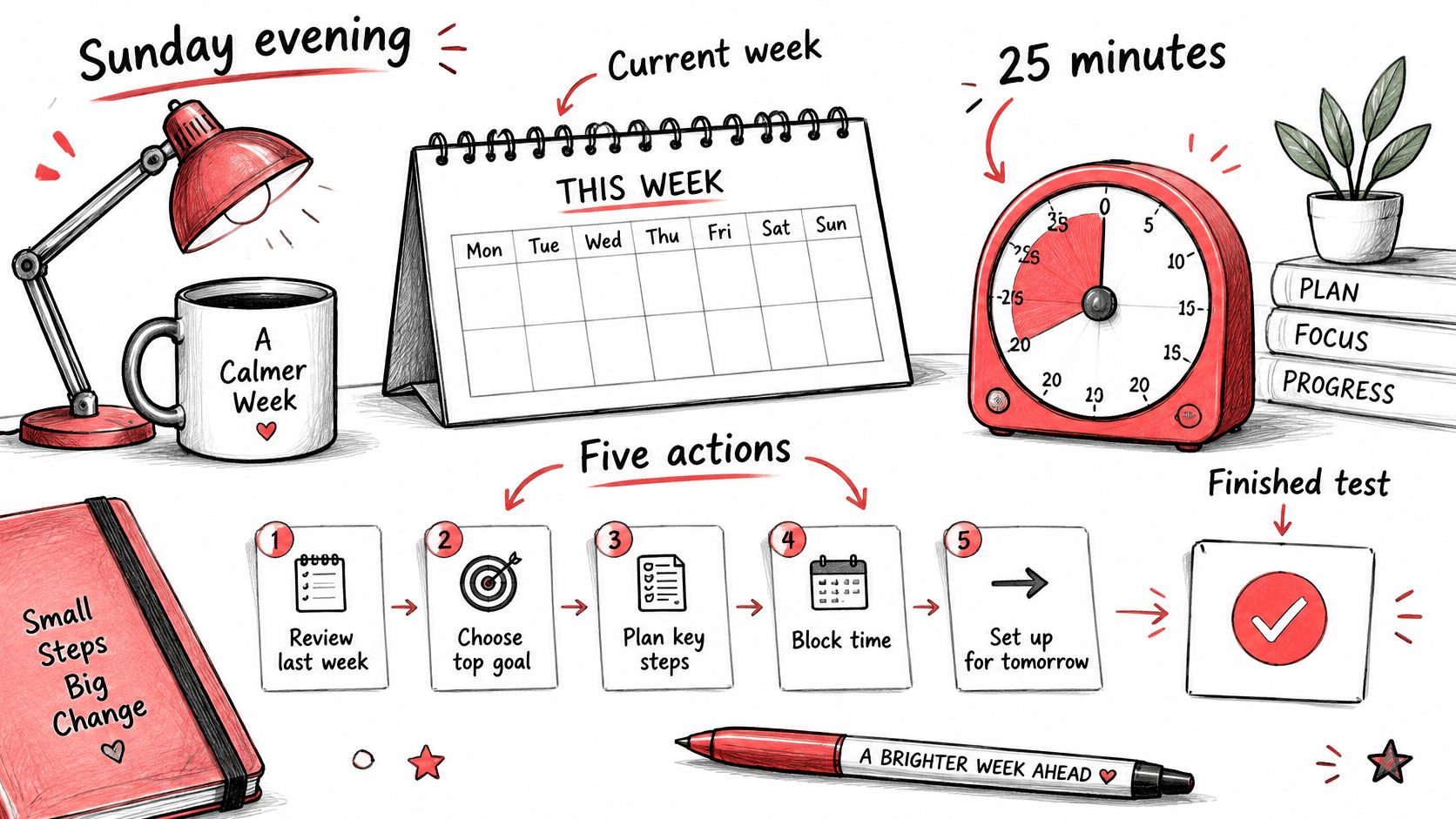
Give yourself a short first session, not a project to reconstruct your entire life. For example, reserve 25 minutes on Sunday evening and aim to finish a record you can retrieve independently afterward.
- Open only the current week. Leave historical backfilling for another session so the empty grid doesn't become a task list.
- Choose your working format. Use a week-grid for compact records, or keep your dated daily journal and add a weekly index.
- Capture an event. Write a clear sentence, attach a relevant photo without changing its original date, and choose a reusable tag.
- Make mood capture optional. Record your present observation if useful, without inventing earlier observations to complete a summary.
- Save an independent copy. Export the available record or photograph the paper spread, then check that the copy opens outside the original tool.
Life Calendar is a mobile option on the App Store and Play Store, with colors, notes, images, moods, and tags attached to weeks. A paper weekly spread is an equally valid starting point.
If your reflections include faith, HolyJot's guide to digital prayer journaling with HolyJot offers a purpose-specific approach. Keep that purpose distinct from the mechanics of organizing dates.
Finish by recording a memorable week from last month and testing whether you can recognize it from the saved copy. If reviewing it makes you feel worse, stop for the evening rather than adding more entries.
Life Calendar offers a weekly view of your life with space for notes, images, moods, and tags, connecting individual memories to their place in time. Visit Life Calendar to explore the week-grid format and begin with the week you're living now.