Reflective Journal Format: Structures and How to Use Them
Explore the reflective journal format, a five-part weekly structure, and how to organize observations, feelings and takeaways in one clear entry.

In this article
- Why a Reflective Journal Needs a Format
- Two Jobs Every Format Has to Do
- Common Reflective Journal Structures Compared
- How to Build a Weekly Entry in Five Parts
- The Quick Reference Card
- Worked Examples of One Week in Three Formats
- Version 1, free narrative
- Version 2, the five-part entry
- Version 3, tagged mood log
- Loosening Structure When Experiences Do Not Fit
- When the six-stage cycle fights you
- How Much to Write and When to Stop
- What the evidence supports, and what it doesn't
- Where reflection turns into rumination
- Choose Your Weekly Format and Start This Week
Sunday evening, the notebook is open on the kitchen table, and after a minute of staring you write "busy week, fine" and close it. Same thing next Sunday. By the end of the quarter you have a dozen entries, all roughly the same length, and no clear answer to what you learned or what you'd do differently.
The problem isn't discipline. A blank page asks you to remember and analyze at the same time, and under that pressure the easiest response is to default to a summary of events.
A reflective journal format fixes that by giving the page a few named parts: what happened, what it meant, what you'll test next. Three questions come up again and again, and they're the spine of this guide. Which structures exist, how to fill one in properly, and when to loosen or drop the structure altogether. You'll finish with one format chosen and a first entry ready to write.
Why a Reflective Journal Needs a Format
A record of events is not a reflection. "Client call, 45 minutes, tense" is a record. "The call went badly because I hadn't written the scope down, and I'll send a written summary before the next estimate" is a reflection, because it names a cause and a change.
A reflective journal format is the small set of headings, prompts or fields that moves you from the first sentence to the second. It isn't decoration, and it isn't a school exercise. It's the mechanism that makes the writing reusable.
Two Jobs Every Format Has to Do
- Capture. Get down what happened with enough accuracy that you could describe it to someone else a month from now. The date, the people, the numbers, what was said.
- Interpret. Turn that record into a claim about cause and effect, plus one specific thing to try next.
A blank page is like cooking dinner from memory. Sometimes it works, and you can never repeat it exactly. A recipe card does two jobs at once: it records what you did, and it lets you adjust the salt next time. A format is the recipe card for a week.
Structure is on your side. The moment a template makes you feel like a clerk filling in a form, it has stopped doing its job.
That's the test to apply to every structure here. Does it help you say something you wouldn't have said otherwise? If it only adds fields, drop it. What follows covers personal journals and learning journals, weekly records and per-event records, in the order you'd use them.
Common Reflective Journal Structures Compared
Five structures cover almost everything you'll meet, from a university handbook to a notes app on your phone. Here they are side by side.
| Structure | Stages or prompts | Best for | Main risk |
|---|---|---|---|
| Gibbs reflective cycle | Description, feelings, evaluation, analysis, conclusion, action plan | Structured academic or training reflection | Can feel like filling in a form |
| What, so what, now what | Event, meaning, next step | Quick reflection on a single event | Stops early if meaning is skipped |
| Five-part weekly schema | Context, observation, meaning, evaluation, next action | Weekly personal records with a clear feedback loop | Needs a few minutes of discipline each week |
| Free narrative | Whatever the writer chooses | Emotional or unusual experiences | Lessons often go unstated |
| Tagged mood log | Mood, tags, one image, short note | Busy weeks and spotting long-term patterns | Thin on reasons unless a prompt asks why |
Gibbs moves through six stages and was built for assessed work. It suits a learner who has to show evidence of each stage to a tutor or an assessor. In personal use, the action plan is the only stage that changes anything, and it's the one people leave until last and skip.
What, so what, now what is the fastest of the five. It works well on a single event you want to process before the day ends. Its weakness sits in the middle question, where "so what, it was fine" is always available.
The five-part weekly schema is designed for a personal record. Each part has one job, and the sequence ends with something you can check seven days later. That loop is the entire point, not a bonus feature.
Free narrative gives you room when an experience is strange, painful, or doesn't fit categories. You pay for the freedom with a missing lesson, because the writing usually stops when the feeling is spent.
A tagged mood log takes under a minute, which makes it a practical choice in a heavy week. It surfaces patterns across months. It won't tell you why a mood appeared unless a prompt asks.
Pick the row that matches your goal rather than the one that sounds most rigorous, and run it for three weeks before changing anything. If your notes sprawl across pages, the note taking advice from AIDictation shows how to keep headings tight so an entry stays scannable a month later. It also helps to settle early whether you're keeping a diary or a journal, since the two carry different expectations about audience and honesty.
How to Build a Weekly Entry in Five Parts
The five parts below each do one thing. Read the reason next to every step, because the reason is what stops the step from becoming a ritual.
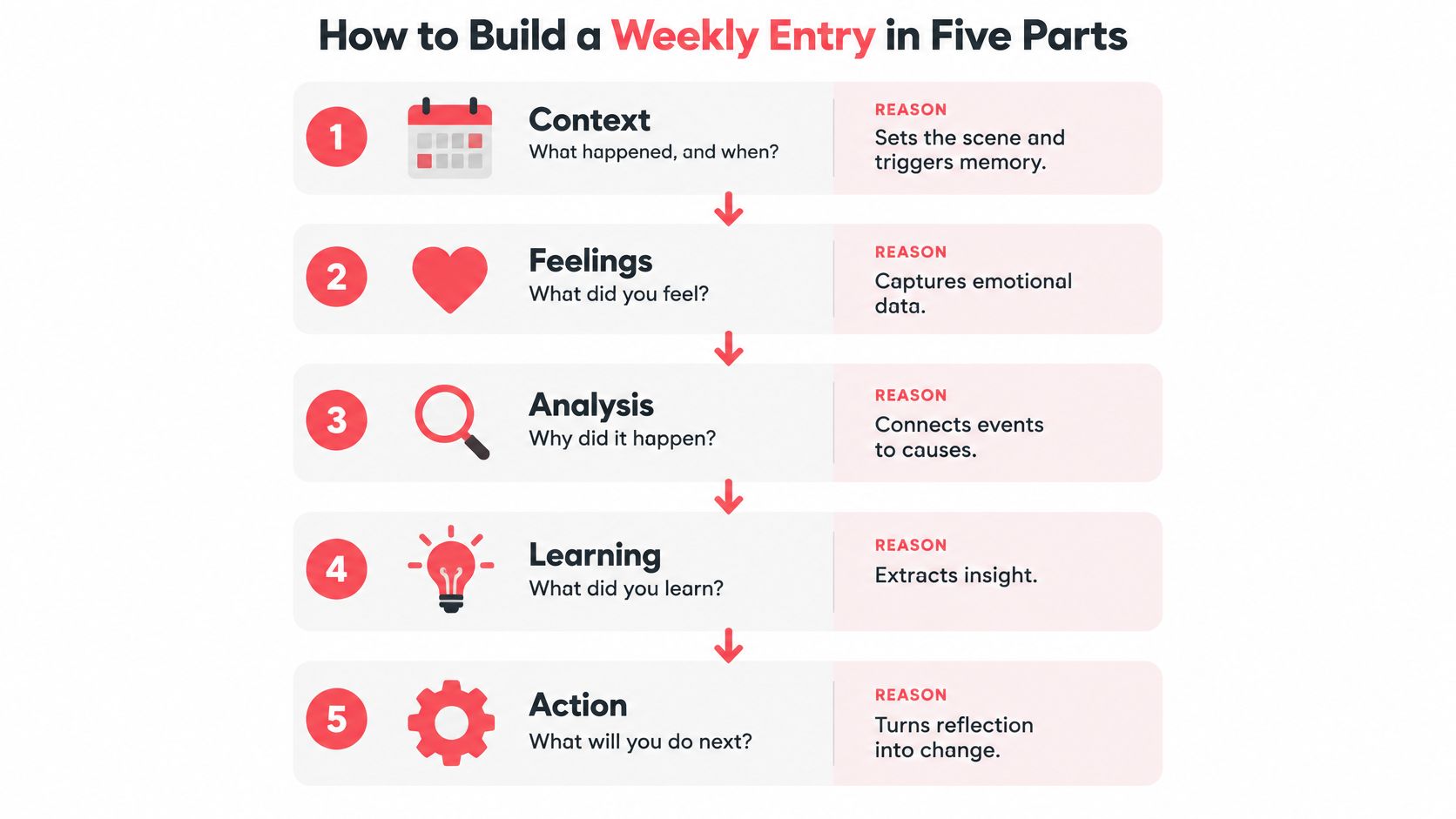
- Context. Ask "What happened, and when?" One or two sentences naming the event and the day. This sets the scene and gives your memory a handle, which matters when you reread in November.
- Observation. Ask "What can I see or count?" Facts, messages, photos, timings, numbers. Not conclusions. "He was rude" is a judgment. "He ended the call after two minutes" is evidence you can check.
- Meaning. Ask "What does this show?" Why the event mattered, including what you felt, what you assumed, and at least one alternative explanation. If you decide the client was dismissive, force a second reading, such as a deadline their own manager set.
- Evaluation. Ask "What changed because of this?" What worked, what failed, and why. Here a week becomes a lesson instead of a story.
- Next action. Ask "What will I test next week?" One concrete change, small enough to verify. "Confirm scope in writing before any new estimate" beats "communicate better".
Why this order rather than a single blank box? A schema that separates description, interpretation and action converts memory capture into a feedback loop, as the reflective writing study on Sciety describes it: observable events supply the inputs, interpretation identifies the cause, and the planned action creates a measurable follow-up. That study also shows prompt design changes what people produce. Fully structured prompts produced the highest reflective-thinking scores, while semi-structured prompts produced the highest critical-thinking scores, among 88 participants who each completed six reports over three months.
The Quick Reference Card
| Part | Prompt | Write this | Avoid |
|---|---|---|---|
| 1. Context | What happened, and when? | One or two sentences naming the event and the day | A mood word with no event |
| 2. Observation | What can I actually see or count? | Facts, messages, photos, or numbers | Judgements such as he was rude |
| 3. Meaning | What does this show? | Feelings, assumptions, and one alternative explanation | A single story treated as the only cause |
| 4. Evaluation | What changed because of this? | What worked or failed and why | A recap of the event with no judgement of the result |
| 5. Next action | What will I test next week? | One concrete change that can be checked | A vague promise to do better |
Tags, mood and images belong on the same page, but each needs a question attached. A photo with no caption is clutter. A photo answering "what does this show?" is evidence. A tag such as "client work" earns its place once it recurs for six weeks and the pattern becomes visible. A mood selection records the emotional state of the week; add one line of reason and it becomes data you can compare.
A finished entry has no orphan lines. Every sentence answers a prompt, and the last one is specific enough that you could verify it next Friday. If you want a bare scaffold to copy, this weekly notes template gives you the fields without extra commentary.
Worked Examples of One Week in Three Formats
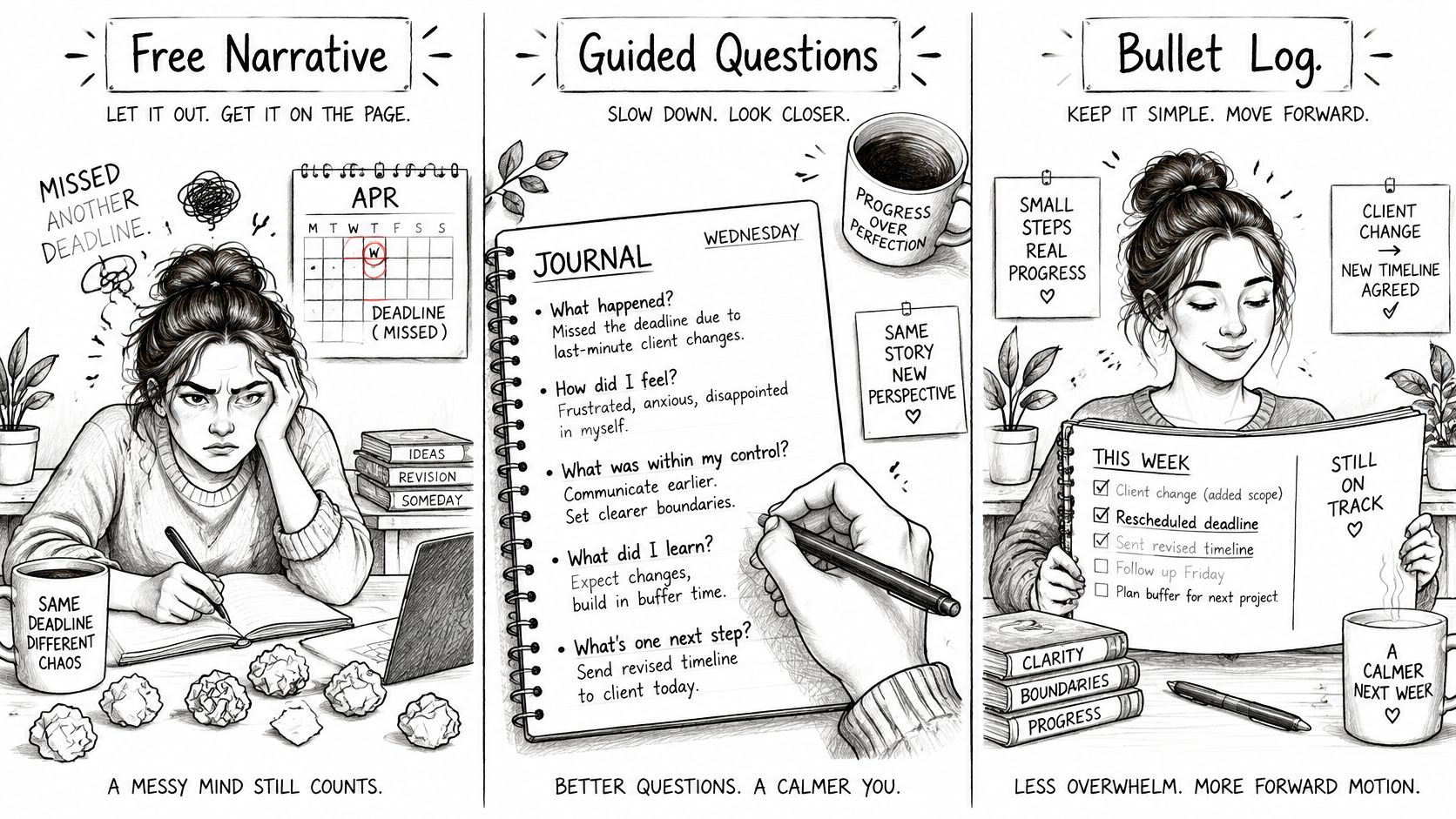
One event, three ways to record it. Say a project missed its deadline because the client added requirements on Wednesday afternoon. You want to learn something, and you also want to close the laptop.
Version 1, free narrative
"Wednesday was a mess. The client emailed at 4pm with three new requirements, everything shifted, and I ended up rebuilding the schedule until ten. I'm frustrated and I think they handled it badly."
That's honest and fast. It captures the mood and the timeline. It hides the writer's own decision, which was to agree to a scope without writing it down. The paragraph ends on blame, and blame isn't a lesson.
Version 2, the five-part entry
- Context: Wednesday, the client changed the project scope.
- Observation: three new requirements arrived by email after 4pm, and the deadline stayed the same.
- Meaning: I felt blamed and rushed; the client may have been under pressure from their own board, which would explain the abrupt email.
- Evaluation: I'd agreed to the original scope verbally, so there was nothing to point back to when the changes landed.
- Next action: before any new estimate, confirm scope in writing and ask the client to reply with agreement.
Same afternoon, more work, one line you can act on. The alternative reading in step three is what saves the entry from becoming a complaint.
Version 3, tagged mood log
Mood set to stressed. Tags "work" and "client". One attachment, the screenshot of the 4pm email. Note: "scope changed again."
This version takes forty seconds and preserves the evidence. Reread it in three months and you'll find that "scope changed" appears in five different weeks, which is a finding in itself even though no reason was ever recorded.
For a routine week with nothing dramatic, three lines are enough: walked at lunch three times, slept badly Tuesday, keeping the earlier finish. Not every week deserves an essay, and a log small enough to maintain is a log you'll still be keeping next year.
Ask which of the three versions you'd reopen next week. If the answer is the mood log, keep it and add one prompt on the day something big happens.
Loosening Structure When Experiences Do Not Fit
Most guides hand you one framework and never say when to bend it. Formal guidance is often more relaxed than the templates suggest: the reflective journals guide from the Norwich University of the Arts library states that no single structure is required and recommends adapting headings to the assignment or learning context. Writing for yourself, you have more latitude still.
The trick is separating what an entry must achieve from the shape it takes. Required outcomes stay constant. Optional containers can be swapped or dropped.
Required outcomes: evidence of what happened, an interpretation of why, and one next step. Everything else is packaging.
When the six-stage cycle fights you
Emotional events. A breakup, a difficult diagnosis, a conflict at work. Six stages feel absurd here. Write the factual note, set the mood, skip the analysis prompts that feel like pressing on a bruise, and come back in a few days. The entry doesn't owe anyone completeness.
Routine weeks. Nothing happened. A three-line entry is finished, not lazy. Forcing analysis onto a quiet week trains you to invent problems so the template has something to chew on.
Culturally specific experiences. Standard guidance asks how someone from another culture, age or socioeconomic group might read the event, but rarely explains how to do that without stereotyping. The workable version is to name one specific person who was there and ask what they'd have noticed: what would a colleague who grew up elsewhere have heard in that meeting? That's perspective-taking, not a claim about a group.
Events that resist stages. Some things arrive as a jumble of memory and feeling. Write them as free narrative first, then add two lines at the end: what you think caused it, and what you'll do next.
Before closing any entry, run three checks. Is there evidence someone else could verify? Is there a sentence explaining why it happened? Is there an action? If a container makes those three harder to write, it's costing you more than it gives.
How Much to Write and When to Stop
Two modes settle most of the length question. The split is worth seeing in one picture.

Recording mode takes about a minute. Date, mood, an optional one-line explanation, and one image or artifact only when it carries meaning. You're filing evidence, not analyzing it. Done on the day, it costs almost nothing and it stops the week from vanishing.
Reflection mode is the weekend session. Take the raw notes from the week and add causes, consequences, one alternative reading, and a next behavior. That's the five-part entry, and once a week is enough.
What the evidence supports, and what it doesn't
Journaling is often described as though volume were the active ingredient. The better evidence is more modest. A systematic review and meta-analysis in Family Medicine and Community Health reported an average 5% reduction in mental-health measure scores for journaling interventions versus controls, with larger subgroup reductions for anxiety (9%) and PTSD (6%), alongside substantial heterogeneity and methodological limitations. Treat those figures as context for a low-burden habit, not as a promised result, and certainly not as treatment.
Stop rule: if the same event starts replaying, the entry is growing without new facts, or the action line is still blank, jump straight to the action and return later.
Where reflection turns into rumination
Replaying a difficult event in finer and finer detail feels like work and isn't. Longer entries and richer emotional description don't automatically produce insight, and a constrained format often gets finished when an open one gets abandoned. Recent structured methods lean on exactly that: a clinical-education approach described in this journal article on reflective practice uses a compact format of three realizations, two discoveries, and one challenge with an action plan, while feedback-enhanced journaling designs set predefined sections, prompts, and a closing message to yourself.
Practical caps that keep an entry useful:
- Ten minutes or about 150 words. One mood check, one insight tied to an actual observation, one small next step.
- One open loop. Leave with five actions and you'll do none of them.
- A pause when it bites. Expressive writing can raise arousal, blood pressure and negative mood in the short term, so skip the hard prompt and return when you're steadier.
- Support when it persists. If distress continues or starts disrupting sleep, work or relationships, talk with someone you trust or a qualified professional. A journal is a tool, not a clinician.
Decide the week's mode before you open the app. Light mode is mood, key event, lesson, next action. The expanded version waits for the week that needs it.
Choose Your Weekly Format and Start This Week
Pick the format you will still finish on a tired Thursday. Choose one row from the comparison table and treat it like a training plan: for a personal record, start with the five-part weekly schema; during a heavy work season, the tagged mood log is the honest choice because it protects the habit while asking for less writing.
Put the prompts where your eyes land before doubt does. Use the first page of a paper notebook, a pinned note, or the fields in your phone. If you want the prompts held inside a weekly grid, Life Calendar lets users mark each week with colors and add notes, images, mood, and tags to it, and it uses your birthday to generate a grid of your life in weeks, with each week shown as a box. A plain document with five headings works just as well.
Set a review three weeks out and check three things:
- Did every entry include evidence? Something checkable, not only a feeling.
- Did every entry name a next action? Even a small one.
- Did one prompt get skipped every single time? If yes, drop it. A prompt that stays blank is telling you the format is too stiff for the life it is meant to catch.
To keep the routine from narrowing into paperwork, pair the entry with these self-reflective activities. When five prompts feel like too much, expressive journaling is the looser, feeling-first lane for weeks that need room before structure.
Write this week's entry before the weekend, in the format you chose. That is the whole assignment.
Life Calendar turns the week you are living into a box you can fill in. Add a note, a photo, a mood and a tag to the current week, then widen the view to see how this one sits among the weeks already recorded. That is the difference between a journal that disappears and one you consult. Open Life Calendar and put this week's entry where you will find it a year from now.