Self Reflective Activities: 8 Ways to Track Growth
Explore 8 self reflective activities for reflecting on experiences, feelings, and personal growth, from weekly reviews to letters to your future self.

In this article
- 1. Weekly Review
- How to run it in 20 minutes
- 2. Gratitude Journaling
- Where it breaks down
- 3. Mood Tracking and Emotion Labeling
- The line between reflection and rumination
- 4. Life in Weeks Visualization
- What to do with the grid
- 5. Photo-a-Day or Weekly Photo Reflection
- Making it stick
- 6. Wheel of Life Assessment
- Running it honestly
- 7. Gibbs Reflective Cycle
- Applying it to one event
- 8. Letters to Your Future Self
- What to put in it
- How the eight self reflective activities compare
- Start With One Practice This Week
- Calibrate what you expect
- The first session
People who try to reflect often end up with a few vague thoughts before bed and nothing they can revisit later. Sunday evening arrives, someone asks what you did in March, and you can produce a deadline, a birthday, and a blank space where the rest of it should be.
The fix isn't more reflection. It's a method narrow enough to finish and structured enough to look back on. Structured attention training behaves like a skill rather than a mood: a 2024 meta-analysis of 26 randomized controlled trials run during the COVID-19 pandemic found mindfulness interventions significantly reduced depressive symptoms compared with control conditions, with a pooled standardized mean difference of -1.14 (95% CI -1.45 to -0.83).
Each of the eight activities below fills one of four gaps.
- Recall: you can't reconstruct a period, so the lessons in it evaporate.
- Emotional clarity: you feel something all week and can't name it.
- Perspective: the weeks blur into one long undifferentiated stretch.
- Planning: you notice the pattern and change nothing about it.
Pick the gap that's costing you most. For a model of how working professionals build the habit, these reflection habits for women lawyers are a good starting frame. Then start with item one if your problem is recall, and item three if your problem is that every week feels identical.
1. Weekly Review

A weekly review is one fixed session where you look back over the last seven days, note what happened, name what worked, and set the next week. It's the cheapest fix for the recall gap, because seven days is short enough to remember and long enough to show a pattern. A week with three late nights and one finished deadline reads very differently written down than remembered.
The evidence on written reflection is sobering in a useful way. A longitudinal meta-analysis of expressive writing studies found a small but statistically significant delayed reduction in depression, anxiety, and stress symptoms (Hedges' g = -0.12; 95% CI -0.21 to -0.04), and sessions spaced 1 to 3 days apart produced stronger effects than sessions separated by 4 to 7 days or more than 7 days. Translation: don't let the Sunday session be your only touchpoint with the week.
How to run it in 20 minutes
- What happened: one line per working day, plus anything that shifted.
- What went well: a single highlight, specific enough that you could repeat it.
- What didn't: the friction, not the self-criticism.
- What's next: two commitments, never five.
David Allen's Getting Things Done treats the weekly review as the maintenance step that stops a commitments list from rotting; the same logic applies to your memory of a year. A weekly notes template removes the blank-page problem entirely, and structured weekly notes keep the questions in the same order so that months stay comparable.
The trade-off is honesty about what this is: administration, not therapy. It will feel dull by week three. Cap it at 20 minutes and keep going anyway.
2. Gratitude Journaling
Gratitude journaling fixes a bias, not a mood. You're training attention to register the help you received, the thing that went right, the ordinary Tuesday that was fine. Three to five specific entries beat a page of vague positivity every time.
Specificity is the whole practice. "Family" isn't an entry. "My sister drove 40 minutes to sit with me at the dentist and made jokes in the waiting lot" is an entry, and it's the kind you can still learn from in two years.
The habit is common enough to be measurable. In 2025, 25% of U.S. respondents said they kept a mindfulness journal or log to track progress and feelings, according to an Ipsos survey of 1,000 U.S. members.
Where it breaks down
Gratitude lists fail in two predictable ways. First, they become a chore: same three items, same wording, zero attention. Second, they get used as a muzzle, a way to argue yourself out of a legitimate complaint. If a week was bad, log the bad week and find one small thing that held. That's honest, and honesty is what keeps the practice alive past February.
Practical rule: Change the prompt every week. Who helped you? What did you almost miss? What did you handle better than you would have a year ago?
Robert Emmons and Michael McCullough's early gratitude studies asked participants to list weekly blessings rather than daily ones, which suits anyone who finds daily writing unsustainable. Mine the old entries during a weekly review to see who keeps showing up.
3. Mood Tracking and Emotion Labeling

Mood tracking answers what a weekly note can't: how did that week feel? A note records events. A mood entry records the temperature of the period, and after six or seven weeks you have something no single day can show, which is the pattern.
Precision is the point. "Fine" and "stressed" are placeholders. "Anxious about the deadline and relieved it's finally visible" is data. Psychologist Daniel Siegel popularized the phrase "name it to tame it," and the Mood Meter developed by Marc Brackett's team at the Yale Center for Emotional Intelligence splits emotion into energy and pleasantness so you pick a word instead of describing fog.
The line between reflection and rumination
This practice carries a real risk. A 2025 study found self-reflection was associated with depressive symptoms until rumination was controlled, after which it appeared protective, which suggests direction matters more than volume. A 2025 meta-analysis in the same journal found rumination was negatively associated with well-being (r = -0.252, p < 0.001) and linked to poorer sleep.
- Log the cause, not just the label. One sentence of context: what was happening when you felt it.
- Use the same ten words. A fixed vocabulary makes weeks comparable. Free-form emotion words don't.
- Review monthly, not hourly. Patterns need distance; a rolling daily check turns tracking into surveillance.
Consistent examples help here, and these mood tracker examples show how a simple scale and a one-line reason fit together. If a month of entries shows the same low score attached to the same situation, stop tracking it and change it.
4. Life in Weeks Visualization
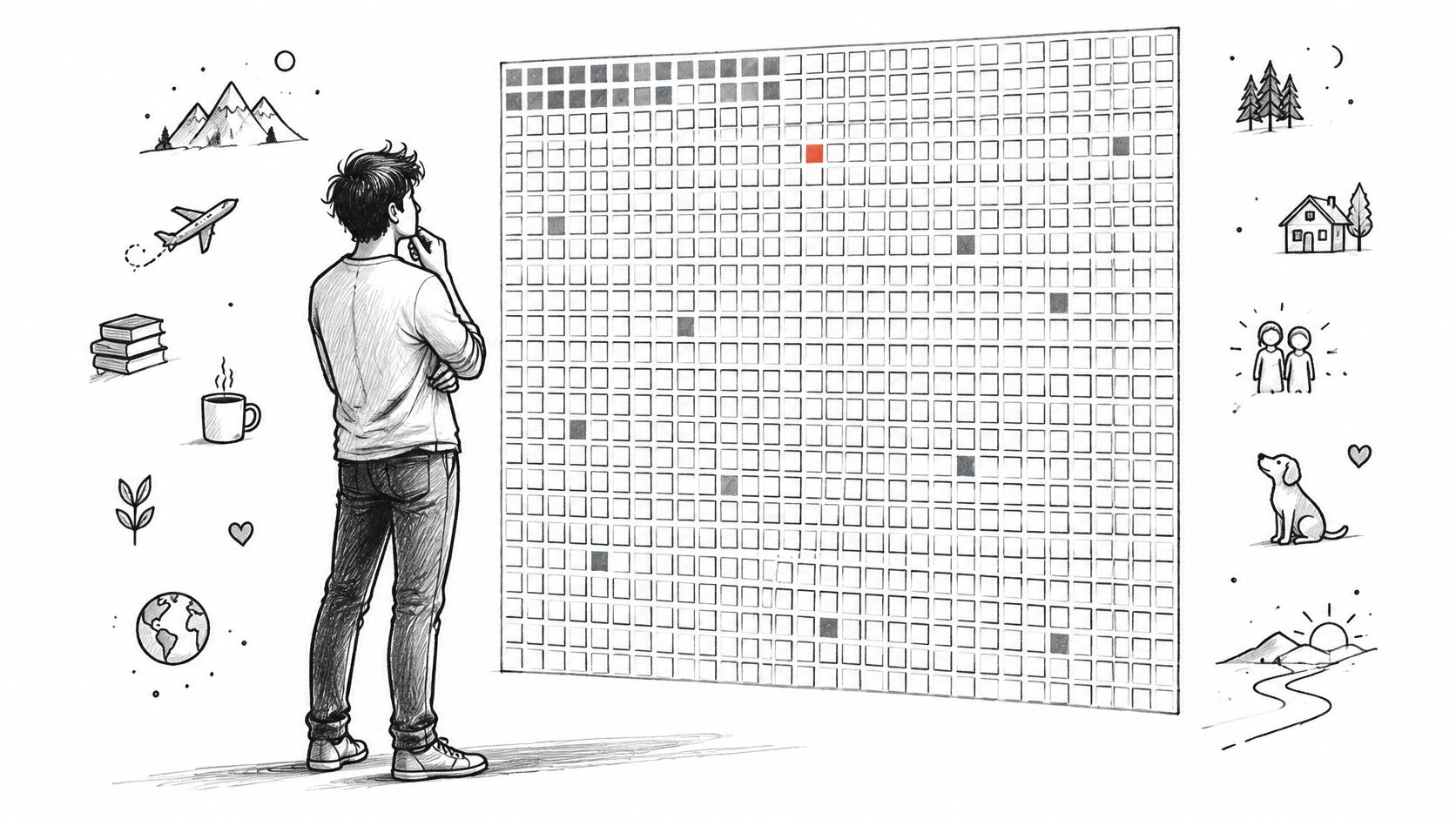
Memory gives you a highlight reel. A life-in-weeks grid gives you the shape: one square per week, a little over 4,000 squares for an 80-year life, past weeks shaded in. Two things happen when you look at it. The years you can't remember become visible as volume, and the years ahead stop being abstract.
Tim Urban's 2014 Wait But Why post "Your Life in Weeks" popularized the grid. Oliver Burkeman's 2021 book "Four Thousand Weeks" made the argument that follows from it: the constraint is real and the number doesn't grow. Neither of them tells you what to do on a Tuesday, which is why the grid pairs well with a written record.
What to do with the grid
- Shade the past and label five or six squares with events you'd otherwise lose: a move, a diagnosis, a job you left.
- Mark the current week so the overview stays anchored to now rather than to nostalgia.
- Pick one future square a quarter out and decide what you want it to hold.
The grid doesn't tell you to do more. It tells you that a week is the unit you actually spend, which is a far easier thing to plan around than a year.
The failure mode is staring at the grid instead of living in it. Use it once a quarter, then close it. For how weekly records sit inside the grid, this life calendar app overview walks through the structure.
5. Photo-a-Day or Weekly Photo Reflection
A camera roll is not a record. You have the pictures and no way to find the week they belong to, which is why photo reflection needs a container: one image per week, chosen deliberately, filed next to the week it belongs to.
Choosing the photo is the reflection. Deciding which single frame represents seven days forces a judgment about what mattered, and that judgment is the insight you'd otherwise skip.
Making it stick
- One per week beats one per day. Project 365 is a great January and a brutal February. Weekly survives the year.
- Caption it in one line. Why this photo and not the other one you took at 2pm.
- Review monthly. Open four weeks at once and look for repeats: the same street, the same person, the same desk.
The trade-off is real. Pictures capture the visual side of a week and skip the interior. A photo of a hospital corridor says nothing about how you felt waiting in it, which is why the caption and the mood entry carry the rest.
A photo answers "what did it look like?" A note answers "what was it like?" You need both to reconstruct a period.
Empty weeks are data too. Say you move house in April and take no pictures for three weeks; that gap is worth a paragraph in the record, because it tells you where your attention went.
6. Wheel of Life Assessment
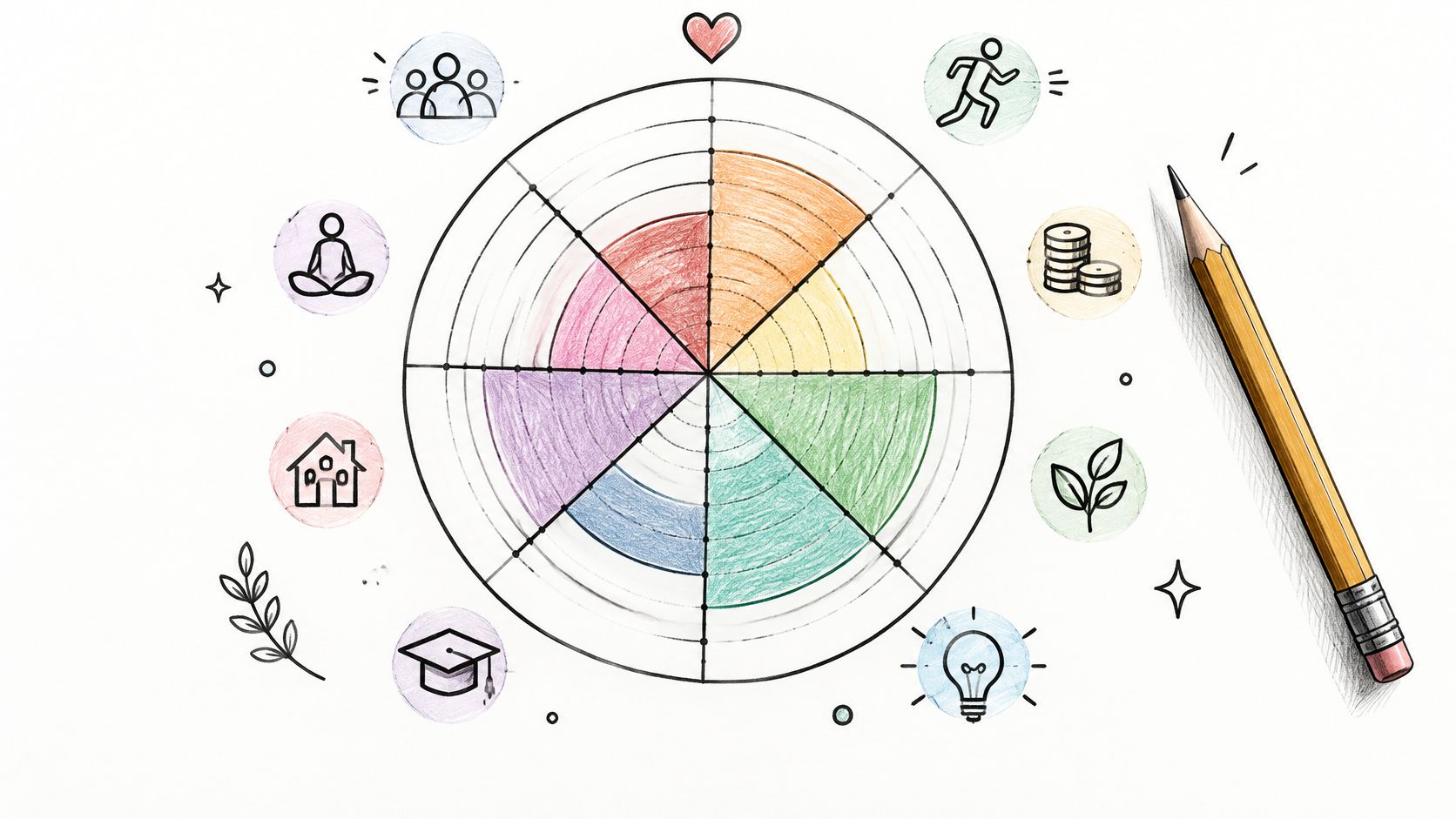
The Wheel of Life fills a different gap from journaling: it shows which part of life is being starved while the rest looks fine. Rate each area from one to ten, mark the scores around the circle, connect them, and look for the dent. The pattern matters more than the total. An 8 in work beside a 3 in health points somewhere specific; six 5s point nowhere.
Treat it as a ten minute assessment with a short shelf life. Coaches use it at intake because it exposes the neglected quadrant fast, but it only works if the categories match your life. Swap “career” for “money” if money is the pressure. Keep the list short enough that the lowest score stays visible.
Running it honestly
- Choose your own areas. A borrowed template can miss the two categories carrying the problem.
- Rate the last 30 days. Recent scores are easier to explain than a lifetime average.
- Write one sentence per low score. Name the constraint: time, money, energy, skill, or nerve.
- Pick one repair for the lowest area. Small enough to finish before the next weekly review.
Repeat it quarterly and compare shapes. A rising average can still hide a deepening dent, while a flat average with one category climbing is often progress.
The trade-off is that scoring feels decisive before it is useful. A low number without a reason becomes quarterly guilt. A low number with a cause and a next step becomes a plan.
The wheel finds the gap. It does not close it.
7. Gibbs Reflective Cycle
The Gibbs cycle gives a single event a spine. Six stages run in order: description, feelings, evaluation, analysis, conclusion, action plan. Nursing and teaching programs teach it because it moves a person from "that went badly" to "next time I'll do this instead."
Applying it to one event
Pick the hardest 20 minutes of your week, not the whole week. Then work through:
- Description. What happened, in plain facts.
- Feelings. What you felt at the time, and after.
- Evaluation. What went well, what didn't.
- Analysis. Why it happened: what was driving you, the other person, the pressure.
- Conclusion. What else you could have done.
- Action plan. One or two specific steps for next time.
Say a difficult conversation with a colleague went sideways on Wednesday. The description is two lines. The analysis is where the value sits, and the action plan is where you find out whether you learned anything. Keep it to two lines and reread it at the next weekly review, because a plan you never check is a wish.
Set expectations low on the emotional payoff. A meta-analysis of 16 randomized controlled trials involving 1,749 participants found no statistically significant overall effect of expressive writing on psychological health (Hedges' g = 0.04; 95% CI -0.06 to 0.14), physical health, or quality of life. Structured writing about a hard event is a thinking tool, not a treatment.
Use Gibbs on the event you keep replaying. The goal is a specific change in behavior, not a better story about what happened.
8. Letters to Your Future Self
A letter to your future self is the only activity here that creates a comparison. You write the current state, what's happening, what you're worried about, what you expect, then seal it with a date and read it later. The distance between the two documents is the insight.
Set the date deliberately. Six months out is long enough for something to change and short enough that you remember writing it. Twelve months works if you put a reminder in your weekly record for the week it's due, otherwise the letter disappears into a folder nobody opens.
What to put in it
- The facts: where you live, what you're working on, who's around.
- The worries: name the thing keeping you up. That's the paragraph that reads most strangely later.
- The predictions: three specific guesses about where you'll be. Being wrong is the point.
- The questions: what you hope you'll have figured out by then.
Hal Hershfield's research on future self-continuity at UCLA and Stanford examined how people who feel more connected to their future selves make different financial decisions. The letter is the low-tech version of that idea: it turns the person you'll be in a year into someone specific rather than a stranger. FutureMe sends email to a chosen future date if you'd rather not trust your own filing.
Write it on a bad week. A letter written when everything is fine reads like a weather report; one written under pressure reads like evidence.
How the eight self reflective activities compare
| Item | Typical Frequency | Main Output | Structure Level | Best For |
|---|---|---|---|---|
| Weekly Review | Weekly | Review of the past week and plan for the next | Flexible, with three core parts | Spotting patterns and planning ahead |
| Gratitude Journaling | Daily or weekly | List of specific things appreciated | Light, prompt-based | Noticing positive experiences |
| Mood Tracking and Emotion Labeling | Regular intervals | Mood ratings or labels, optionally with context | Simple, consistent tracking | Identifying emotional patterns and triggers |
| Life in Weeks Visualization | One-time or periodic review | Grid showing weeks across a lifetime | Visual and low-detail | Gaining perspective on time and life priorities |
| Photo-a-Day or Weekly Photo Reflection | Daily or weekly | Photo archive with optional captions | Light, image-based | Preserving memories and noticing everyday details |
| Wheel of Life Assessment | Periodically, often quarterly | Ratings and visual overview of life areas | Structured, rating-based | Comparing life areas and setting priorities |
| Gibbs Reflective Cycle | For a significant event | Analysis and an action plan | Highly structured, six stages | Learning from specific experiences |
| Letters to Your Future Self | Occasionally, for a chosen future date | Letter capturing present thoughts and hopes | Flexible, date-based | Connecting present perspectives with future goals |
Start With One Practice This Week
You don't need all eight. Choose the gap that costs you most, run one activity for four weeks, and only then add a second, preferably the weekly review, which pulls everything else into one place. Four weeks is long enough to know whether a practice fits and short enough that quitting costs you almost nothing.
Calibrate what you expect
Convenience has a ceiling. A 2023 meta-analysis of 43 randomized controlled trials of mindfulness apps, covering roughly 5,852 participants in depression comparisons, found a small but statistically significant benefit over control conditions (g = 0.24; 95% CI 0.17 to 0.31; number needed to treat 13.57), with moderate heterogeneity for anxiety outcomes (I² = 44%). Design and engagement move the result more than good intentions do.
Regularity beats intensity, and the people who sustain a practice tend to make it small and frequent. In Mindful Leader's Q1 2025 Meditation Practice Report, 56.6% of 212 surveyed meditation practitioners reported meditating daily. Daily is the norm among people who keep going, not weekly heroics.
The first session
Schedule it for this Sunday, 20 minutes, and answer three questions: what happened, what did I learn, what do I want next week to hold. Write one highlight and one lesson before you close the week. Do it again the following Sunday, and the one after that.
Life Calendar is one option if you want the record and the review in the same place. It presents your life in weeks and lets you attach notes, images, moods, and tags to each one, so a review pulls from the same week it's reviewing instead of from memory.
Life Calendar gives every week of your life a square, and each square can hold the note, photo, mood, and tags that made that week what it was, so the record exists before the memory fades. Open the week you're in, write one highlight and one lesson, and let the grid show you the pattern you'd otherwise miss. Visit Life Calendar to start your first week.