Diary Journal Difference: How to Choose the Right Format
The diary journal difference explained: how the two formats differ in structure, timing, writing style and privacy, and which one suits your goal.

In this article
- Diary and Journal Side by Side
- Why Diary and Journal Overlap in Practice
- How Entry Frequency Changes What You Capture
- What each cadence costs
- How Writing Style Shapes the Record
- What the record has to support
- Privacy and Searchability in Digital Records
- Three questions the label doesn't answer
- Habits that keep the original intact
- Which Format Fits Your Situation
- When the answer flips
- Choose Your Format Before Your First Entry
The usual advice draws a bright line. A diary is what happened. A journal is how you felt. Pick one label, buy a nicer notebook, and write every day until the habit looks serious. That advice fails the moment a real week gets messy. A page that starts with a landlord meeting ends in a worry about money. A themed notebook about a move fills up with bus times, box counts, and who still has the spare key.
The diary journal difference is a choice of organizing principle, not a rank of how deep the writing is. Diaries sort entries by time and events. Journals sort them by meaning, a theme, or a subject. Photos, moods, tags, and privacy settings then blur the line, because the same week can hold a fact, a picture, and a later reinterpretation. The useful question is what you will need to find, and when.
Diary and Journal Side by Side
A diary files an entry where it happened in time. A journal files an entry where it belongs in meaning. That single choice explains most of the rows below.
| Feature | Diary | Journal |
|---|---|---|
| Organizing principle | Date and sequence of events | Theme, idea, feeling or subject |
| Entry frequency | Usually daily or per event | Irregular, whenever something matters |
| Time span | Self-contained entries, often one day | Can cover months or follow a project |
| Typical content | Activities, events, opinions, private thoughts | Experiences, observations, ideas, emotions, goals, sketches |
| Writing style | Spontaneous, written during or soon after the event | Reflective, can be retrospective |
| Dated entries | Almost always | Often undated |
| Typical purpose | Chronological record of what happened | Understanding, processing or developing ideas |
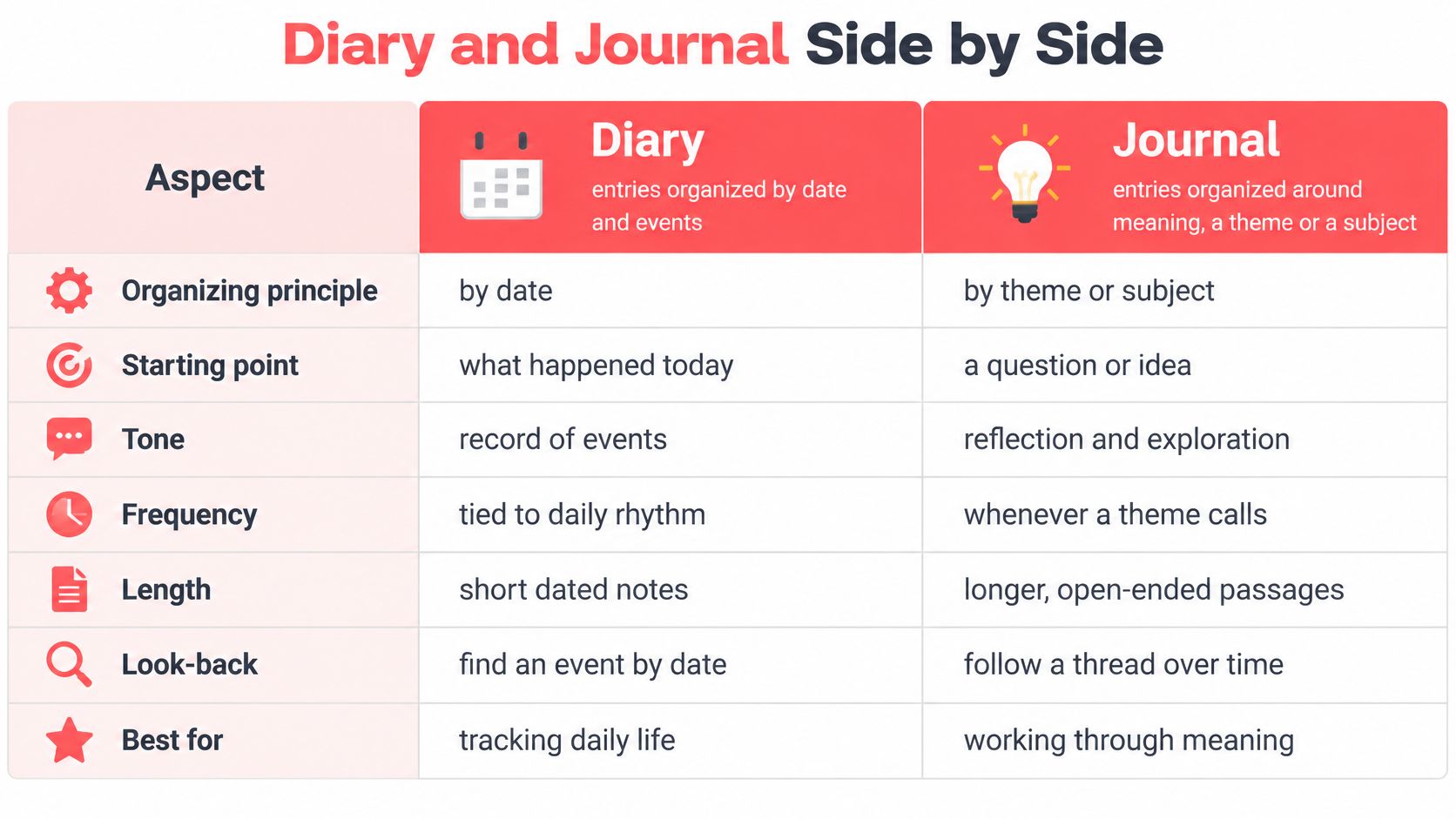
Read the table as a center of gravity, not a border. A dated page can still turn reflective; a themed notebook can still hold appointments and prices. Digital records make the split less tidy: one entry can carry a photo, a mood and tags, so it is stored by time and retrieved by theme.
The word diary comes from the Latin dies, meaning day, which is why readers still expect a daily entry even when the writer skips days. The label matters less than the job the record has to do. A shop page organized around choosing horse diaries by reading level makes the same point in miniature: “diary” can be the label on the shelf while fit decides the choice.
Practical rule: Find the row that matches the purpose you actually have, then take the label that fits that purpose. Don't take the one that sounds more serious.
Why Diary and Journal Overlap in Practice
Either word can name the same record. The labels point to an organizing principle the writer chooses. They aren't a legal or social definition.
Everyday usage blurs the two, especially in North America and France, where people switch between the words freely. The McHenry County Historical Society diaries collection guide treats the split as one of structure, frequency, and purpose, not a universally fixed definition. Reference scholarship still separates a diary's spontaneous, contemporaneous style from a journal's more reflective and retrospective approach. Practice doesn't follow that line neatly.
Two ordinary cases show the blur.
Say you date an entry every evening for a week. Monday is the landlord visit. By Friday you are still circling the same rent worry, and the page has become an argument with yourself. The dates never left. The job changed from log to meaning.
Or say a project journal is supposed to hold ideas. In practice it lists meals on travel days, the weather, and the 9 a.m. appointment. It works as a factual daily log, even if the cover says journal.
A journal may cover longer periods or follow a preselected theme. Diary entries are commonly self-contained and written during or soon after the event. Decide what the record must do. Let the organizing principle, not the word, set the structure.
How Entry Frequency Changes What You Capture
How often you write changes what survives, and how hard the habit is to keep.
Time-diary research typically asks people to reconstruct the previous 24 hours once a day. That keeps a chronological account. It stays vulnerable to recall bias, particularly for brief or nonsalient activities. You remember the argument. You drop the ten-minute errand that later explains why you were late.
Ecological momentary assessment captures behavior in real time or near real time, so recall error falls. Missed prompts and moment-selection bias come in instead. People answer when life is calm and skip the prompt when it isn't. A meta-analysis of 494 EMA samples reported average compliance of 79%, with a standard deviation of 13.64 percentage points. Even a well-run prompt system loses about one response in five, and samples spread widely around that average.
Handwriting every single day is already uncommon. A 2025 Great Britain survey of 2,095 adults, published by YouGov, found that 7% wrote a personal diary or journal by hand every day, while 67% never did so, as summarized by Lanternly.
What each cadence costs
| Cadence | Main data risk | Effort for the writer |
|---|---|---|
| Daily reconstruction of the last 24 hours | Recall bias for brief or minor activities | Low per day, depends on memory |
| Real-time prompts (ecological momentary assessment) | Lower recall error, but missed prompts and skewed moment selection | High; average compliance of 79% across 494 samples |
| Expressive writing protocol | Concentrates on one stressful experience | 3 to 5 sessions of 15 to 20 minutes |
| Weekly consolidation | Some recall loss across seven days | Low; one sitting per week |
A practical compromise is low-friction capture during the week, then one consolidation sitting. Jot the event when it happens. On Sunday, add notes, images, moods, and tags. You keep timely capture without the prompt load many people abandon. A mood tracker journal can sit in that weekly pass so a feeling has a place without a ping every few hours.
If you only write when a prompt fires, the weeks you were busiest are the weeks the record goes quiet.
How Writing Style Shapes the Record
Same Tuesday. Two entries.
Diary version: met the landlord at ten, rent goes up by 40 euros, took the bus home.
Journal version: the rent increase made me feel the flat was never really mine.
The first is a sequence. The second is an interpretation. A traditional diary primarily captures chronological details of daily events. Journaling, especially therapeutic or expressive journaling, emphasizes interpretation, emotions, perceptions, and meaning-making. The Advances in Psychiatric Treatment review of expressive writing treats these as different recording models, not polite synonyms. Expressive-writing protocols generally use only 3 to 5 sessions of 15 to 20 minutes on a stressful or emotional experience. They don't require a daily log at all.
What the record has to support
That split changes the information architecture.
- Event-centred records need a date, a sequence, and fast retrieval. You want "what happened on the 12th" in one look.
- Reflection-centred records need longer free text and emotional context. A mood word without the paragraph that produced it is a thin substitute.
A diary can hold feeling. A journal can hold plain facts. The rent note can grow a sentence about fear, and the "never really mine" page can still name the landlord and the euro figure. Style is a bias, not a lock.
Ask whether you will later search by date or by theme. If the answer is the date, the entry needs a timestamp. If the answer is the theme, it needs a tag or a longer reflective paragraph, sometimes both.
Privacy and Searchability in Digital Records
Most explanations stop at labels and tone. They skip what happens after you add a photo, a mood chip, and a search box.
Recent work on technological writing interventions describes digital journaling systems that combine text with photographs, calendar organization, word tags, privacy controls, and, increasingly, AI-powered features. The Frontiers in Psychiatry paper on those interventions also defines diary data broadly: repeated first-person accounts of events, experiences, emotions, and reflections, with no single prescribed method of analysis. Once that's true, the practical difference depends less on the name and more on how entries are indexed, retrieved, shared, and read later.
Three questions the label doesn't answer
Should sensitive reflections sit beside ordinary events? A rent fear next to a grocery list is easy to scroll past in private and easy to overshare if a week is exported whole. Split storage when the reflection would hurt someone if a backup, a shared device, or a screenshot left your hands. Acres on note app exports is a useful check on what leaves an app when you export, because an export is often wider than the page you meant to keep.
Do tags improve memory or flatten it? A tag such as "anxious" helps you find a pattern across months. It also invites you to treat a complicated afternoon as one word. Keep the tag, and keep the sentence that disagrees with it.
Which privacy controls matter when images and emotions share a record? A photo of a kitchen can identify a home. A mood score from the same week can identify a crisis. Lock the combined record, not only the sad paragraph. A diary with photos raises that stake, because the picture often reveals more than the prose.
Habits that keep the original intact
- Date-stamp factual entries when you write them.
- Mark a later reflection as written later, so Tuesday's fear isn't rewritten as if you felt it on Sunday.
- Keep automated labels, sentiment scores, or mood scores separate from the original wording. The record should still show what you wrote at the time.
Search is a gift and a rewrite risk. Index the week. Don't let the index replace the week.
Which Format Fits Your Situation
| Your main goal | Better fit | Why |
|---|---|---|
| Record daily events to look up later | Diary | Date and sequence make retrieval easy |
| Work through a stressful experience | Expressive journal | Three to five sessions of 15 to 20 minutes focus on feeling and meaning |
| Track ideas, projects or creative work | Thematic journal | Entries group by subject rather than by date |
| Log life regularly without daily pressure | Weekly record | One time unit holds events, moods, images and reflection |
| Keep a long family or travel log | Dated diary with reflective pages | Chronology stays intact while reflection adds depth |
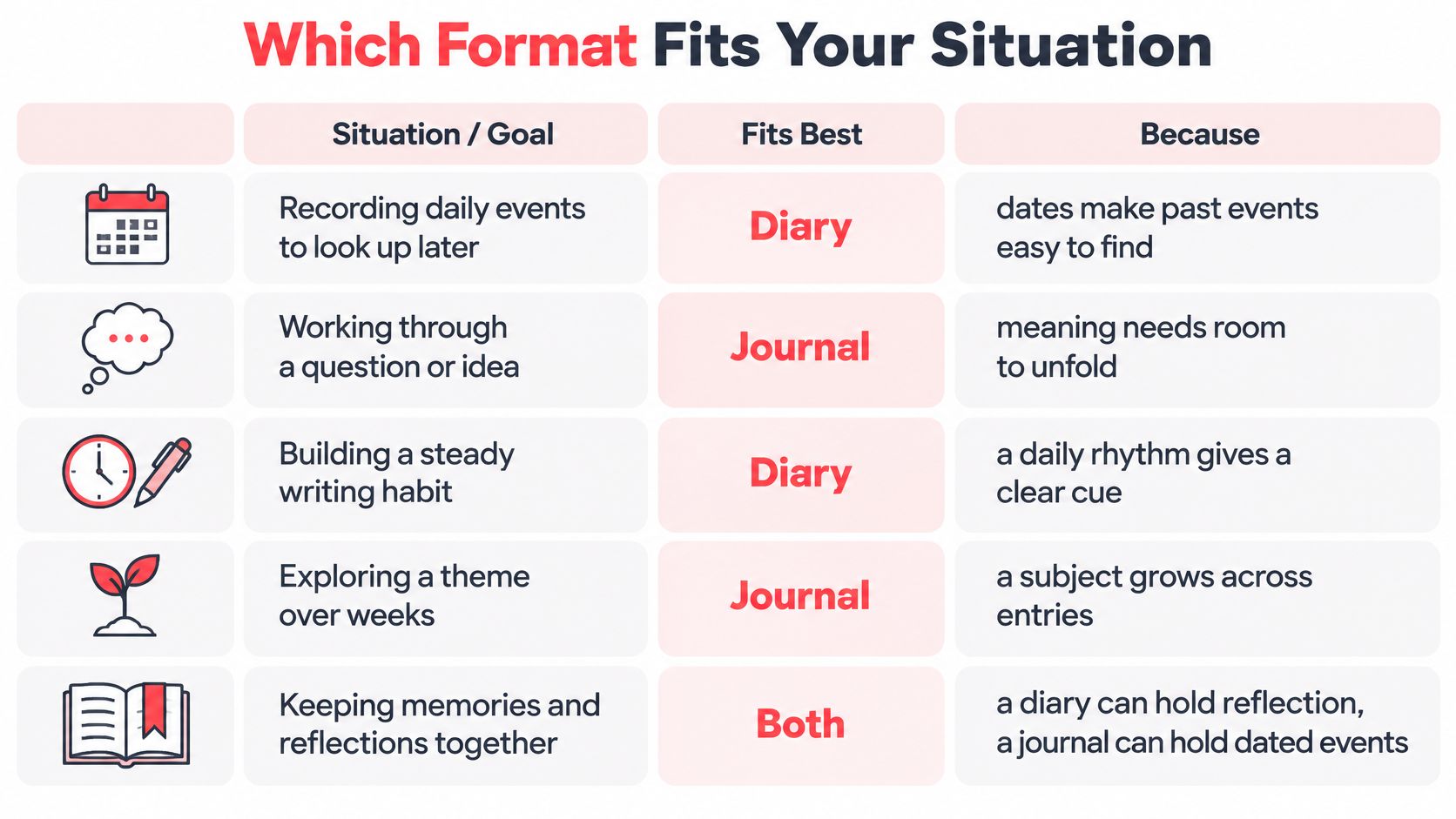
Match the row to the job you will still care about in a month. Looking up "what we did on the Tuesday we missed the train" is a diary job. Untangling one stressful experience is an expressive-journal job, short and bounded. Ideas, projects, and creative work belong in a thematic journal so the thread isn't scattered under unrelated dates.
A weekly record is the format for people who want regularity without a daily quota. One time unit can hold events, moods, images, and reflection together. For a long family or travel log, keep the dated spine and add reflective pages when a place or a person needs more than a line. If you still want paper in your hands, it helps to compare ring binder and traveler's notebooks before you commit, because a refillable cover lets a dated log and a themed insert live in the same object.
When the answer flips
A daily diary that keeps returning to one fear has already become reflective. Accept the journal function. Don't force the next entry back into a list of errands just to protect the label.
A project journal that suddenly needs a timeline should gain dates. Add them beside the theme. Don't throw out the subject grouping to look like a classic diary. Self-reflective activities fit that second case when the point is insight and the dates are only there so you can see the order.
Cadence, structure, and purpose decide the format. The word that sounds more serious does not. For regular recording that isn't every day, a weekly record keeps chronology and reflection in one time unit, so you don't have to pick a single label.
Choose Your Format Before Your First Entry
Choose the format before the first line. Three answers are enough: how you will search later, by date or by theme; how often you can realistically write for four weeks; and how sensitive the content is.
Comparisons still describe a diary as dated and chronological, and a journal as broader, able to hold reflection, ideas, prompts, sketches, goals, or undated entries. The same comparisons admit the overlap. A stronger frame, set out in this diary versus journal techniques note, treats the split as an organizing principle. Diaries organize around time and events. Journals may organize around meaning, themes, or creative work. A weekly record can preserve chronology while combining events, emotions, images, and reflection in one time unit. That is the format that records life regularly but not every day.
- Write your main goal in one line.
- Match it to the goal table above and take that fit.
- Pick a cadence you can keep for a month, not the one you wish you had.
- Date every factual entry, and mark later reflections as later.
- Decide in advance which content stays private, and where it is stored.
Some people keep Life Calendar as a personal diary, while others use it to keep their past and future in perspective. It uses your birthday to generate a grid of your life in weeks, each week a box you can mark with colors and fill with notes, images, mood, and tags.
Today, write the one-line goal and pick the row it matches. Start there, not with a blank page and a vague wish to "journal more."
Life Calendar gives each week of your life a box where notes, images, mood, and tags can sit together, so a regular record doesn't have to be a daily diary or a free-form journal. That weekly grid is built for the diary journal difference as people write: chronology in the layout, reflection in the card. Visit Life Calendar and put this week's goal on the week you're in.