Photo Journal Ideas: 8 Weekly Formats for Recording Life
Discover 8 photo journal ideas for documenting your life week by week, from weekly snapshots and mood tracking to year-in-review collages. Start today.
In this article
- 1. Weekly Photo Snapshot
- Choose for meaning, not appearance
- 2. Project 365 Photo Diary
- Keep the daily work small
- 3. Mood-Tracked Photo Journal
- Separate the scene from the feeling
- 4. Life in Weeks Milestone Journal
- Preserve uncertainty when working backward
- 5. Humans of New York-Style Story Journal
- Ask, listen, and preserve the person's meaning
- 6. Annual Year-in-Review Photo Collage
- Make the summary readable
- 7. Themed Tag Photo Journal
- Define tags by how you'll use them
- 8. Three Good Things Photo Journal
- Write what made the moment matter
- How the 8 photo journal ideas compare
- Pick One Format and Start Recording This Week
- Match the format to the work you'll actually do
- Give the record a clear home
You're scrolling through last year's phone photos, looking for the weekend when everything changed. You find restaurant plates, screenshots, and almost identical pictures of the dog. The dates are there, but the meaning isn't. You can see what you photographed without remembering why it mattered.
A photo journal adds that missing context. You attach an image and a short account to a day, week, year, or recurring theme. The useful choice isn't a decorative layout. It's the time unit you can keep returning to without turning memory keeping into another unfinished project.
Before choosing among these photo journal ideas, separate capture from organization:
- Capture freely. Keep taking ordinary phone photos without composing every image for a journal.
- Select deliberately. Choose pictures that represent your experience, not just your best photography.
- Add missing context. Record what happened outside the frame and why you wanted to remember it.
Older prints belong in this process, too. If your starting point is a family album rather than a camera roll, MyImageUpscaler's photo digitizing walkthrough offers a starting point for bringing physical photographs into a digital workflow. Keep the originals and label uncertain dates accurately.
The formats below range from a quiet weekly habit to a demanding daily practice. Choose the rhythm first. You can change the appearance later.
1. Weekly Photo Snapshot
Time unit: a week. Choose a photograph that represents the period, then add a short note explaining what the image alone can't tell you. This is the format I'd recommend when you want a dependable record without documenting every day.
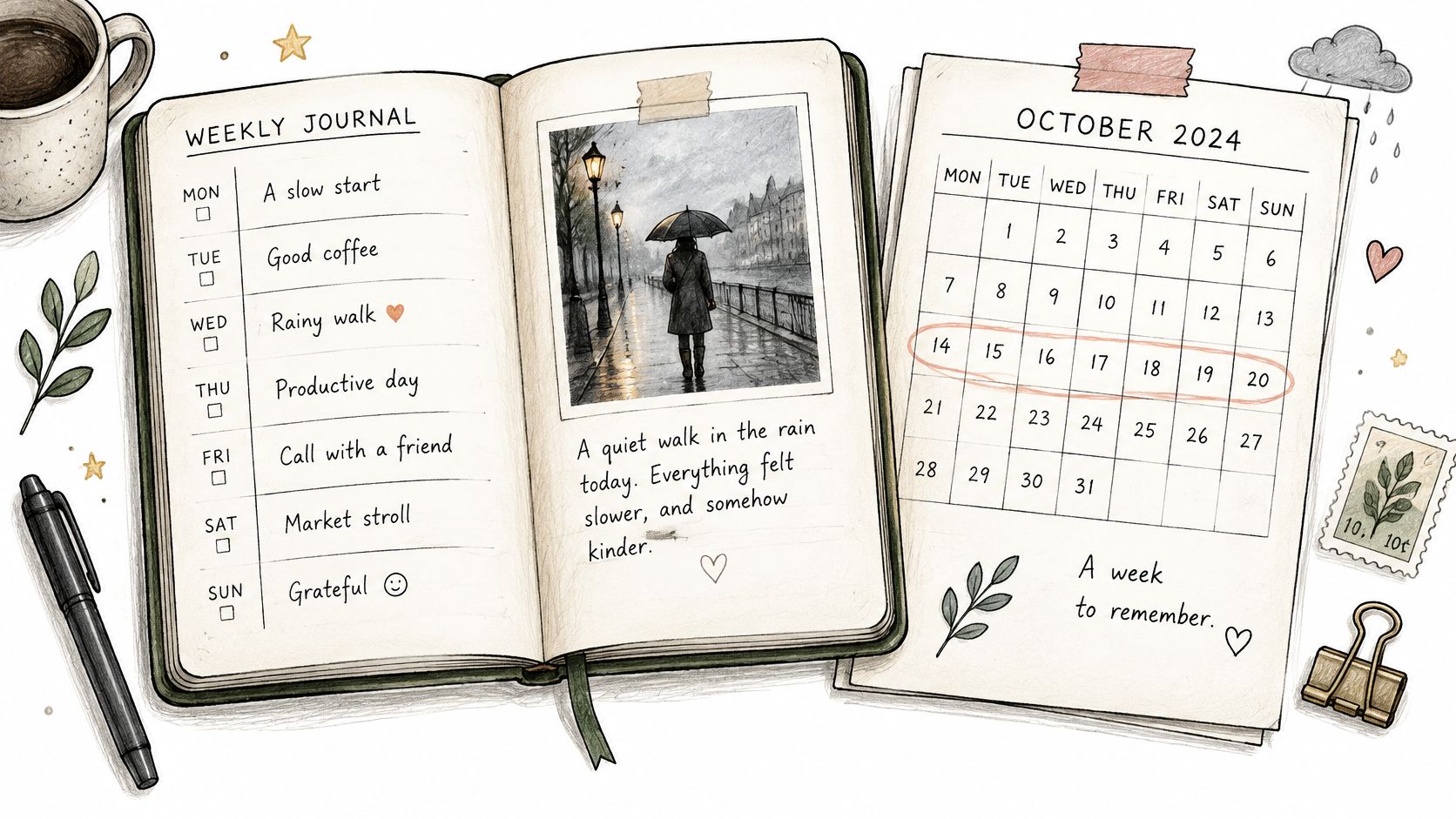
Suppose you photograph a rainy walk after receiving a job offer. The pavement and umbrella establish the scene; your note records the relief, the uncertainty, and the person you called afterward. Without that note, you've kept a weather picture rather than the turning point.
Chronology is a sensible foundation. A study of mobile-photoware use published in Personal and Ubiquitous Computing found that participants primarily organized personal photographs by capture date, while user-added titles were also useful metadata.
Choose for meaning, not appearance
Make your selection at the end of the week, when you can consider the whole period. A technically poor photograph of an important conversation may deserve the space more than a polished sunset.
- Use a fixed reminder. Attach the review to an existing routine, such as Sunday evening planning.
- Write before browsing backward. Record your current interpretation before older entries influence the account.
- Keep quiet weeks. A kitchen table, unfinished puzzle, or familiar walk can represent ordinary life.
The trade-off is compression. A busy week won't fit neatly into a single picture, so let the caption mention what's missing. Don't keep expanding the entry until it becomes a full album.
Practical rule: Select the image that needs a caption, not necessarily the image that would attract attention online.
2. Project 365 Photo Diary
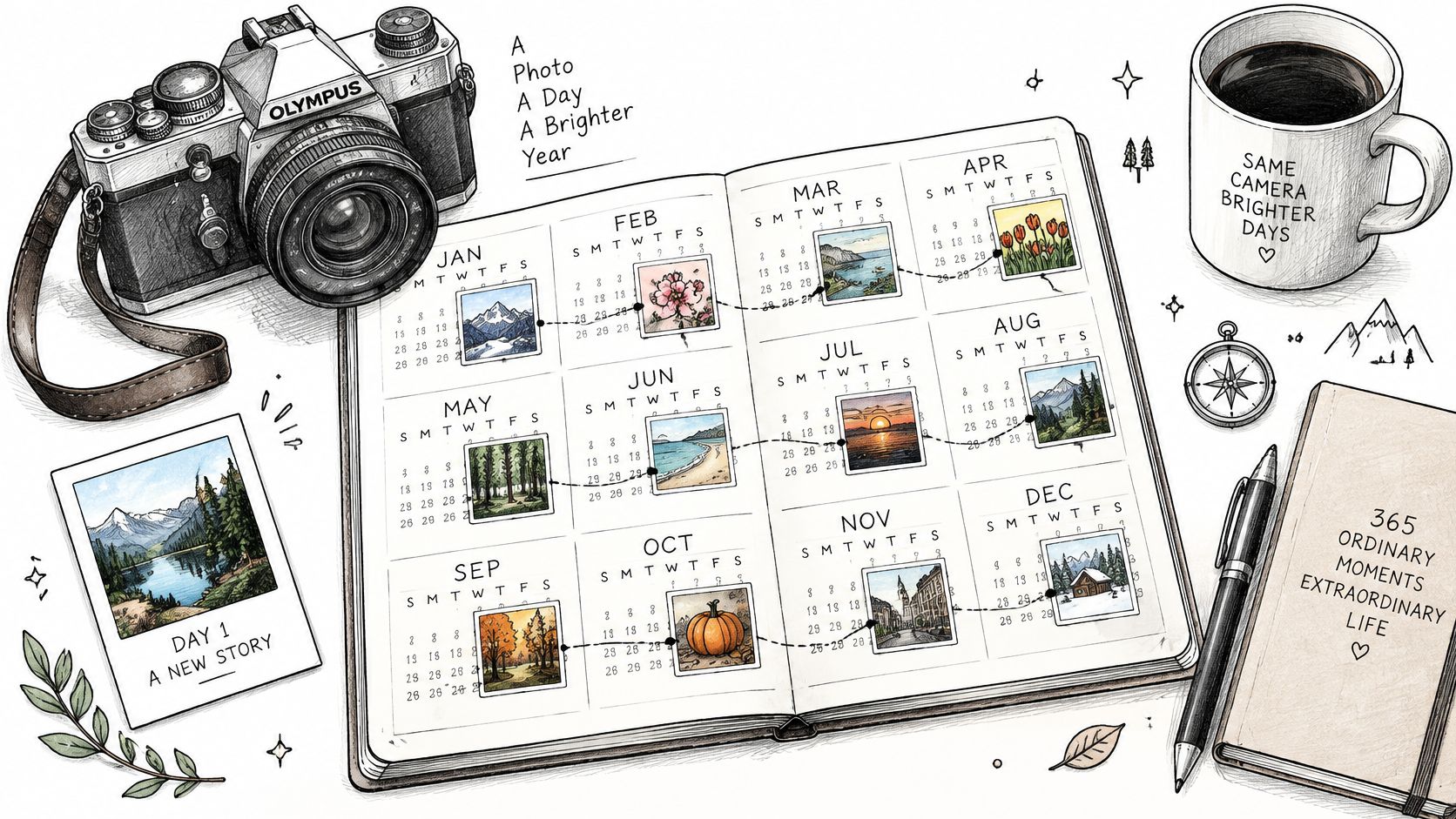
Time unit: a day, sustained across a year. A daily photo diary asks you to notice details you might otherwise leave unrecorded: changing window light, a commute, a workbench, or what dinner looks like during a busy season.
The challenge isn't taking photographs. It's making repeated decisions about what counts, what to write, and whether a missed entry means you've failed. Set a modest capture rule before you begin, such as photographing something you touched, made, or noticed.
Keep the daily work small
Add the date, a descriptive caption, and the detail you'd otherwise forget. A diary with photos works best when the writing supplies context rather than repeating what's visible.
For example, photograph the same desk during a demanding work period. Describe what you're working on, what interrupted you, or what finally became easier. The sequence can document change without requiring a new destination or subject every day.
- Vary your attention. Alternate between objects, people who consent, places, and activities.
- Review weekly. Correct dates and identify useful images while the context is still familiar.
- Leave honest gaps. Don't stage a replacement photograph and present it as an earlier moment.
Daily capture offers detail that a weekly snapshot leaves out. It also creates more material to manage, so avoid elaborate layouts during the capture stage. You can select weekly highlights or build a printed collection afterward.
If you start resenting the camera, reduce the frequency. A shorter, honest diary is more useful than a complete-looking archive you no longer enjoy making.
3. Mood-Tracked Photo Journal
A photograph of a pleasant place doesn't prove you felt good there. A mood-tracked photo journal records the difference between appearance and experience, using either daily entries or a weekly summary.
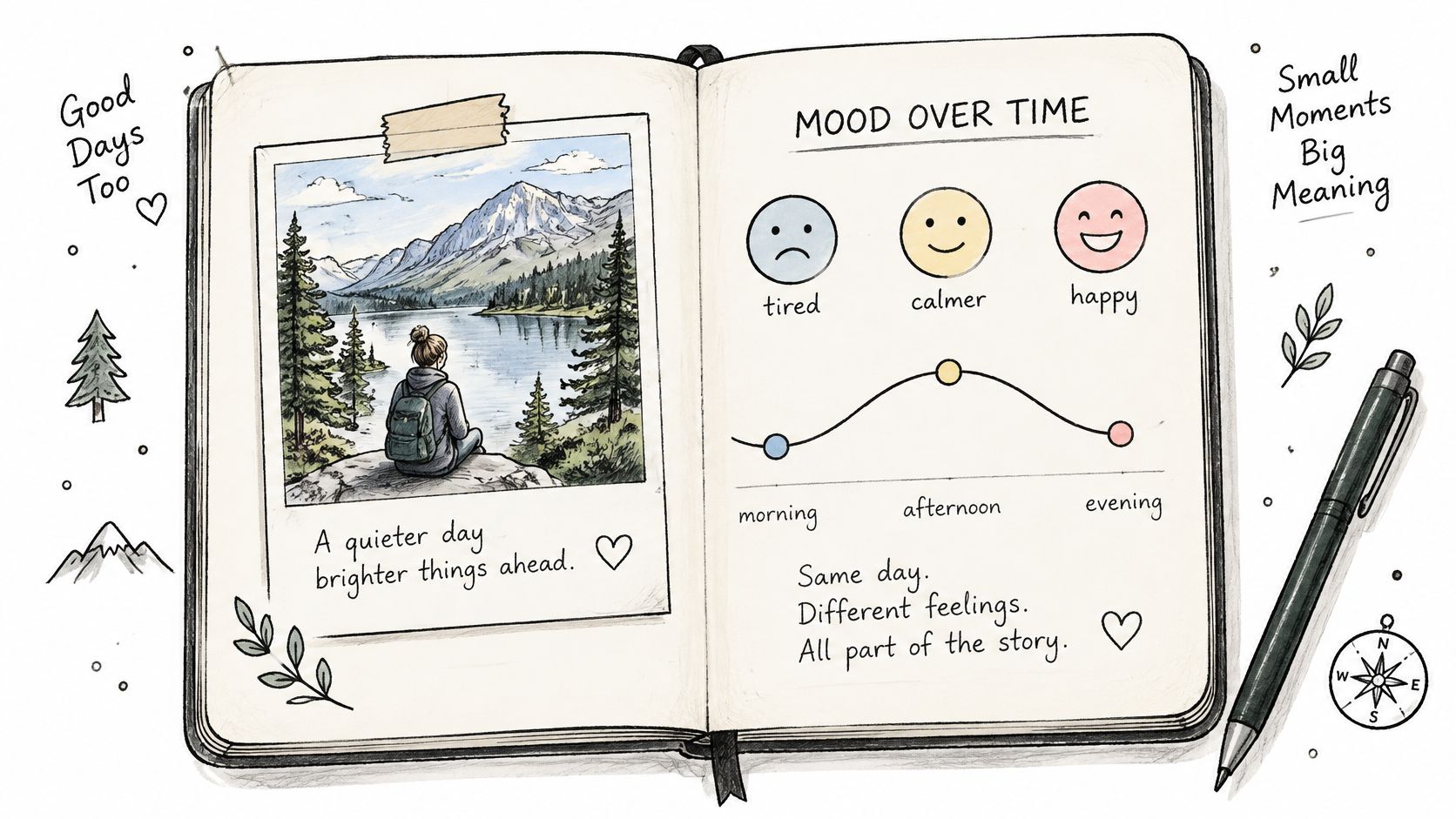
Pair your image with a consistent mood word, then explain the choice. You might record feeling unsettled beside a cheerful group photograph because you were waiting for difficult news. That contrast is valuable context, not an inconsistency to tidy away.
Separate the scene from the feeling
Use a small, stable vocabulary, such as low, unsettled, steady, and upbeat. Keep the meaning of each label consistent, and record it at a similar point in your routine. A mood tracker journal becomes harder to interpret if you continually change the labels or rate only unusually good days.
A useful entry distinguishes:
- What happened. You walked outside after a difficult afternoon.
- How you felt. You were tense before leaving and calmer when you returned.
- What remains uncertain. You don't know whether the walk, a resolved problem, or simple rest made the difference.
In a photographic-memory study published in Psychological Science, participants who took photographs recognized more objects, averaging 80.12%, compared with 70.00% in the no-camera condition. That finding concerns visual recognition, not mood improvement or the accuracy of every remembered detail.
Review your entries monthly rather than judging each day in isolation. Look for questions worth exploring, not diagnoses or proof that an activity causes a particular feeling. If daily tracking makes you scrutinize yourself too closely, switch to a broader weekly reflection.
4. Life in Weeks Milestone Journal
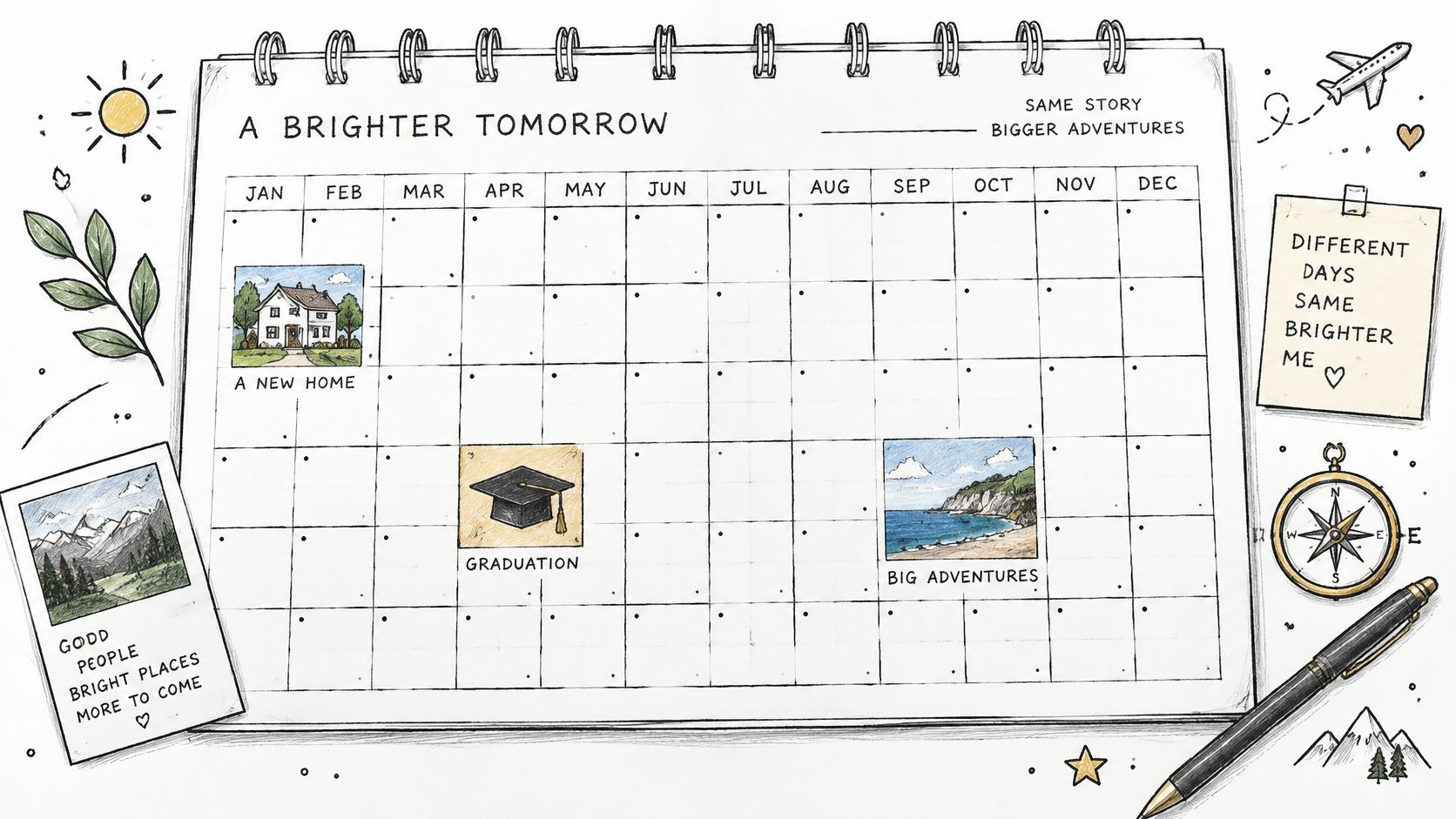
Time unit: the week in which something happened, viewed across your life. This format suits people who want to connect individual photographs with a larger personal timeline. Moving home, finishing a course, changing work, or welcoming someone into the family becomes an entry in a specific period.
Start with the recent past rather than trying to reconstruct childhood immediately. Choose a milestone, locate its date, and attach a photograph with the circumstances surrounding it. A life calendar app can provide the weekly framework, but the useful work is deciding what the event meant to you.
Preserve uncertainty when working backward
Old photographs don't always come with reliable dates. Check writing on the reverse, album order, correspondence, and relatives' recollections, but distinguish an estimate from a confirmed date. If you know only the season, say so rather than assigning false precision.
For example, you might place a childhood moving-house photograph near the likely period and note that a relative remembers it differently. The disagreement belongs in the record. You don't need to resolve every uncertainty before preserving the image.
A milestone journal should show the life you lived, not just the occasions someone thought to photograph.
Include transitional experiences alongside celebrations. A temporary room, the last view from an office window, or a familiar bus stop can explain a major change better than a formal portrait.
The trade-off is selectivity. A milestone-only journal can make ordinary years look empty, so add everyday photographs when they explain a season of life. Review the timeline annually, but don't treat blank weeks as missing assignments.
5. Humans of New York-Style Story Journal
A weekly portrait of a grandparent can become more than a record of appearance. Pair it with their account of learning a trade, leaving home, or changing their mind about something important. The story, rather than the portrait session, is the reason for making the entry.
This Humans of New York-style format uses a weekly rhythm for gathering stories, but the subject may describe an event from any period. Record both the date of your conversation and the approximate date of the experience being discussed.
Ask, listen, and preserve the person's meaning
Choose an open prompt about a turning point, a place they miss, or something they learned slowly. Let the person decline subjects. You're keeping a relationship's history, not extracting an interesting confession.
- Ask separate permissions. Agree on taking the photograph, recording the conversation, and sharing the finished entry.
- Keep quotations exact. If you can't verify the words, paraphrase without quotation marks.
- Offer a review. Let the person correct names, remove details, or choose a different photograph.
- Allow alternatives. Photograph a meaningful object or place when someone doesn't want a portrait.
Family entries deserve particular care. A Frontiers in Psychology article discussing parental photo privacy reports UK findings that 72% of parents consider keeping family photos private extremely important, while 48% don't know that major cloud services may access uploaded photos and associated data.
A private journal doesn't need a public counterpart. Leave out school names, exact routines, addresses, and sensitive personal stories when they aren't necessary. Before choosing storage, review access controls, metadata handling, deletion options, and whether an offline copy better suits the material.
The difficulty here is ethical as much as practical. A compelling entry isn't worth making someone feel exposed.
6. Annual Year-in-Review Photo Collage
Time unit: a year, assembled from smaller periods. An annual collage works best as an editing project built during the year. Select candidates as you go and keep their captions with them, so December becomes assembly rather than excavation.
Suppose your family is assembling a wall print. Holiday photographs may dominate the first selection, while illness, weekday dinners, and a difficult move disappear. Review by month before judging appearance. The finished piece should reflect the year, including ordinary weeks, instead of only the most photogenic outings.
Make the summary readable
Choose a consistent crop and leave enough room for captions to remain legible. If the layout feels crowded, move longer reflections to an accompanying page instead of shrinking everything.
- Select regularly. Keep a favorites album for potential annual images.
- Include ordinary life. Balance celebrations with home, work, friendships, and familiar surroundings.
- Name the turning points. Explain what changed, not merely where the picture was taken.
- Separate goals from outcomes. Record what you intended alongside what happened.
Print is a reasonable option, not an obligation. In a 2025 survey of 1,289 U.S. consumers, 70% said they print photos, according to Rise Above Research's findings reported by The Dead Pixels Society.
Use restrained corrections and retain the original files. Keep technique reading outside the album: an archive of AI editing guides can help you learn effects elsewhere, while the collage itself needs only exposure, crop, and white balance handled conservatively. Any edited version should remain distinguishable from your documentary original.
The main trade-off is hindsight. At year-end, you know how events turned out and may rewrite earlier uncertainty. Preserve the original captions beside your closing reflection, even when you would describe the experience differently now.
7. Themed Tag Photo Journal
Sometimes you remember the subject but not the date. You want the photograph from a shared meal, a particular garden, or a trip with a friend, and scrolling a timeline won't get you there quickly.
Time unit: a theme, layered over your existing dates. Keep the capture date and weekly entry intact, then apply a small set of meaningful tags. Themes such as home, work, outdoors, travel, and making things are easier to maintain than a sprawling list of overlapping categories.
Research on automatic smartphone-photo organization has explored grouping images into themes rather than leaving them in date order alone. For a personal journal, the practical lesson is modest: meaningful groups complement dates, as long as you can still reorganize those groups when a label stops fitting your life.
Define tags by how you'll use them
Suppose you document walks every week. Tagging every image as outdoors adds little if nearly everything qualifies. Splitting local walks from travel answers a more useful question later.
- Define boundaries. Decide whether travel includes local outings or only time away.
- Tag during entry. Apply categories while you remember the context.
- Merge duplicates. Don't maintain separate labels for the same subject.
- Keep private details out. Avoid putting sensitive names or locations in broadly visible labels.
For sensitive material, use a separate storage workflow instead of a discreet tag. Resources describing hidden collections for sensitive photos can help you plan that organization, though a hidden album shouldn't be treated as proof of encryption or restricted access.
The trade-off is maintenance. If tagging takes longer than writing the entry, simplify the vocabulary. Dates carry the structure. Themes earn their place only when they help you find things faster.
8. Three Good Things Photo Journal
Time unit: a week, viewed through positive moments. Gather photographs of things you appreciated and add a specific explanation for each. This format narrows your attention without requiring you to describe the whole week as good.
A morning coffee might represent a welcome pause before a difficult appointment. A completed project might matter because you nearly abandoned it. A photograph of a familiar doorstep might preserve the relief of arriving home.
Write what made the moment matter
Generic gratitude captions soon become interchangeable. Describe the action, person, or circumstance that made this instance worth recording. If you're documenting a supportive message, consider photographing a related object rather than exposing the sender's private words.
- Capture context promptly. Add a voice note or brief caption while the detail is fresh.
- Include modest pleasures. Don't reserve the journal for achievements or celebrations.
- Keep difficult feelings visible. Add an honest closing reflection when the week was hard.
- Adapt the medium. Use spoken descriptions or an object photograph when a conventional image isn't comfortable.
For someone with low vision, limited hand movement, or difficulty typing, a sensory entry can describe sound, texture, temperature, and atmosphere. Voice dictation and a familiar capture routine may be more useful than trying to perfect composition.
Appreciation doesn't require you to edit disappointment out of the same week.
The limitation is selection bias. This journal records what you appreciated, not everything that happened, so don't use it as a complete account of your emotional life.
Revisit entries when reflecting on what you want more room for. A record full of shared meals might prompt you to arrange another, while photographs of unfinished creative work may remind you that enjoyment didn't depend on completion.
How the 8 photo journal ideas compare
Judge each row by its time unit and the gap that unit can hide.
| Item | Capture Rhythm | Photos per Entry | Best For |
|---|---|---|---|
| Weekly Photo Snapshot | Weekly | One | A simple visual timeline of meaningful moments |
| Project 365 Photo Diary | Daily | One | Capturing everyday moments and gradual change |
| Mood-Tracked Photo Journal | Each entry; daily or weekly | One photo paired with a mood | Connecting experiences with emotional patterns |
| Life in Weeks Milestone Journal | As milestones occur | One | Mapping major life events across a timeline |
| Humans of New York-Style Story Journal | Weekly | One | Preserving people's stories and personal history |
| Annual Year-in-Review Photo Collage | Yearly review | Selected photos from the year | Summarizing and reflecting on the year |
| Themed Tag Photo Journal | Flexible; organized by date and theme | One or more, as entries are added | Browsing memories by topic |
| Three Good Things Photo Journal | Weekly | Three | Recording gratitude and positive moments |
Higher photo counts raise weekly effort. Sparse units need clearer labeling later.
Pick One Format and Start Recording This Week
Choose the time unit that matches your existing rhythm. A weekly snapshot suits someone who already reviews a calendar at the weekend. A daily project suits someone who enjoys close observation and can tolerate repetition. A themed system suits someone whose main frustration is finding related memories later.
You don't need to combine every format. Start with the smallest practice that preserves something you'd otherwise lose. Add complexity only when you can name the problem it solves, such as needing mood context or wanting to retrieve photographs by subject.
Match the format to the work you'll actually do
The practical differences matter more than the appearance:
- Choose weekly capture when you want continuity without daily administration.
- Choose daily capture when subtle changes and ordinary routines are the main subject.
- Choose milestones when you want a broader life overview and accept that some periods will remain sparse.
- Choose stories when preserving someone's voice matters more than collecting images.
- Choose annual reviews when you already have entries worth editing into a summary.
- Choose themes or appreciation prompts when you need a useful focus for selecting photographs.
Keep your first setup plain. Use a date, a meaningful image, and a note about what happened beyond the frame. Save elaborate page design for later, if you enjoy it, rather than making it the price of admission.
At the end of the month, test retrieval instead of judging prettiness. Can you find the period you want? Does the caption explain why the picture matters? Would someone you photographed be comfortable with how you stored and described it?
Give the record a clear home
Our Life Calendar app uses your birthday to generate a grid of your life in weeks. You can associate notes, images, moods, and tags with individual weeks, connecting a broad overview with details from particular periods. It's available on the App Store and the Play Store.
Whatever tool you choose, keep access and preservation separate from presentation. Retain original image files, maintain a backup, and avoid assuming that a private-looking layout guarantees private storage. Review what you're comfortable keeping, especially when entries involve children or other people's sensitive experiences.
The best photo journal ideas are the ones you can repeat without manufacturing an interesting life for the camera. Start with an ordinary moment from this week. Write what the photograph leaves out, then let the next entry arrive at its own pace.
Life Calendar offers a weekly grid for keeping photos alongside notes, moods, and tags. Visit Life Calendar to explore the format, then start by recording a meaningful image and its context in the week it happened.