8 Mood Tracker Ideas That Actually Stick in 2026
Explore 8 practical mood tracker ideas, from weekly life-in-weeks grids to CBT thought records, with tips for logging consistently and spotting patterns.
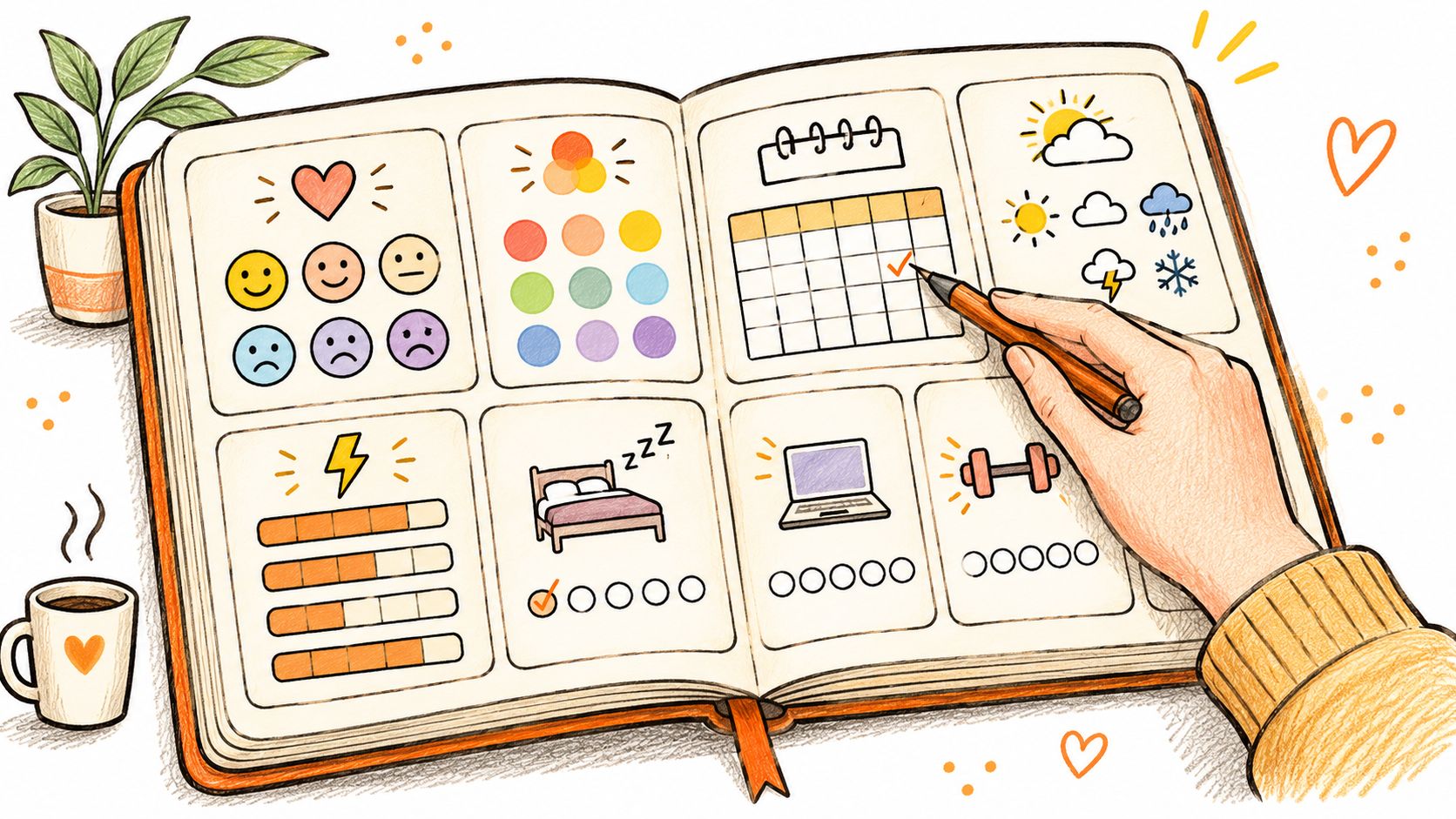
In this article
- 1. Weekly Mood Rating in a Life-in-Weeks Grid
- Why the week wins on sticking power
- 2. Quick Daily Mood Logging with Emoji and Activity Tags
- What users actually ask for
- 3. Mood-Tagged Photo and Text Journal
- The three-part entry that survives
- 4. Year-in-Pixels Mood Heatmap
- What completion actually looks like
- 5. Mood and Symptom Correlation Tracking
- Correlation is not a cause
- 6. Mood Meter Emotional Check-In
- Why vocabulary improves the record
- 7. Gratitude and Mood Journaling
- Keep it specific and dated
- 8. Thought and Mood Record (CBT-Style Journaling)
- The four columns that matter
- Mood Tracker Methods at a Glance
- Pick One Method, Give It Four Weeks
The most common advice about mood tracking is to log every day and let the data pile up. That advice is why so many trackers get abandoned by February. A daily log asks for a decision every 24 hours while the payoff arrives weeks later, and a habit with front-loaded effort and delayed reward rarely survives a busy month.
Mood tracking sticks when the method matches the time you have and the question you want answered. Someone managing migraines needs a different tool from someone who wants to remember what their thirties felt like. The unit of time matters as much as the method. Daily entries capture texture, weekly entries capture meaning, and meaning is what you can still describe a month later.
Most mood tracker ideas content stops at naming apps. This isn't that. These are eight methods with the costs stated up front: minutes per entry, the kind of pattern each one reveals, and the specific conditions under which each one stops working. If you want the market context first, browse mental wellness app statistics before you download anything else.
1. Weekly Mood Rating in a Life-in-Weeks Grid
Tim Urban's 'Your Life in Weeks' post on Wait But Why in 2014 turned a lifetime into a grid where each box stands for seven days. Once a week is a visible unit, rating it is a small step, and it's the most durable form of mood tracking I recommend to anyone who has already quit a daily app.

The mechanics are simple. Pick a fixed day, usually Sunday evening, and give the week a rating or a one-word label. Add one sentence about what happened. The rating and the sentence stay in the same cell, so six months later you're reading a mood next to the event that produced it instead of staring at a bare number.
Why the week wins on sticking power
A day is too small a unit to describe truthfully. Ask someone how Tuesday the 14th felt and you'll get a shrug. Ask how that week went and the answer arrives with a story attached. A week also absorbs one bad morning without dragging the whole record down, which matters if you're prone to reading your own data as evidence of failure.
- Fix the day. Sunday evening works because the week is closed and the next one hasn't started.
- Write the sentence before the rating. Context first keeps the score honest.
- Use a five-point band, not a decimal. Precision you can't repeat is noise.
- Review every three months. Patterns that survive a season are the ones worth acting on.
The honest limit: a weekly rating smooths over a sharp two-day crash. If you're tracking medication response or a rapid mood shift, weekly is too blunt and you need a daily layer underneath.
The record works best when mood sits alongside a weekly entry with notes and images, because the picture does the remembering for you.
2. Quick Daily Mood Logging with Emoji and Activity Tags
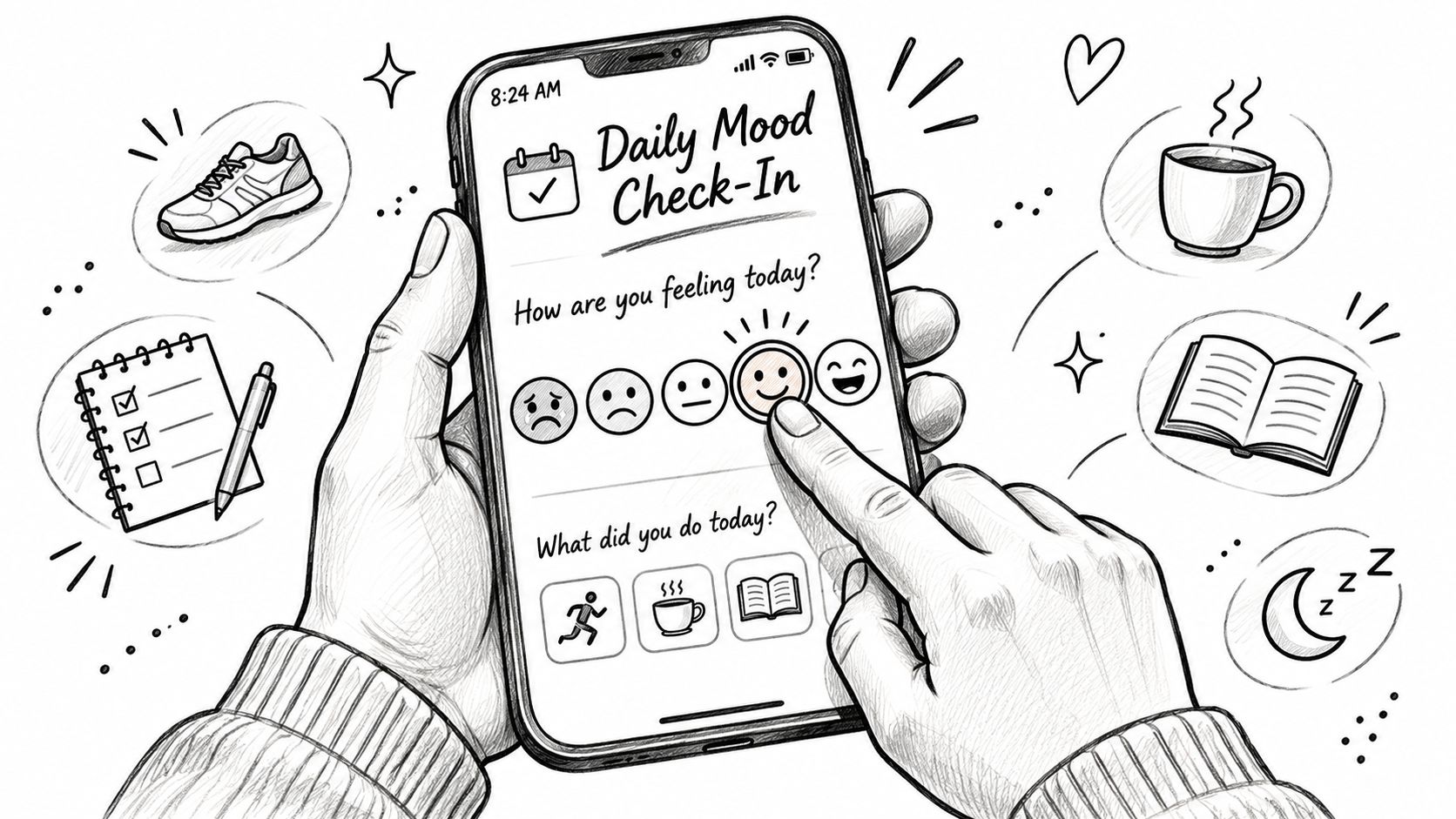
Five seconds is the whole design brief here. You tap an emoji or a five-point face, add a tag or two such as work, gym, or dinner with friends, and close the app. Daylio built a following on exactly this: emoji mood buttons, activity icons, and a chart view at the end of the month.
The setup is minimal. The tags do most of the work, because a bare mood score tells you Thursday was bad, while a mood score tagged with "slept badly" and "deadline" starts to suggest why.
What users actually ask for
A neutral review of 1,803 mood-app reviews found that people valued personalization, intuitive interfaces, and the ability to represent complex, fluctuating moods, while more than 20% of reviews identified areas needing improvement (the review of 1,803 mood-app reviews). Interview research with 22 mood-app users found a preference for simple data-entry screens, paired with a wish for customizable links between moods, triggers, and context.
That combination is the design constraint. Keep the entry fast, then let tags carry the nuance.
- Hold the scale at five levels. Seven or ten options slow every tap and add nothing you'll use later.
- Cap tags at 10 to 15. Beyond that you start inventing categories mid-entry and the categories stop matching.
- Anchor the reminder to an existing habit. After brushing your teeth beats a random 3 p.m. ping.
- Let a day go missing. A gap costs you one data point, and the guilt about it costs you the habit.
The trade-off is granularity without meaning. Thirty days of emoji gives you a trend line, not an explanation. Pair the log with a weekly note and the trend line gets a plot.
3. Mood-Tagged Photo and Text Journal
If a bare rating feels thin, attach the afternoon to it. A photo, a sentence, and a mood label in one entry give you three routes back into the memory: the image, the words, and the feeling. Day One has supported photos, mood tags, and location data for years, and that combination is why people keep photo journals for decades while abandoning spreadsheets.
The three-part entry that survives
- One photo. Not an album. The single best frame from the day or the week.
- One sentence. What happened, plainly, without performing.
- One mood label. Applied to every entry, or the filter you build later won't work.
The failure mode is obvious. You take eleven photos, write nothing, and end up with an unsearchable camera roll. Discipline beats volume. A week with one labeled photo and one line is worth more than a week with forty images and no mood attached.
Photos age better than ratings. A mood label alone tells you March was hard. The photo on the same page tells you it was the month you moved.
Mood labels earn their keep at review time. Scroll back a year, filter for low weeks, and you're looking at the ones you'll want context for. That review is where a diary with photos does something a text log can't, because the picture triggers recall the words alone won't reach.
The cost is real. This is the slowest method on the list, often five minutes per entry, which is why it suits people who already take photos and dislike long writing. Skip it if you won't open a camera during a normal Tuesday.
4. Year-in-Pixels Mood Heatmap
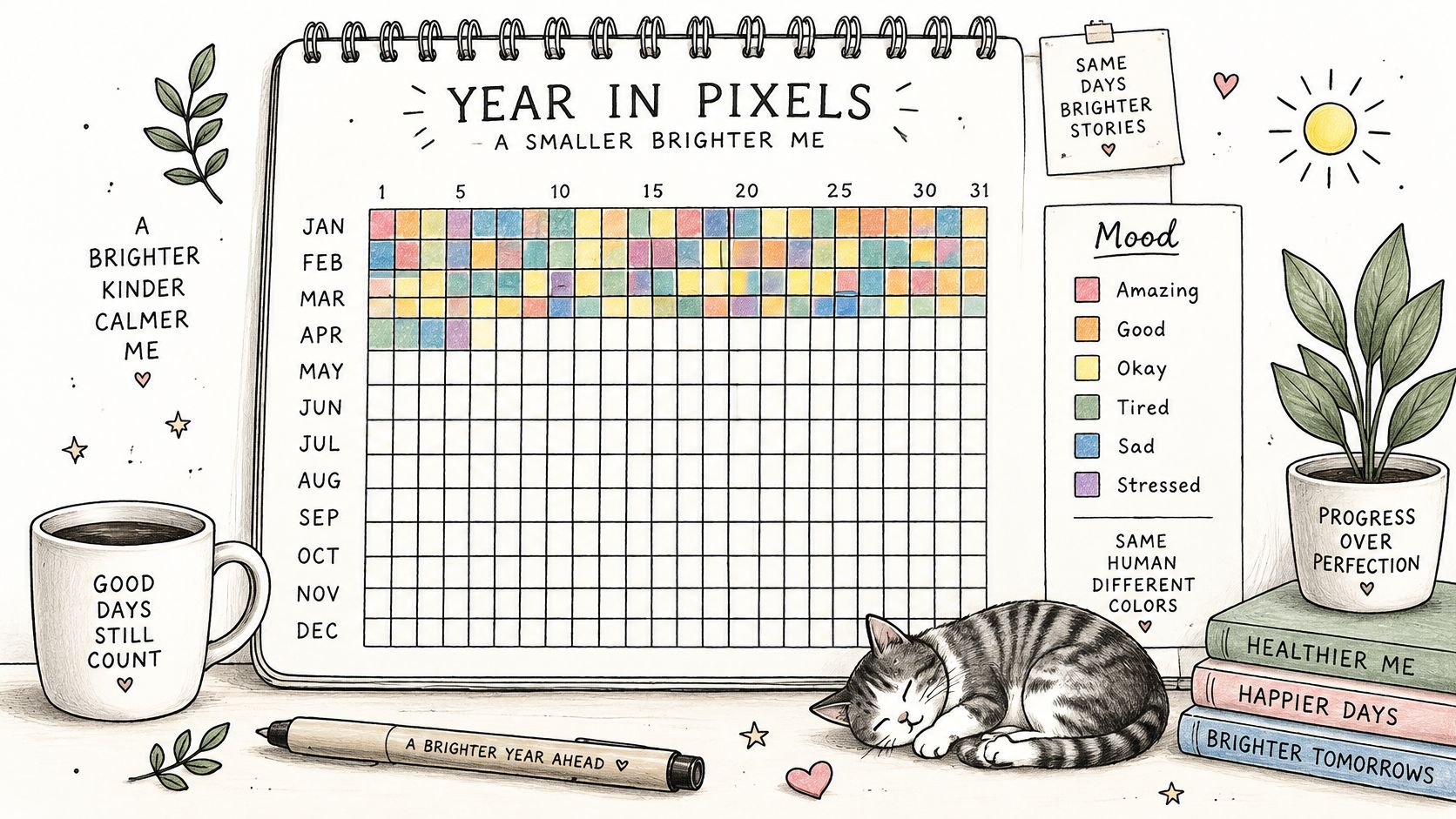
Picture a grid of twelve columns and thirty-one rows, one square per day, one color per mood. Fill a square each night. By December you have a single page showing the shape of the year, and you can find the bad stretch in September without reading a word. Daylio's yearly view renders the same idea automatically.
The paper version is the one people finish.
What completion actually looks like
Daily capture works when each entry is short. An ecological momentary assessment study of 16 older adults with mild cognitive impairment recorded 86.8% adherence across 404 of 448 delivered surveys, with each survey averaging 2.21 minutes (the ecological momentary assessment report). A separate 28-day student study cited in the same report reached 72.8% adherence with entries finished in under 45 seconds, and participation declined as the study went on.
Two lessons for a heatmap. Keep the daily action under a minute, and expect the streak to erode. The grid makes gaps visible, which is good for data and corrosive for morale.
- Use four or five colors, no more. A twelve-shade key becomes a nightly decision.
- Write the legend down. Keep it identical across years or the comparison is worthless.
- Backfill without judgment. A square colored in on Saturday still beats an empty one.
- Treat an empty day as a value. A legend entry for "no record" keeps gaps honest instead of guessed.
5. Mood and Symptom Correlation Tracking
Use this method when the question is narrow: what keeps making this worse? Log mood beside sleep, medication, headaches, cycle, alcohol, or exercise. Bearable is built for exactly this kind of pairing. After a month you can see whether low mood clusters after poor sleep, or whether the thing you assumed was stress lines up with caffeine.
The discipline is choosing variables before you start. Five to seven is the ceiling. Every extra field adds friction to every entry, and the correlation you find at week six is usually visible at week four on three variables. In a life-in-weeks grid, color the week for the suspected pattern and attach a card naming the trigger, so the finding stays visible later instead of disappearing into a daily log.
Correlation is not a cause
Interpretation is harder than tooling. Passive phone and wearable signals such as movement, location, and sleep are being studied for mood prediction, but a strong model inside one research setting still does not prove that your bad Wednesdays are caused by your Tuesday commute.
Self-report carries its own distortion, and passive data raises questions about who owns the record and who can see it.
- Change one variable at a time. Alter sleep and caffeine together and you've learned nothing.
- Record uncertainty. A "mixed" or "not sure" entry prevents false patterns.
- Give a pattern four weeks. Fewer points than that and you're reading noise.
- Bring the export to an appointment. A clinician can interpret what you shouldn't conclude alone.
Anyone tracking a specific condition should start with migraine logging advice from Relief, where the variables and the timing of entries are already worked out.
6. Mood Meter Emotional Check-In
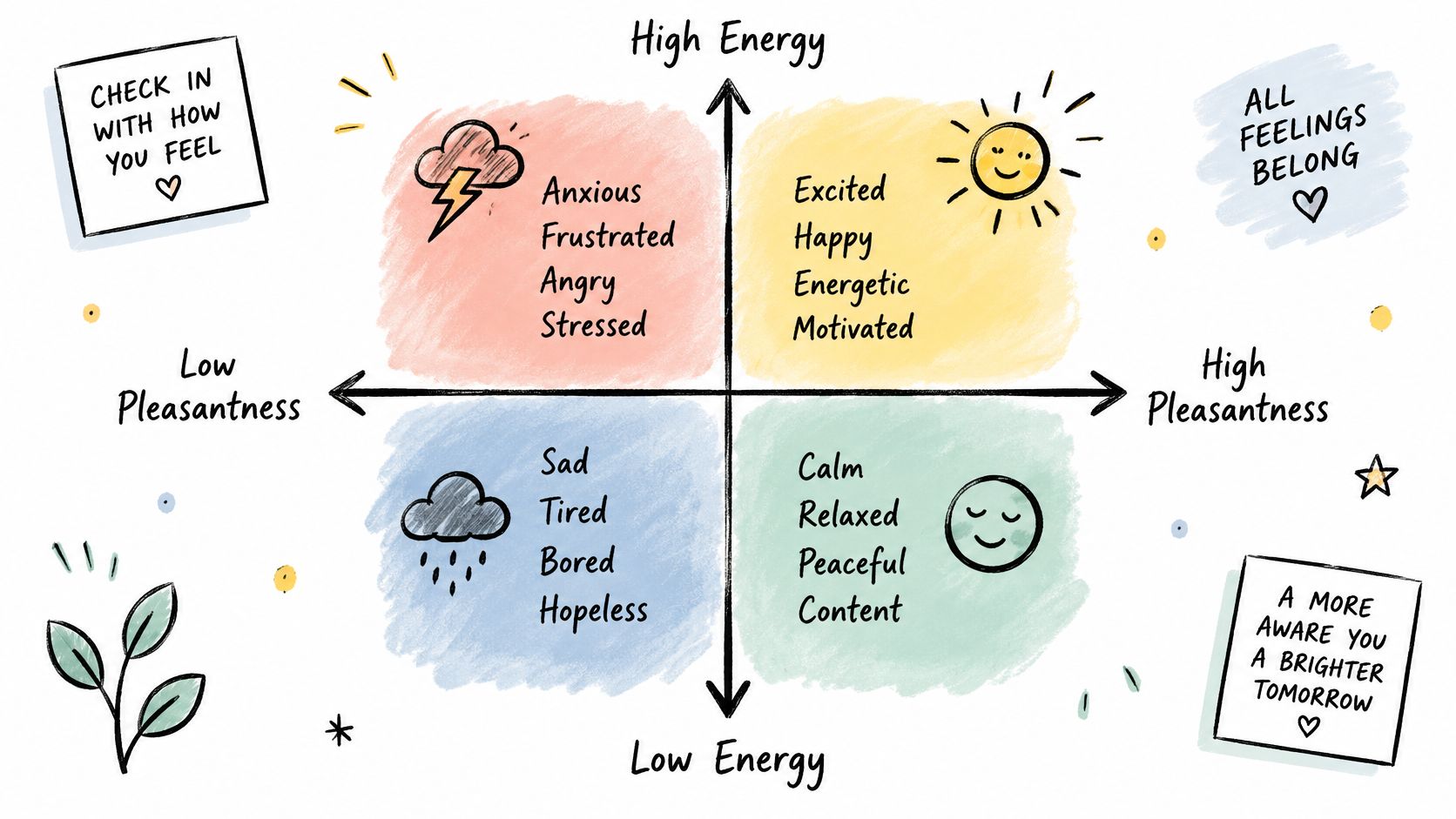
Most mood scales collapse everything into good or bad. The RULER Mood Meter, developed at the Yale Center for Emotional Intelligence and used in schools, splits feeling across two axes: energy and pleasantness. You locate yourself on the grid, then name the emotion precisely. "Irritated" and "discouraged" both sit in the unpleasant half, but one is high-energy and one is low, and they call for different responses.
Why vocabulary improves the record
A label like "bad week" is unusable at review time. A label like "restless and flat" tells you what to change. The Mood Meter's real product isn't the chart, it's the vocabulary, and that vocabulary takes a few weeks to build before it feels natural.
- Record the quadrant and the word. Pleasantness and energy separately, then the specific emotion.
- Print the grid. Keep it next to the journal so you're not recalling the axes from memory.
- Follow one word across weeks. If "overwhelmed" appears four weeks running, that's your finding.
Practical rule: if you can only name the emotion after ten seconds of thought, write the quadrant and move on. Precision you manufacture on the spot isn't data.
The trade-off is friction. Two axes plus a word is slower than tapping a face, and on a hard day that extra thinking is the last thing you want. Use it weekly rather than daily. For more formats at that weekly scale, there are worked mood tracker examples worth copying.
7. Gratitude and Mood Journaling
Gratitude journaling has a reputation problem, and it's earned. Prompted gratitude with no room for a bad day produces entries that read like a hostage statement, and the mood rating next to them turns unreliable. The version that holds up keeps both. Rate the week, then name three specific good things that happened anyway.
The Five-Minute Journal, created by Alex Ikonn and UJ Ramdas, built a widely used format on morning and evening prompts. Structure is why it works. The prompts remove the decision about what to write, so the entry takes minutes instead of becoming a writing project.
Keep it specific and dated
- Three specifics, not three abstractions. "The neighbour took the bins out" beats "my health".
- Rate the mood first. Otherwise the gratitude list rewrites the week in hindsight.
- Reread at month end. The list from a hard month is the one worth reviewing.
- Don't force it. A blank gratitude line next to an honest low rating is a valid entry.
The failure mode is mood laundering. If every week ends with three cheerful items and a seven out of ten, the tracker stops recording your life and starts recording a performance. Two grateful lines in a bad week is a better data point than five in a good one.
This method pairs naturally with a weekly grid, because the gratitude notes give each week content worth returning to while the mood rating keeps the record truthful. Cost is roughly five minutes a week, which makes it the easiest entry here to run alongside another method.
8. Thought and Mood Record (CBT-Style Journaling)
The thought record comes from cognitive behavioral therapy, and it's the most structured method on this list. You write the situation, the mood it produced and its intensity, the automatic thought that arrived with it, and a more balanced alternative. David D. Burns popularised the daily mood log in 'Feeling Good' (1980), and the format hasn't changed much because it works.
The four columns that matter
- Situation. Facts only, no interpretation.
- Mood and intensity. Rate it 0 to 100 so entries stay comparable across months.
- Automatic thought. The sentence that ran through your head, verbatim.
- Balanced thought. What a fair observer would say, not a positive reframe.
Use it selectively. A thought record for every low moment becomes a second job, and the payoff comes from a handful of well-examined events rather than a complete archive.
Frequency isn't free, and more isn't automatically better. A 2025 systematic review and meta-analysis covering 77 quantitative studies found that 15 of them (19%) reported adverse events, with the strongest estimate suggesting about 2% of people with depression or bipolar disorder experienced a lowering of mood while monitoring (JMIR Mental Health). The same review found the most common barrier was time burden or technical problems, named in 9 of 24 studies (38%).
Tracking is a reflection tool, not a treatment. If a record leaves you worse two weeks running, pause it and talk to a clinician about what the tracking is stirring up.
Keep the practice paired with a weekly summary so entries become a pattern instead of a pile of incidents, and stop when it stops helping.
Mood Tracker Methods at a Glance
Every method trades minutes for meaning. Cost is the second column; payoff is the third.
| Method | Time per entry | Insight depth | Best for |
|---|---|---|---|
| Weekly Mood Rating in a Life-in-Weeks Grid | About two minutes weekly | Broad patterns over months and years | Low-effort emotional tracking over time |
| Quick Daily Mood Logging with Emoji and Activity Tags | A few seconds daily | Basic mood and activity patterns | Fast, consistent daily check-ins |
| Mood-Tagged Photo and Text Journal | About five minutes per entry | Rich context from photos, notes, and mood | Recording meaningful events and memories |
| Year-in-Pixels Mood Heatmap | Brief daily check-in | Visual seasonal and yearly patterns | Seeing mood trends across a year |
| Mood and Symptom Correlation Tracking | A few minutes daily after choosing variables | Detailed relationships across health factors | Identifying patterns and preparing for clinician discussions |
| Mood Meter Emotional Check-In | Brief check-in; some learning required | Nuanced emotional awareness and vocabulary | Naming emotions precisely |
| Gratitude and Mood Journaling | A few minutes per entry | Reflective mood and positive-experience context | Combining mood tracking with gratitude |
| Thought and Mood Record (CBT-Style Journaling) | More time than a simple rating | Detailed links between situations, thoughts, and feelings | Structured reflection on difficult events |
Depth only pays off on entries that happen.
Pick One Method, Give It Four Weeks
The failure pattern is consistent. People start with the most thorough method available, run it for nine days, and quit before any pattern appears. Do the opposite. Choose the single method whose time cost fits your actual week, run it for four weeks, then judge. Four weeks is the minimum where a weekly rating, a tag pattern, or a symptom correlation has enough points to mean anything.
- Under two minutes a week: the weekly rating in a grid.
- About five minutes a week: mood plus photo, or gratitude plus rating.
- A minute a day: emoji logging with tags, or the year-in-pixels grid.
- Ten minutes, occasional: the thought record, used only on notable days.
Then add context. A mood score with no note is a number you'll stare at in eighteen months with no idea what it meant. The note, the photo, the tag, the one sentence about the week, that's the part that makes a rating interpretable later. With it, a low week in March reads as the month the contract fell through. Without it, you're left with an unexplained bad patch and no way to learn from it.
Life Calendar puts that structure in one place. It was inspired by Tim Urban's 'Your Life in Weeks', it's available on the App Store and the Play Store, and each week can hold a mood alongside notes, images, and tags, so the rating and the reason stay in the same box.
Review the grid seasonally. Once every three months, scroll back and look for repetition: the same two months low, the same tag showing up before every flat stretch. That review turns scattered check-ins into something closer to a pattern, and a pattern is the only thing a mood tracker was ever supposed to give you.
Life Calendar is built for exactly the weekly methods above: mark a week with a color, add a mood entry, and attach a note, image, or tag so the rating keeps its context instead of floating alone in a separate app. The grid shows your whole life in weeks, which makes a seasonal review of your low and high stretches something you can see. Visit Life Calendar to see how the week grid works, then set a reminder for Sunday evening and record your first week.