Mood Tracking Calendar: How It Works and What It Reveals
See how a mood tracking calendar stores daily entries, reveals weekly patterns and stays easy to maintain.

In this article
- Why a Dated Mood Record Matters
- How a Mood Calendar Stores Each Day and Week
- Keep observations beneath the summaries
- Make the calculation visible
- Reading Patterns Across Weeks and Months
- Separate the pattern from its explanation
- Review the ordinary and positive stretches too
- Choosing a Calendar Format for Your Routine
- Match the format to your access needs
- Check privacy before sharing
- How to Set Up Your First Two Weeks
- Build a small, consistent record
- Keep reflection separate from treatment
- Keeping Tracking Gentle Without Over-Monitoring
- Notice when documentation becomes self-surveillance
- Use neutral language and leave room for uncertainty
- Start a Two-Week Trial and Review It
- Make a decision about the routine
You've felt low for much of the month, but you can't quite say when it started. Was last week harder, or does it just feel that way today? You remember a difficult conversation and a few better evenings, but not how they fit together.
A mood tracking calendar gives those memories a dated home. It can be as simple as a readable grid, a mood rating, and a short note. The aim isn't to measure every feeling. It's to keep enough context to look back without turning your emotional life into another task to get right.
Why a Dated Mood Record Matters
Say you describe a month as exhausting. Your calendar, however, shows lower moods around a demanding deadline, a lighter stretch afterward, and another dip during disrupted sleep. Those are different accounts: one describes your overall impression, while the other preserves changes within it.
The date is the essential field. A rating without a date tells you how you felt at some point. A dated rating lets you place that feeling beside what came before and afterward.
This approach predates smartphone apps. In a 2011 daily-record study, 55 people with generalized anxiety disorder rated anxious and depressed mood over 21 consecutive days, allowing researchers to examine whether changes in one emotional state preceded changes in another.
A dated record helps you ask what happened when, rather than treating a whole month as one undifferentiated feeling.
For personal use, the same organizing principle is straightforward. Attach your observation to its date, and add enough detail to recognize the circumstances later. A note about an overnight journey may explain why a low entry deserves different consideration from an ordinary workday.
Specialized journals also use this principle. MicroTrack's resource on structured mood logging for microdosing reflection offers context for that particular use, but a dated record shouldn't be read as evidence that a substance caused an emotional change or is safe or effective.
Documentation isn't diagnosis. The diary study establishes a recognized way to observe emotional change, not proof that keeping a personal calendar treats a mental-health condition.
How a Mood Calendar Stores Each Day and Week
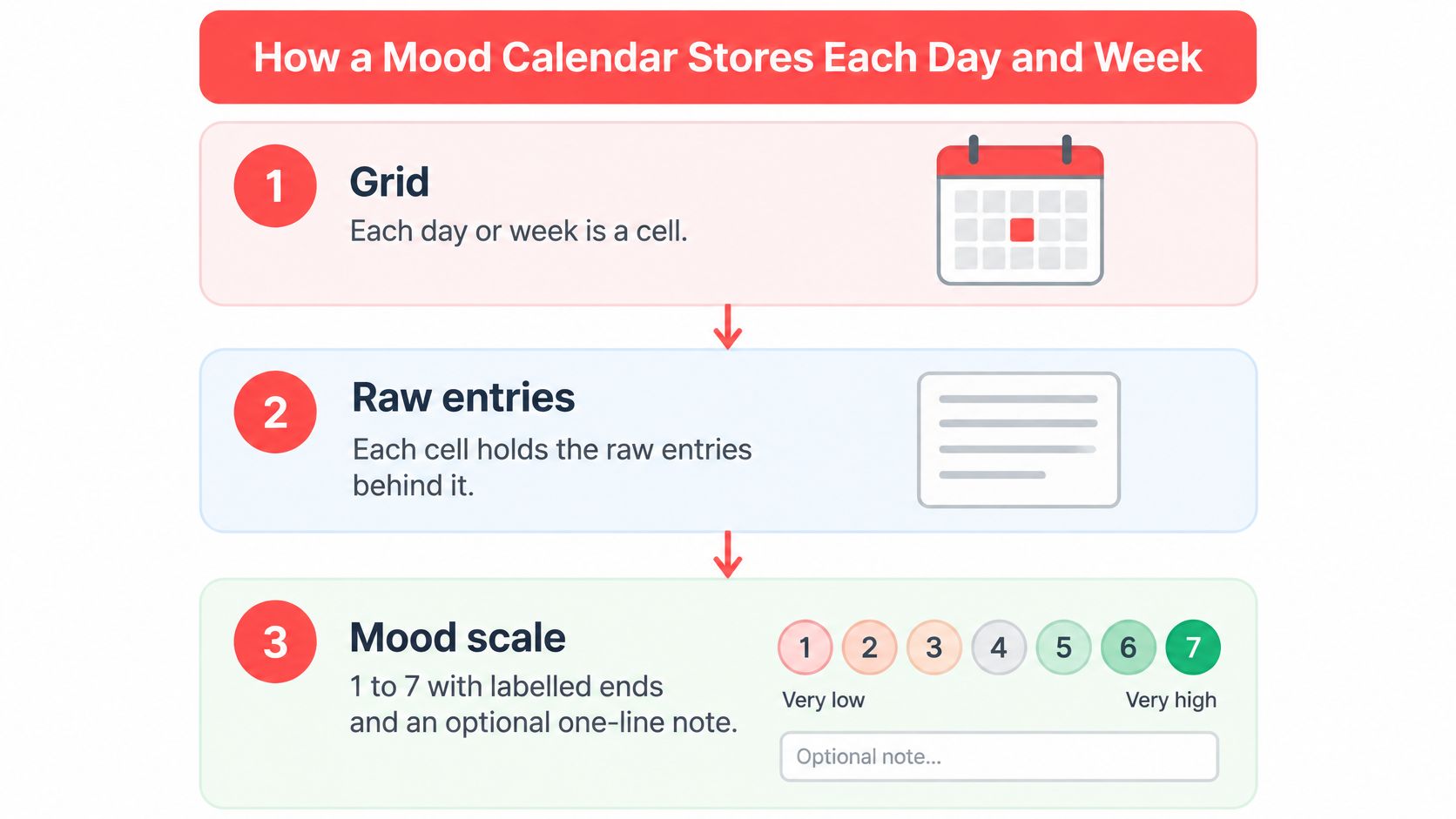
Think of the calendar as a grid with records behind it. Each cell represents a day or week. Its color or number is a shortcut to the underlying entries, not a replacement for them.
For a hypothetical setup, you might use a scale from 1 to 7, with very low and very high as the labeled ends. Decide whether you're recording your mood right now or your impression of the day. Those questions aren't interchangeable, so keep the wording consistent.
Keep observations beneath the summaries
A raw entry holds the timestamp, rating, and optional note. A daily summary combines that day's observations, while a weekly summary makes a broader comparison possible. A monthly view can then display weekly means alongside gaps.
The distinction between momentary measurement and weekly aggregation matters. The ecological momentary assessment protocol describes repeated self-reports in everyday settings, supporting a clear separation between individual observations and summaries calculated from them.
Consider a hypothetical week with ratings of 2 and 6. Their mean is 4, but neither observation was a 4. Keeping the originals lets you see the contrast that an average conceals.
Data layers in a mood tracking calendar
| Layer | What It Holds | Example | Why It Matters |
|---|---|---|---|
| Raw entry | Timestamp, mood rating, optional note | Hypothetical entry: 14 March, 21:10, rating 3, note about sleeping badly | Keeps the original observation intact |
| Daily summary | Average of the day's entries and entry count | Hypothetical ratings of 3 and 5, shown as 4 from 2 entries | Separates days with several check-ins |
| Weekly summary | Mean, range, entry count, and trend | Hypothetical ratings of 4 then 6: mean 5, range 4–6, 2 entries, upward sequence | Makes weeks comparable at a glance |
| Monthly view | Weekly means and number of recorded weeks | Hypothetical month with 3 of 4 weeks recorded | Shows gaps alongside trends |
Make the calculation visible
Here's another hypothetical sample: Monday has a rating of 4, with a note about 5 hours of sleep. Tuesday has a 6, with a note about an enjoyable run. Wednesday is marked not recorded.
If those are the only observations, the weekly cell should say mean 5.0, with 2 of 7 days recorded. It shouldn't imply that every day felt moderately positive.
Also decide how the weekly mean is calculated. Averaging all raw entries gives more weight to days with frequent check-ins; averaging daily means gives each recorded day equal weight. Either approach needs a clear label.
A guide to the life-calendar app format can help you picture a weekly overview. For a quick scan, start with the weekly summary, then open the underlying entries whenever the color or average surprises you.
Reading Patterns Across Weeks and Months
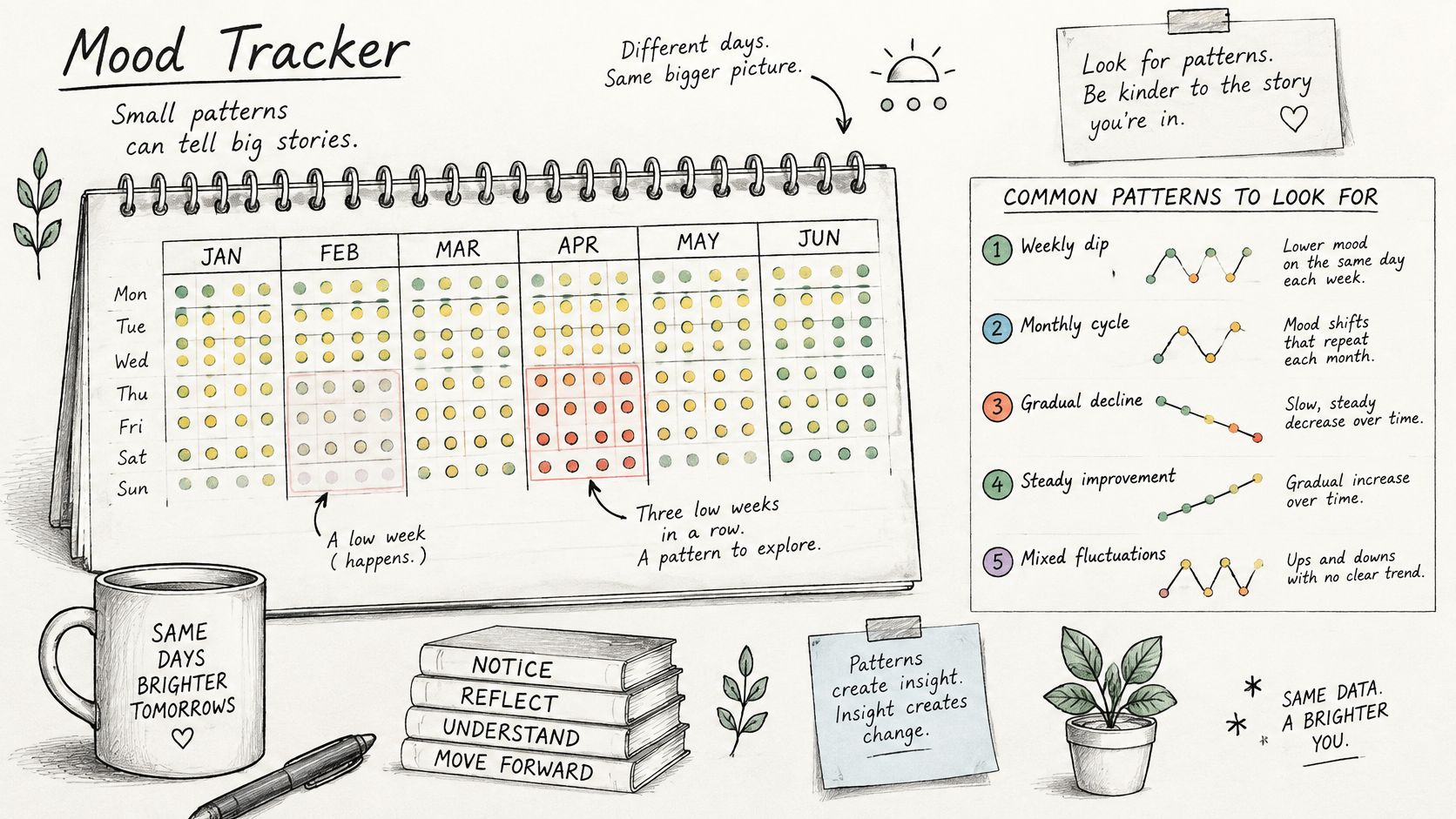
A pattern needs repetition and context. A difficult week is worth acknowledging, but it doesn't establish a recurring cycle. Repeated changes give you something to investigate, not a verdict about why you feel that way.
Start by naming what you can see. Is the average falling? Are certain weekdays repeatedly lower? Or does a fairly ordinary weekly average hide large swings?
Separate the pattern from its explanation
The examples below are hypothetical illustrations, not clinical thresholds.
Common patterns and how to read them
| Pattern | What the Calendar Shows | Example | Read It Cautiously |
|---|---|---|---|
| Weekly dip | Mean falls for several weeks in a row | Weekly means move from 5 to 4 to 3 | Check sleep and workload notes before drawing conclusions |
| Recurring weekday pattern | Similar low ratings on the same weekday | Mondays repeatedly fall below the other recorded weekdays | Confirm it repeats before acting on it |
| Volatility | Wide range inside one week | Range of 1 to 7 within a single week | One extreme rating isn't a trend |
| Event cluster | Notes and low moods share a week | A move and an exam both fall in week 9 | The record shows timing, not cause |
| Steady stretch | Small variation across weeks | Weekly ranges stay within 3 points for 8 weeks | Stability can also mean fewer entries, so check the count |
Suppose, hypothetically, your Mondays average 2.8 across six weeks. Read the Monday notes before deciding that the weekday itself is the problem. You might find late shifts, a recurring meeting, or inconsistent recording times.
That distinction changes your next question. Rather than concluding that Mondays make you unhappy, you could ask whether low Monday ratings tend to coincide with particular demands. You can then watch for exceptions, including Mondays that felt easier.
Review the ordinary and positive stretches too
Looking back needn't focus only on dips. A 2024 Arizona State University report described 413 participants in mood-tracking studies lasting 21 and 28 days, finding that viewing emotional histories was associated with greater persistence of positive emotions.
That finding gives a reason to revisit pleasant periods, without promising that reviewing a calendar will improve everyone's mood. Notes about companionship, rest, or an absorbing activity may be worth remembering in their own right.
For a hypothetical comparison, place one four-week window beside the next. Use the same scale and summary method, and resist treating a sparse, flat-looking period as proof of calm.
Before interpreting a change:
- Count the entries. Check how much of each period you recorded.
- Check the range. Look beyond the average for contrasting experiences.
- Read nearby notes. Consider the circumstances beside lower ratings.
- Compare periods. Look for repetition and exceptions before forming an explanation.
Choosing a Calendar Format for Your Routine
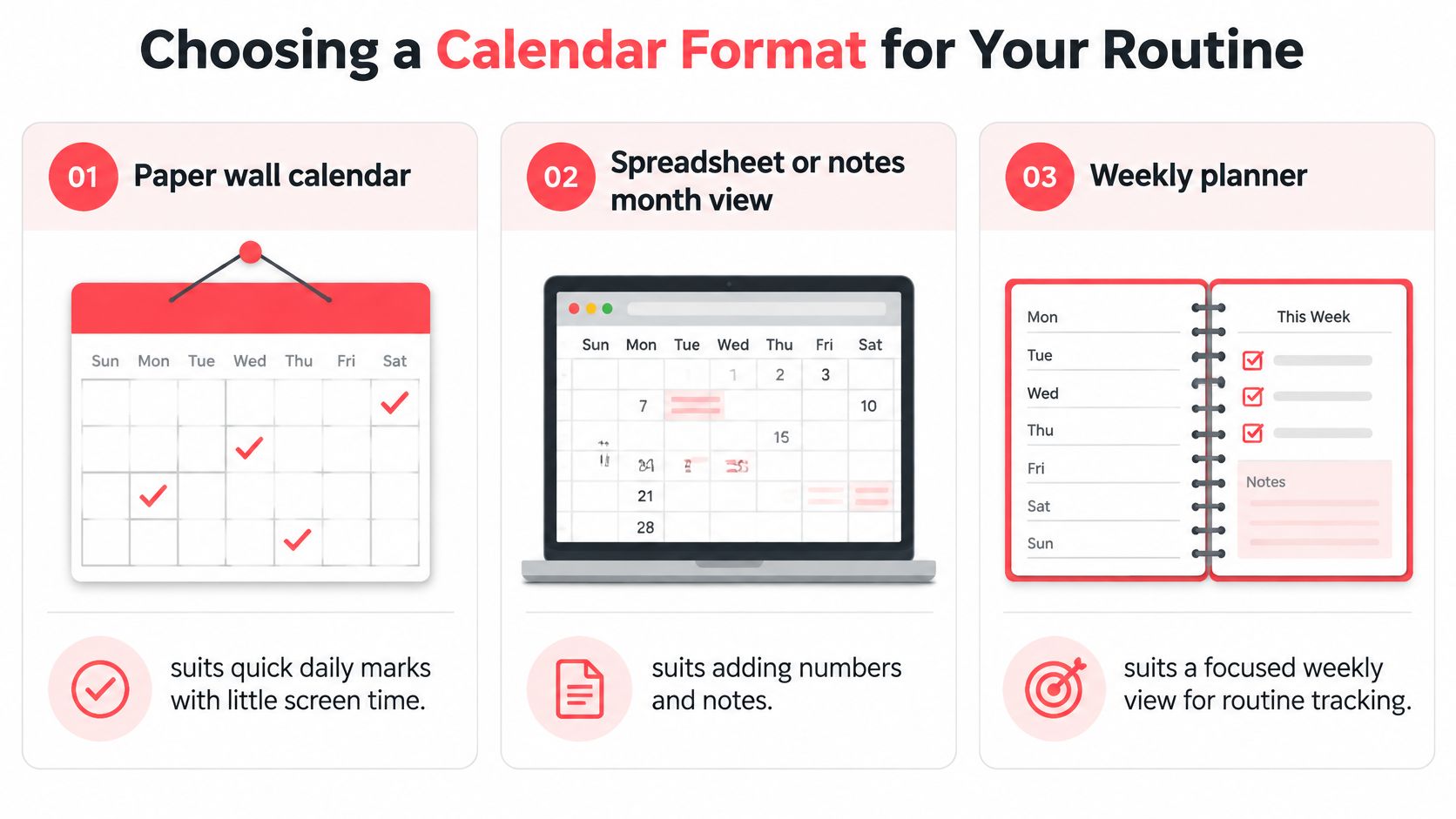
Choose the format around the kind of record you want to keep. A wall calendar makes quick marks visible, while a spreadsheet lets you inspect calculations. A weekly planner gives events more room but less day-by-day detail.
Ease of use matters more than a perfect streak. A format that requires too much typing, reliable connectivity, or constant attention may not fit your circumstances.
Calendar formats compared
| Format | Best For | Entries Per Day | Offline Use |
|---|---|---|---|
| Paper wall calendar | Quick daily marks and low screen time | A colored dot or short word per day | Yes |
| Month view in a notes or spreadsheet app | Adding numbers and longer notes | Several rows per day | Usually yes, if the file is available locally |
| Weekly life-calendar app | Long-view reflection with notes, images, and mood per week | Organized around weekly records rather than a daily quota | Verify offline behavior before relying on it |
| Mood-tracking app with daily prompts | Frequent, timed check-ins | Several prompts per day when configured | Test saving and reopening entries without a connection |
Match the format to your access needs
A 2025 JMIR report described declining participation, with 65.7% of participants still answering questionnaires by study week eight, and cited 66.8% adherence among healthy controls completing daily smartphone self-assessments over nine months. Those findings favor realistic expectations over assuming a complete record.
Look for readable text, controls you can comfortably select, and mood words that make sense to you. If typing is difficult, a short label may be preferable to a long journal prompt. The Android journal-app guide offers another starting point for considering writing-focused formats.
With Life Calendar, we organize life into weekly boxes that can hold notes, images, mood, and tags. Some people use it as a personal diary; others use it to keep their past and future in perspective. Our default week start depends on your birthday and changes from year to year for most users, but you can choose a fixed start under Settings > Grid Appearance > Week Start.
Check privacy before sharing
For any digital format, establish where entries are stored, whether they sync to a cloud account, and who can access that account. Before sending an export, inspect it for private notes, photographs, and information about other people.
Selection rule: Pick the format you can imagine still using during a busy, distracted week, not just the one you're enthusiastic about today.
How to Set Up Your First Two Weeks
Treat the first fortnight as a usability trial, not a test of discipline. You're finding out whether the record is clear enough to revisit and light enough to maintain.
Configurable prompts are a safeguard, not merely a convenience. A 2025 systematic review covering 77 eligible studies reported mood lowering associated with monitoring in approximately 2% of people with depression or bipolar disorder, while noting that adverse events were underreported.
Build a small, consistent record
The following is a suggested setup, not a validated monitoring schedule.
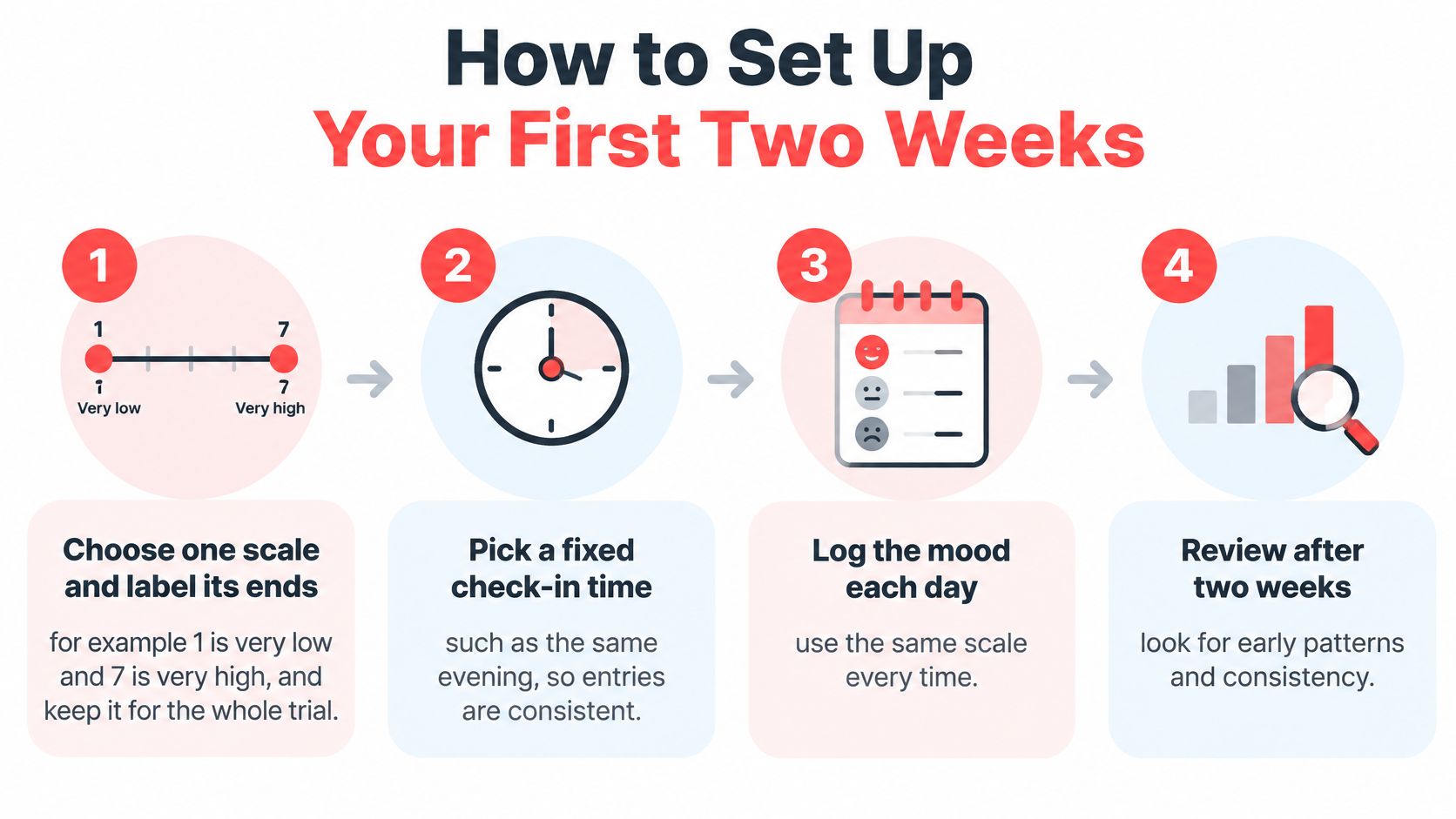
Choose a scale and label its ends. For example, use 1 for very low and 7 for very high throughout the trial. Keeping the same meanings prevents a change in scoring from looking like a change in mood.
Pick a regular check-in time. An evening check-in may fit beside an existing routine. A consistent time reduces avoidable differences between, say, a rushed morning rating and a relaxed late-night rating.
Record the rating before writing. Add at most a short line about sleep, a main event, or another relevant detail. You don't need to explain or justify every feeling.
Mark skipped days as not recorded. Don't reconstruct them unless you have a contemporaneous record to use. An explicit gap is more honest than a guessed rating.
Make reminders optional. Try a daily or weekly prompt only if it helps; as a practical trial rule, reduce it after ignoring it for several consecutive days. The reminder should serve your routine, not demand compliance.
Review after the fortnight. Look at coverage before interpreting weekly averages. For a hypothetical daily-entry trial, 10 entries across 14 days could be a personal completeness target, but it isn't a clinical cutoff and fewer entries aren't a failure.
Keep reflection separate from treatment
If writing feels unfamiliar, a practical guide to starting a journal can help you keep notes brief and concrete. Avoid expanding the record into a long questionnaire unless there's a clear reason.
If you're working with a therapist on depression, Uptown Psychology's structured depression exercises for guided therapy may provide a separate resource to discuss with them. A calendar can hold observations for that conversation, but it doesn't replace guided therapeutic work.
A usable first fortnight has dated cells, consistent labels, and recognizable notes. It doesn't need an elaborate explanation for every day.
Keeping Tracking Gentle Without Over-Monitoring
More logging isn't automatically better. The systematic review of mood-monitoring experiences identified negative psychological effects among a small number of users and emphasized underreporting and inconsistent study designs; it also reported 64% pooled adherence, with reminders associated with lower adherence and higher attrition, although possible confounding limits that interpretation.
That isn't a reason to assume tracking is harmful. It's a reason to pay attention to your experience of doing it, rather than assuming frequent entries must be beneficial.
The trade-off is personal: you may gain useful context, or you may start scrutinizing every fluctuation. A record becomes less useful when maintaining it leaves you more preoccupied with your mood than with living your day.
Notice when documentation becomes self-surveillance
Pay attention to changes in how you use the calendar:
- Rumination. You repeatedly reopen an entry to work out exactly why you felt low.
- Self-judgment. A low rating feels like evidence that you've failed.
- Compulsive checking. You consult the chart before deciding how you feel.
- Pressure to improve. You choose a higher rating because you want the calendar to look better.
You don't need to wait until these reactions become severe before adjusting the routine. Turn off prompts, stop reviewing charts for a while, or replace ratings with a brief weekly reflection.
A single word may be enough on a hard day. You can also pause for a fortnight and notice whether the break feels relieving. These are options for reducing burden, not treatment prescriptions.
You're allowed to have an experience without recording it.
Use neutral language and leave room for uncertainty
Describe a rating as low, rather than calling it a bad day. A difficult feeling can coexist with a meaningful conversation or a worthwhile activity. Your calendar doesn't need to flatten those experiences into a judgment.
Treat missed entries as a limitation of the record, not a character flaw. They might coincide with stress, limited time, access problems, or just forgetting. Unless you recorded the reason, leave it unknown rather than assigning meaning to the gap.
Seek professional support if low mood persists, daily functioning becomes difficult, or a pattern concerns you. You don't need a complete calendar or a convincing chart to ask for help.
If you have thoughts of self-harm, seek prompt support from a qualified professional or a local crisis service. If you might act on those thoughts or can't stay safe, contact local emergency services or go to the nearest emergency department. Don't wait for a calendar review to confirm that you deserve support.
Start a Two-Week Trial and Review It
Choose a format that fits your ordinary routine, then settle on a clearly labeled scale. Use the suggested fortnight as an experiment in gentle documentation, with permission to skip, simplify, or stop.
At the end of the trial, review the calendar rather than grading yourself. Count the observations, inspect the weekly means and ranges, and read the notes beside any dip. If events cluster around a lower period, write down the association without declaring a cause.
Make a decision about the routine
Choose the outcome that fits your experience:
- Keep it. Continue if the record feels useful and manageable.
- Reduce it. Use the lighter weekly or word-only options if daily recording feels intrusive.
- Pause it. Take a break if tracking increases preoccupation or distress.
A short trial produces questions to explore, not conclusions about your mental health. A worrying or persistent pattern belongs in a conversation with a qualified professional, regardless of how tidy the record looks.
Your next action can stay small: set up tonight's entry, choose a review date, and turn off any prompt you don't need. The successful outcome is a record that helps you remember your experience without making you feel accountable to a chart.
Life Calendar offers a weekly grid with notes, images, mood, and tags, so you can keep emotional observations beside the experiences they belong to. Visit Life Calendar to explore the format and download it from the App Store or Play Store, then create your first weekly record at your own pace.