Format of Diary Entry: Structure, Layouts and Examples
Learn the format of diary entry: date, greeting, body, closing and signature, plus layouts for daily, weekly and reflective diary entries.
In this article
- The Six Parts of a Standard Diary Entry
- How to Write the Body of a Diary Entry
- Three Common Layouts Compared by Writing Purpose
- Writing an Entry for Emotional Processing
- Mixing Structured Fields with Free Writing
- Privacy and Input Choices for Sensitive Entries
- Choose a Format and Write Your First Entry
The page is open, the date is written at the top, and the next line is where many writers stall. You've decided to keep a diary, you have a notebook or an app in front of you, and you're not sure whether to start with "Dear Diary," whether to describe the whole day, or whether any of it matters.
What makes the format of a diary entry easier is that it isn't a rulebook. It's a set of parts you assemble for a purpose, and the purpose is nearly always the same. You're writing something down now so that a version of you, six months or six years from now, can find it and understand it. Every decision about layout comes back to two questions. Will future you be able to retrieve this? And is this safe to write where I'm writing it?
A date, a body, a reflection. Each part does a job. Add the ones that do work for you, skip the ones that don't, and don't feel obliged to keep a greeting that makes you cringe every time you write it.
The Six Parts of a Standard Diary Entry
A standard diary entry is a dated, first-person record, which is the whole definition and the reason every other part is optional. The six-part format set out by My Diary Journal runs from a date at the top to an optional signature at the bottom, and it's worth seeing all six in one place before you trim anything.
| Element | Purpose | Example |
|---|---|---|
| Date | Anchors the entry in chronological time | 14 March 2026 |
| Day and time | Adds when the events happened | Saturday, evening |
| Greeting (optional) | Sets a personal, diary-style address | Dear Diary, |
| Body | Recounts events, conversations and feelings | Met Ana for lunch; she told me about the job offer |
| Closing thought (optional) | Records the main reflection | I want to say yes, but I am not sure yet |
| Signature (optional) | Marks the entry as personal | Mira |
The date earns its place in every format. It anchors the account in time, so a page written in March still makes sense in November without any caption. Take the date away and you have a block of prose with no sequence to it.
Day, time and location add resolution. "Saturday, evening, kitchen table" answers questions the date can't. It's a small addition that pays off when two similar days sit side by side and you need to tell them apart.
The greeting sets the voice. "Dear Diary," signals that this page is the personal register rather than a report. If it feels like a costume, leave it out. The format treats it as optional, and so should you.
The body carries nearly all the value. It mixes four jobs: recounting what happened, describing conversations or observations, expressing emotion, and reflecting on what the experience meant.
A closing thought and a signature finish the page. One sentence of reflection tells future you what the day added up to, and the signature marks the entry as yours. Drop both and it's still a diary.
Here's the whole thing assembled:
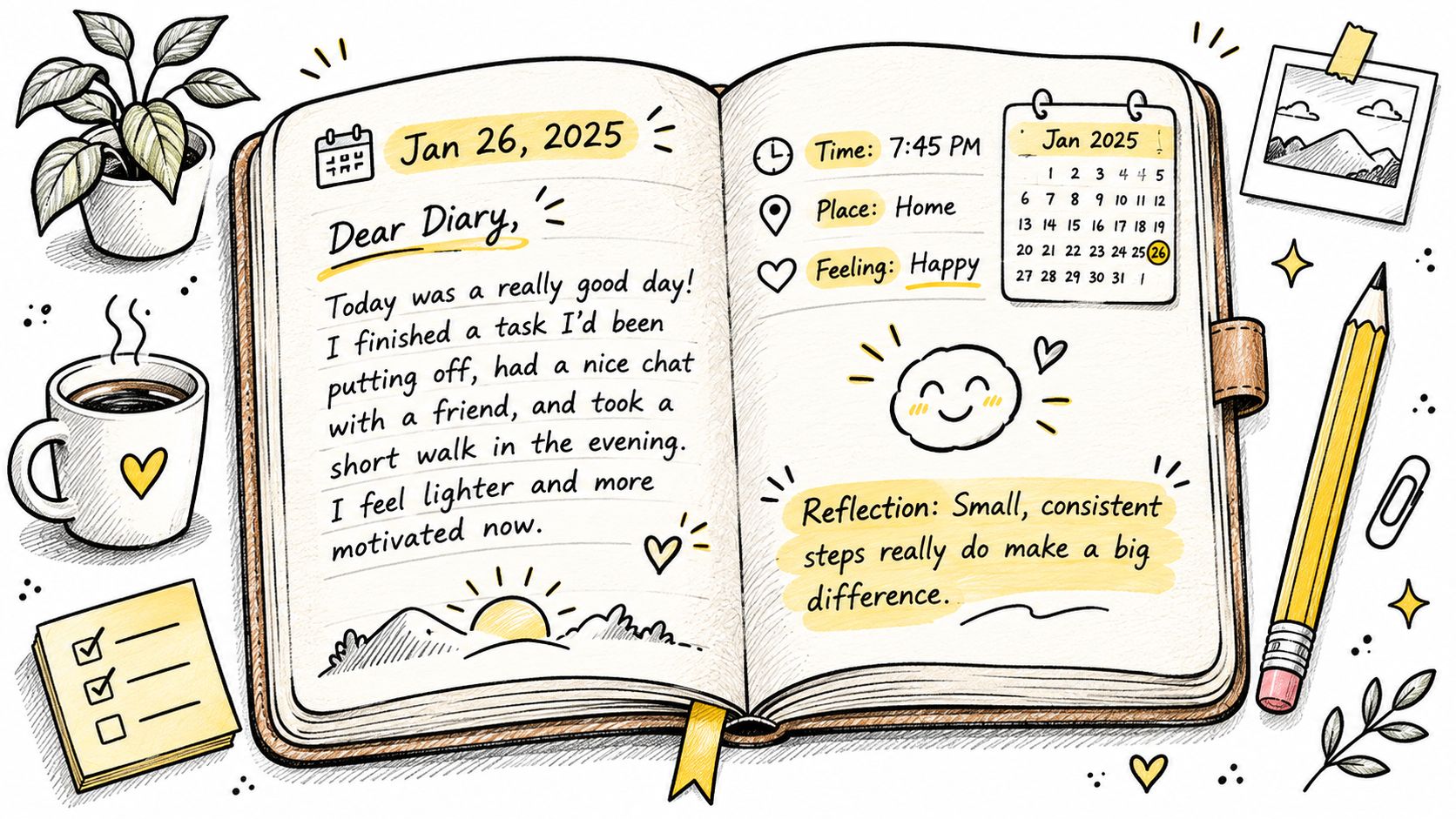
14 March 2026, Saturday evening Met Ana for lunch at the place on Elm Street. She told me about the job offer and I talked more than I listened. I want to say yes to my own thing too, but I'm not sure yet. Mira
Decide now which optional parts you'll use, and then keep the date in every entry you write. That one habit does more for the record than any other.
How to Write the Body of a Diary Entry
The body is the part new diarists get wrong most often, and the failure is nearly always the same one: it turns into a summary of the day instead of a record of anything. Two lines saying "work was busy, then I went home, then I watched something" leave future you with nothing to hold on to.
A body worth rereading does five things. Run them in order each time, and the page almost writes itself.
The five steps below are the sequence to hold in your head as you draft.
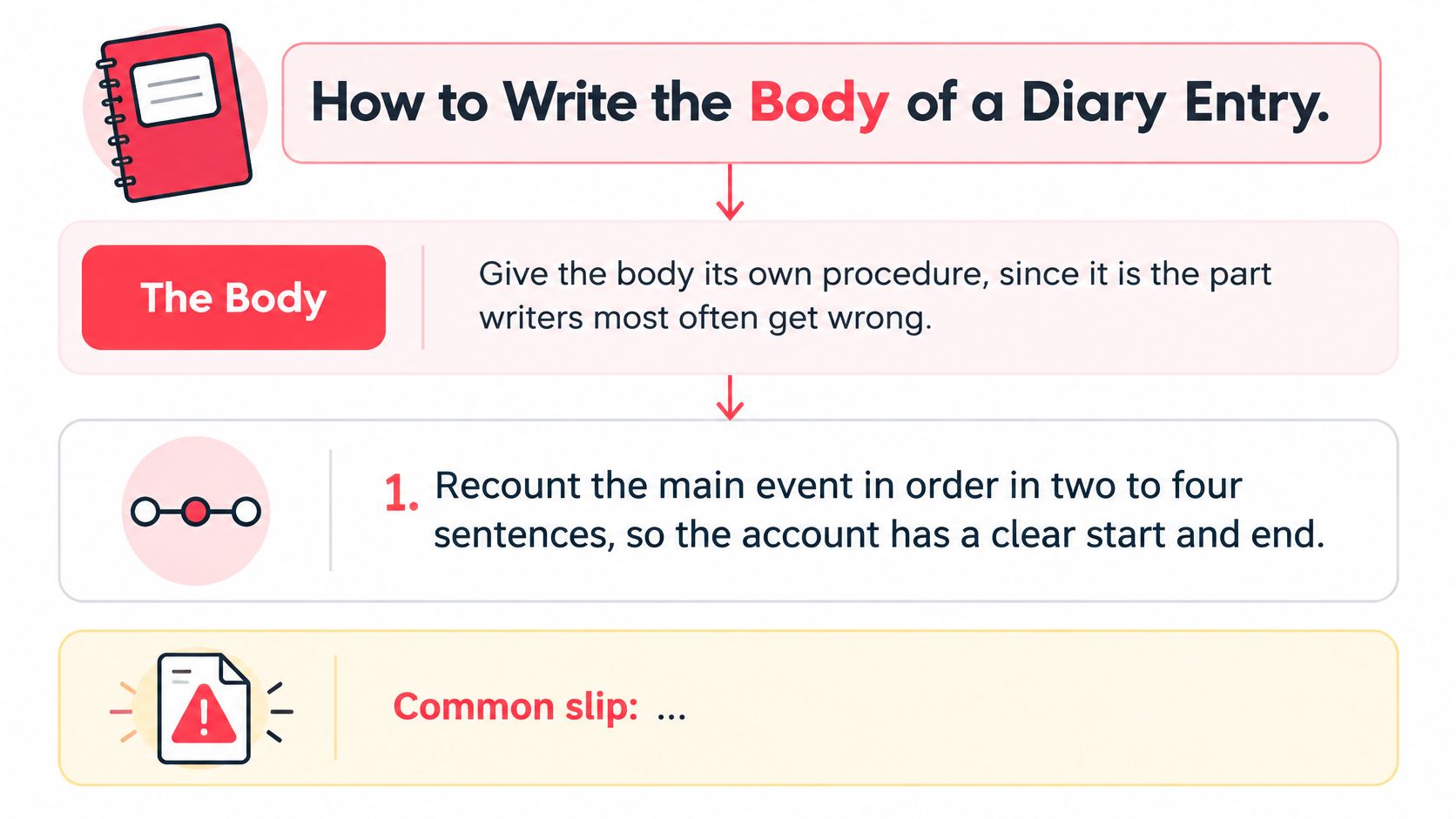
Recount one main event in order. Two to four sentences with a clear start and end. The reason is simple: a single event with a beginning and a finish is retrievable, while a timetable of the day isn't. Common slip: summarizing everything from breakfast to bed.
Add the people and the lines you remember. Quote a line word for word when you can, because named details and exact phrases are what later recall searches for. "Maya said she'd been waiting two weeks for an answer" beats "we talked about it."
Name the emotion in plain words. Tired, relieved, annoyed, flat. "It was fine" records nothing about how the day felt, and mood is the one thing only you can supply.
Write one reflection sentence. Why did it matter, or what changes next? This is the step that turns a log into a diary, and it's the step most often skipped. Common slip: ending on a fact instead of a meaning.
Check your tenses. Past for what happened, present for how you feel as you write. Mixing them isn't a crime, but be deliberate about it so the entry reads as a record rather than a tangle.
Here's a body built from those five moves:
Maya called at six and we argued about the flat deposit again. She said, "You always decide first and tell me after," and she was right. I went quiet, apologized, and we agreed to look at two places together on Sunday. I felt relieved once it was out in the open. I've been avoiding that conversation for a week, and saying sorry took less courage than I expected.
The last sentence is step four. The one before it is step three, the quoted line is step two, and the opening three sentences are step one. Write only these five moves for a week and the habit will hold without any further system.
Three Common Layouts Compared by Writing Purpose
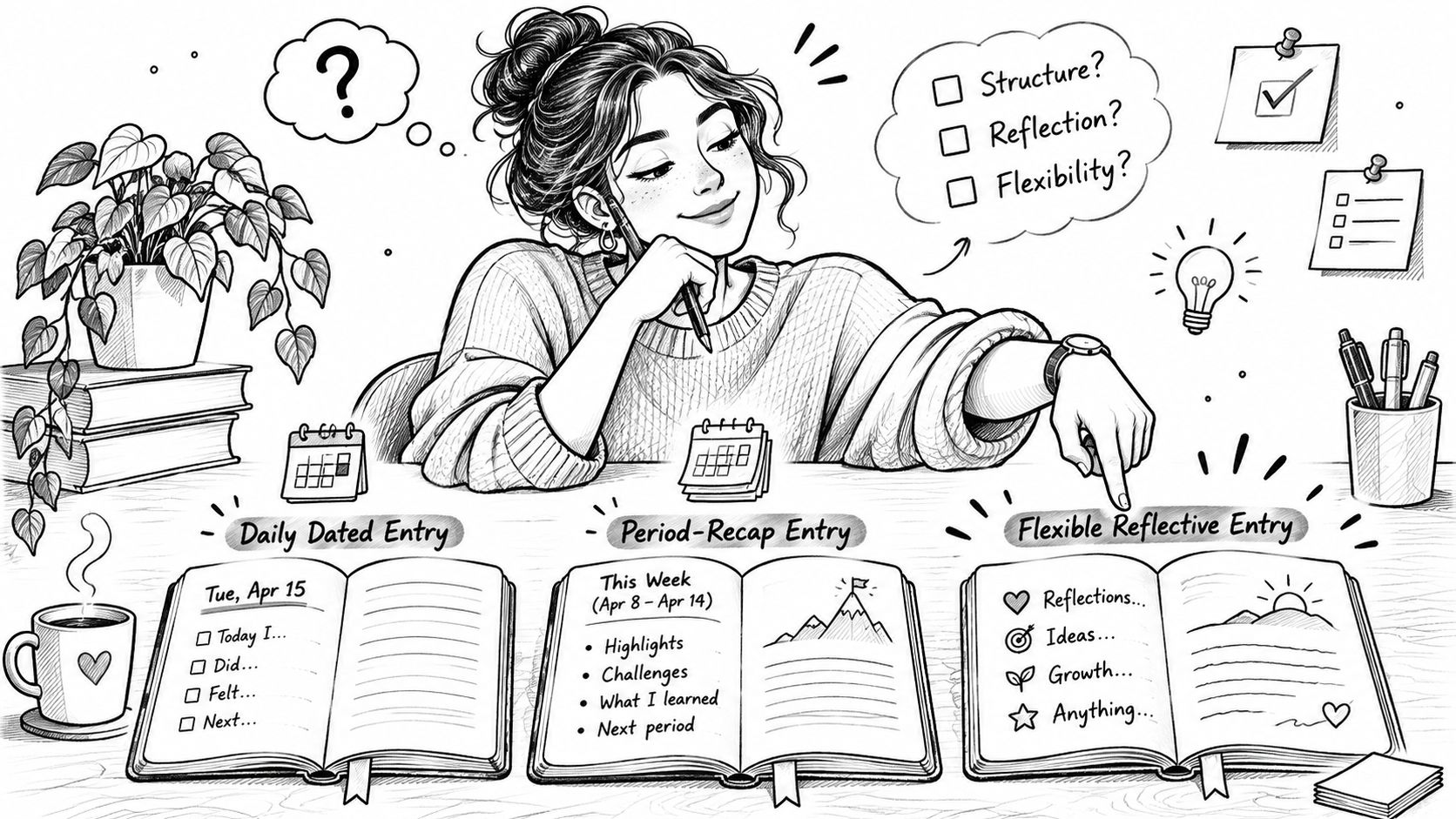
Three layouts cover nearly every reason people keep a diary: recording ordinary days, reviewing a period as a whole, and pulling a specific experience back out of memory years later. The timed expressive session runs on different logic and is treated separately, so the comparison stays with three.
| Layout | Best for | Core fields |
|---|---|---|
| Daily dated entry | Routine record of ordinary days | Date, events, mood, reflection |
| Weekly layout | Seeing a period as a whole over time | Week heading, notes, images, mood, tags |
| Event schema | Retrieving specific experiences later | What, who, where, when, reflection |
The right choice depends on how you plan to read the entry back. A layout is a retrieval system, so pick the fields that match the question you'll ask later: "what was that stretch like," "when did that happen," or "who was there."
The daily dated entry is the familiar form, and it suits anyone who wants a steady line of ordinary days. A usable entry can be one line: "12 March: worked late, walked home the long way, felt lighter by the front door." Its strength is rhythm. Its weakness is that fifty near-identical days blur into one another, which is why the mood and reflection fields matter: they are what make one Tuesday distinguishable from the next.
The weekly layout puts the week at the top and places notes, images, moods and tags beneath it. Photographs earn their keep here, because a picture of the street where the week happened does more than a paragraph of description. If you want to see how images and text sit inside one entry, this guide to keeping a diary with photos walks through it. Life Calendar is built on the same unit: it shows life as a grid of weeks, each week can be marked with colors and given notes, images, a mood and tags, and some users keep it as a personal diary while others use it to keep their past and future in perspective. A weekly line might read: "Week of 9 March: two good mornings, one argument, a lot of rain, photo of the flooded path."
The event schema records what happened, who was involved, where it happened, when it happened, and a short reflection. The structured event layout described by Memory Share treats each field as a retrieval cue, so later recall can be triggered by a person, a place or a date. A sample entry reads: Date, 7 March, 6 pm; Event, dinner with Maya; People, Maya and my brother; Place, the small restaurant on Elm Street; Reflection, I felt more settled than I expected.
The trade-off to watch: structured fields scan beautifully and read thin. Fixed slots help when you know what you'll search for later, and they get in the way when the point of writing is to discover what you think. Pair them with the body work above or the entry becomes a form you filled in.
If you're choosing a layout to support how you feel as much as what you remember, the journaling advice from reVIBE Mental Health explains how the habit supports wellbeing, which helps you judge how much reflection an entry needs. Pick the layout that matches why you're writing, not the one with the most fields.
Writing an Entry for Emotional Processing
Writing down what happened and working through why it still stings are different jobs, and the second one has a shape of its own. A dated note with one event and one reflection records a day. It doesn't process anything, and treating a short factual log as if it did is where people get discouraged.
The prompts below come from the protocol used in expressive-writing research, not from the daily-logging habit.

The review of expressive-writing research in Advances in Psychiatric Treatment describes the conventional intervention as continuous writing for roughly 15 to 20 minutes per session across three to five consecutive days, focused on your deepest thoughts and feelings about one stressful or emotionally significant experience. The proposed mechanism is that sustained writing pushes you toward narrative construction and meaning-making instead of fragmented, repetitive rumination.
Three prompts structure each session:
- What happened? Plain account, no interpretation yet.
- What did you feel or think? The part you'd normally edit out.
- What meaning or change emerged? What you can see now that you couldn't then.
Outcomes vary across individuals and study designs, so treat this as a focused exercise rather than a cure, and don't confuse it with ordinary daily journaling.
Session shape: set a timer, keep the pen moving, and don't stop to phrase anything well. Polishing is writing; this is processing.
A three-day version that works for many people: day one, what happened and how it felt. Day two, the thoughts you've been avoiding about it. Day three, what has changed and what remains unresolved. If you want a lighter thread running alongside it, a simple mood tracker gives you a before-and-after line that's easier to read than a page of prose. And if the experience is still overwhelming, talk to a professional rather than relying on writing alone.
Mixing Structured Fields with Free Writing
Most format guides answer "what parts does an entry have?" and stop. The question that decides whether you're still writing in three months is different: which parts stay the same every time, and which parts stay open?
The diary-study guidance from User Interviews separates open-ended entries, which invite unexpected detail, from structured entries, which improve consistency and comparability across time. Its practical recommendation combines both: a few repeatable fields plus an optional free-writing area.
Frequency is the reason that matters. Many diarists write only occasionally, returning when a week holds something worth recording. A template built for the most committed writer will lose everyone else in a fortnight.
Here is where fixed fields earn their keep: retrieval. When "how it felt" appears in every entry, you can scan six months of Tuesdays and watch a mood shift you never noticed while living it. Free writing handles the opposite job, catching the detail no field anticipated.
| Field | Status | Why it stays or stays optional |
|---|---|---|
| What happened | Always | Keeps the record of events consistent |
| How it felt | Always | Connects the record to mood over time |
| What mattered | Always | Gives the entry its reflection |
| Next action | Optional | Useful only when something needs follow-up |
| Photo, voice or longer note | Optional | Added when the week warrants more detail |
The three-field rule: every entry gets what happened, how it felt and what mattered. Everything else is a bonus, not a requirement.
That split avoids the two ways diary templates fail. A template with nine fields is too demanding for a quiet Tuesday, and a blank page offers too little prompting to get you started at all.
If you keep your diary in Life Calendar, the same division applies: colors, mood and tags act as the fixed fields, and each note, called a card, is the free-writing space.
If you want a scaffold to copy, this weekly notes template gives you the fixed three in a shape you can reuse. Fill those three every time, and add extra material only when the week deserves it: a trip, a loss, a milestone, a decision. Build your own template with no more than four fixed fields before you add anything else.
Privacy and Input Choices for Sensitive Entries
The fastest way to capture a thought is often the worst way to capture a sensitive one. Speed and honesty pull in opposite directions once the material is personal, and format guides rarely mention it.
A 2025 study of mobile expressive-writing interfaces found that keyboard text entry was preferred to voice messages because it offered greater privacy and supported reflection (ACM study of mobile expressive-writing interfaces). The preference makes sense. Nobody wants to dictate a difficult memory on a train.
That applies directly to how you choose an input method.
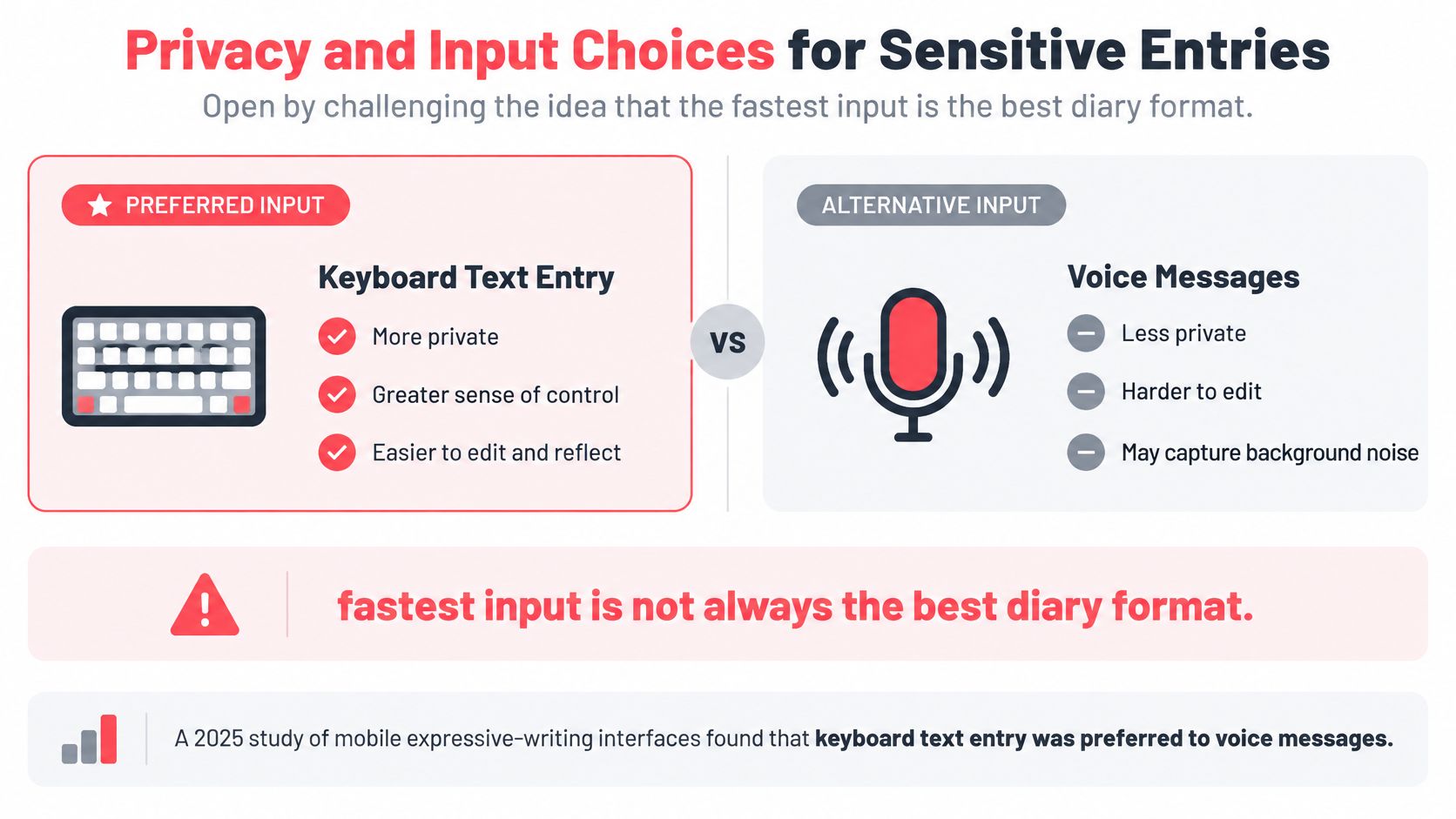
| Input | Privacy and emotional fit | Speed | Best use |
|---|---|---|---|
| Typed text | Most private, room for reflection | Slower | Sensitive thoughts |
| Voice | Fast, but less private in shared spaces | Fast | Quick notes when alone |
| Images | Captures context, may reveal people or places | Fast | Context for a less sensitive week |
| Structured mood field | Quick, but flattens nuance | Fastest | Daily tracking |
The workable pattern is a private core: sensitive thoughts go into typed text or locally processed data, while optional media covers the less sensitive context, a photo of the street, a weather note, a shot of the desk you worked at.
Choose by asking three questions. How private is this material? If the answer would embarrass you at a family dinner, it goes in text. How much context will a future reader need? A photo answers that faster than prose. How intense is the emotion right now? High intensity favours the slower, more reflective input.
Before you put anything sensitive into an app, read its privacy policy and confirm where entries are stored and whether they're shared. For our part, Life Calendar doesn't use cookies for tracking purposes, and it doesn't sell, trade or transfer personally identifiable information to outside parties unless users are given advance notice. If speaking is your fastest route when you're alone, this guide to voice-to-text covers the setup before you rely on it.
Nobody chooses an input method by accident once they've asked those three questions. The gap isn't a missing list of entry parts, it's the absence of a risk-aware habit of choosing.
Choose a Format and Write Your First Entry
Answer three questions and the layout picks itself.
- Do you want a steady record of ordinary days? Start with the daily dated entry, one line on quiet days and a full body when something happens.
- Do you want to see a period as a whole and revisit it? Use a weekly layout with the week as the heading and notes, images, moods and tags beneath it.
- Are you working through a hard experience? Use the expressive session for three to five days, then return to a standard layout once the intensity drops.
The weekly route fits Life Calendar well. The app uses your birthday to generate a grid of your life in weeks, with each week shown as a box, and you can mark each week with colors and add notes, images, mood and tags to it. It's available on the App Store and the Play Store. If you'd rather draft an entry with help before committing it to the record, these guides to multi-model AI chat explain how to compare assistants, which matters more than usual when the text is personal.
Now write one entry today. Date at the top. A body of three to five sentences holding one event and one feeling. One reflection sentence at the end that says what it meant or what changes next.
Then leave it for a week and come back to it. Read the entry as a reader rather than as the person who wrote it, and notice which fields you used. Keep those, drop the rest, and your template will reflect your real habits rather than an imagined ideal diarist who has time to write two pages every evening.
Life Calendar makes the weekly version of a diary entry the default, so each week of your life is a box you can color, annotate and revisit. You can add notes, images, mood and tags to any week and watch the record build into a view of your past and future at once. Download it on the App Store or the Play Store, or visit Life Calendar to see how the grid works.