Journal About Life: How to Record Weeks That Matter
Learn how a journal about life records weeks, moods, and milestones, what research says, and how to start a private weekly record.

In this article
- What a Journal About Life Actually Holds
- A record, not a finished story
- Meaning is optional, not a performance
- Pick the Record That Matches Your Life
- Formats for a journal about life
- Choose by the gaps you can accept
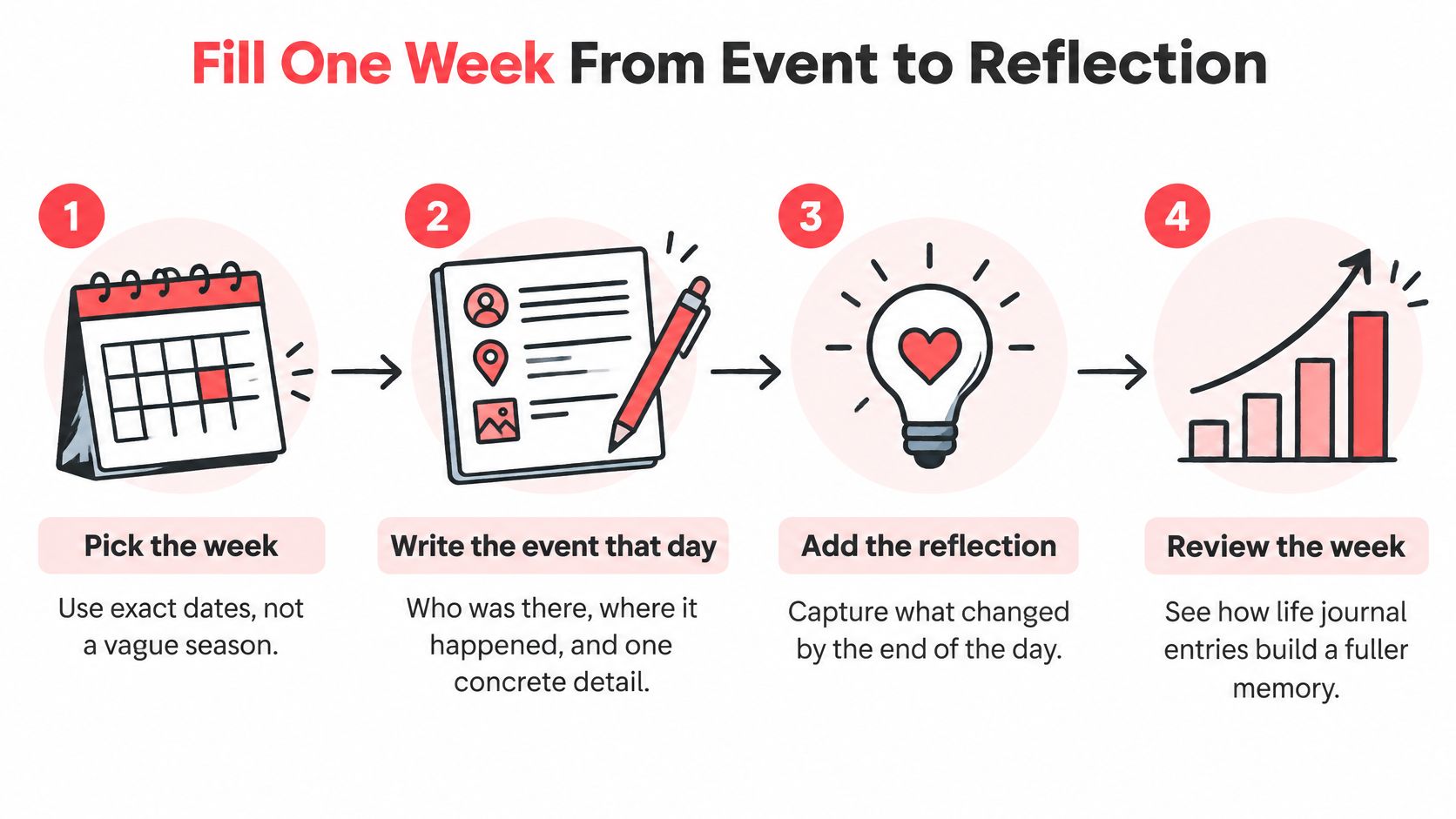
- Fill One Week From Event to Reflection
- Build the entry in manageable moves
- Know when the week is finished
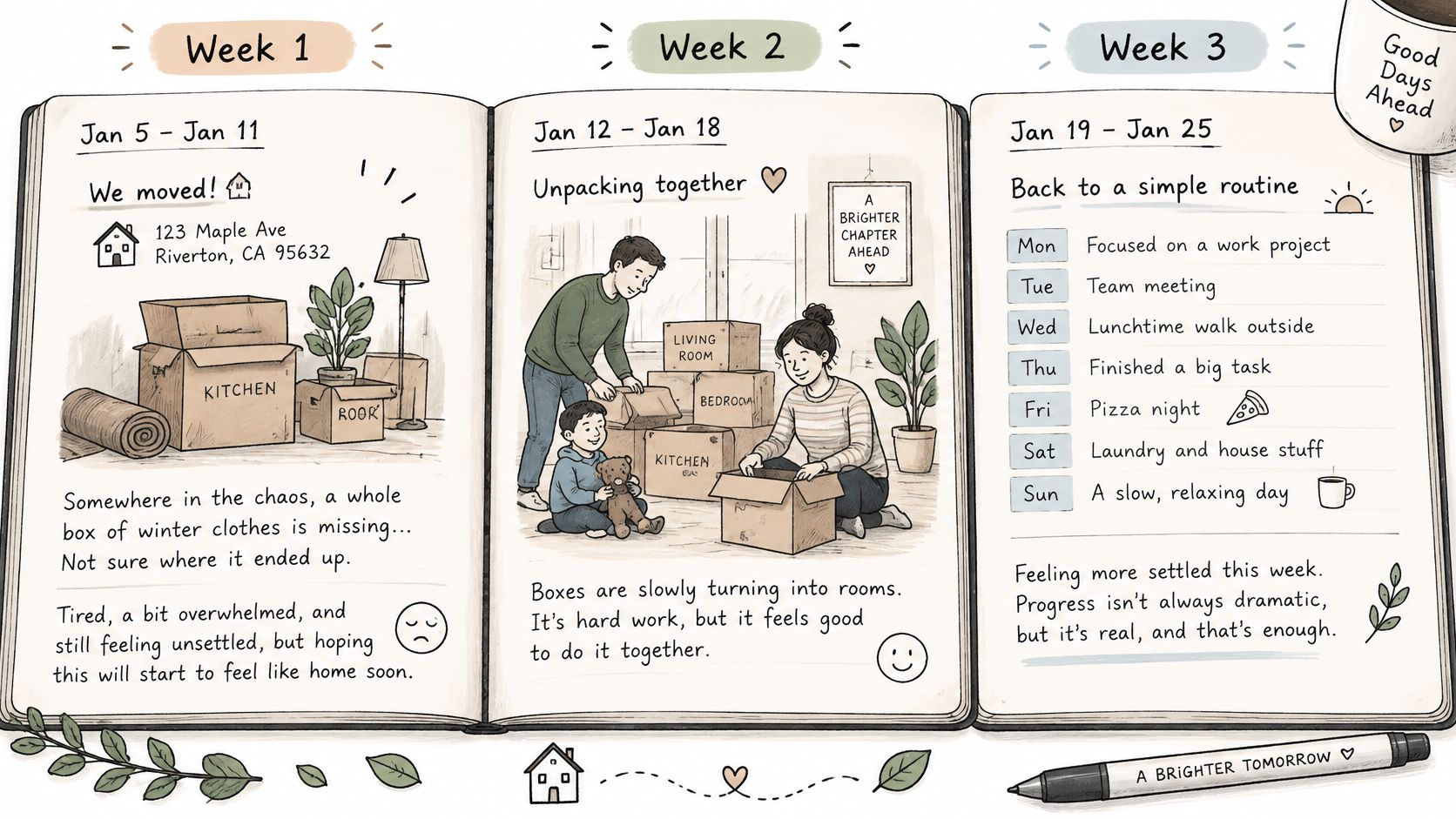
- Three Weeks Written as Life Journal Entries
- The week of a move
- An ordinary working week
- The week of a health appointment
- Why a Later Memory Drops the Details
- What the comparison actually found
- What a weekly record can preserve
- What Writing Research Supports and Limits
- What expressive-writing studies actually found
- Use prompts to clarify, not prescribe
- Choose a Private Place and Record This Week
- Where a life journal can live
- Keep only the detail you need
If you'll remember the important parts of your life, why write down an ordinary week? Because knowing that you moved, changed jobs, or spent time with friends isn't the same as remembering the empty kitchen, the conversation on the train, or how uncertain you felt before a decision.
A useful journal about life keeps those particulars without requiring a polished story every evening. Treat it as a weekly record made while the experience is still close, not an autobiography you'll somehow reconstruct later.
What a Journal About Life Actually Holds
Think of a week as a box. Say you've just moved home: inside that box go a note about the missing kettle, a picture of the old kitchen, and a few words about sleeping somewhere unfamiliar. You don't need to describe everything you did. You need enough context to recognize that stretch of life later.
A life journal is a dated record of experiences, reflections, and personal milestones. Its organizing question is simple: what would help my later self understand this period?
A record, not a finished story
A daily diary follows the day. It suits someone who wants to describe events and feelings as an ongoing conversation with themselves, without deciding which moments deserve a place in a broader timeline.
A memoir works backward. The writer selects earlier experiences and shapes them into a narrative, often using whatever records and recollections remain.
A weekly life journal sits between them:
- The note records what happened.
- The image preserves a visual detail, when useful.
- The mood describes how the period felt.
- The tag makes related weeks easier to find.
These elements don't need equal space. A quiet week might need only a sentence about a familiar walk and a note that work finally felt manageable.
Meaning is optional, not a performance
You can add reflection without forcing every week into a lesson. If questions of purpose or belief matter to you, Life Purpose App's reflective writing prompts for spiritual seekers offer starting points for that part of an entry.
Keep the purpose practical: preserve a recognizable piece of life. The format, the writing method, and the storage location should serve that purpose, rather than turn an ordinary week into another assignment.
Pick the Record That Matches Your Life
Start with a weekly life journal unless you already have a reason to choose something else. It gives everyday experiences a place without asking you to produce a complete account each night.
The important trade-off isn't paper versus an app. It's how much you want to capture, how often you're willing to return, and what you're comfortable leaving undocumented.
Formats for a journal about life
| Format | Cadence | What you capture | Burden | What waiting costs |
|---|---|---|---|---|
| Daily diary | Most evenings | That day's events and feelings | High; easy to abandon | Little of that day, if the habit holds |
| Weekly life journal | Once a week, plus optional midweek notes | Highlights, mood, photos, and tags for the week | Moderate | Early-week detail if nothing was noted sooner |
| Milestone log | Only at big events | Moves, jobs, trips, relationships, health turning points | Low | Ordinary weeks and the feeling around the event |
| Photo roll alone | Whenever a picture is taken | Images with weak written context | Low | Why it happened and how the period felt |
Choose daily writing if a short evening note already feels easy. It offers room for the changing texture of a day: an argument in the morning, an apology at lunch, and relief by bedtime. That detail can matter, but don't choose it merely because daily writing sounds more serious.
A milestone log makes sense when you want a highlight record. You can document a graduation, a move, or a change in a relationship without promising to capture the stretches between them. The limitation is deliberate: you'll keep turning points, not the full texture of a life.
Decision rule: Choose the least demanding format that still preserves what you want to revisit.
Choose by the gaps you can accept
A photo roll is useful evidence, but it isn't automatically a journal. A restaurant photograph might preserve the table and the meal while omitting the reason you met, the news your friend shared, or why you went home feeling different.
You don't have to give up photographs or an existing diary to keep a weekly record. A weekly entry can act as an index, pointing to the longer note or selected image that belongs to that period.
If the labels themselves are confusing, this explanation of the difference between a diary and a journal can help you choose by purpose rather than terminology. You don't need to satisfy a strict definition before you begin.
Circle a row and try it for the next four weeks as a practical experiment. Change cadence only after you've noticed what feels burdensome or what you keep wishing you'd recorded.
Fill One Week From Event to Reflection
Begin with a specific week, not a broad intention to write about your life. You can collect small fragments as events happen, then decide what belongs in the finished record.
A systematic review of mobile-phone mood and stress assessment explains why recording experience in natural settings, close to the moment, reduces recall bias compared with retrospective reporting. That's a useful principle for journal design, not proof that you need frequent alerts or continuous tracking.
Build the entry in manageable moves
Pick the week and give it dates. Use its start and end dates rather than a label such as a difficult spring. A defined boundary helps you decide which events belong together.
Capture the event that day, when convenient. Note who was there, where it happened, and a concrete detail, such as waiting outside the station in the rain. These are capture notes, so fragments are enough.
Select images rather than importing everything. For example, choose a picture of the packed hallway and another of the first meal in the new home. Each should add something your written note doesn't already preserve.
Add a mood and useful tags. A word such as mixed can fit better than forcing a complicated week into happy or sad. Use broad tags such as work, family, health, travel, or home so you won't have to remember an elaborate filing system.
Separate the event from your interpretation. At a weekend sitting, describe what changed and what you made of it. Keeping reflection apart from factual notes lets you recognize that your interpretation might change later.
Mark a milestone only when something turned. A move may deserve that label; an ordinary working week doesn't need one. Leaving the label empty is an accurate choice, not an incomplete entry.
Keep the timing of the writing visible. Preserve the original capture date and identify later additions when your tool allows it. A same-day reaction and a later understanding are different kinds of information.
Know when the week is finished
A completed record might say that you handed over the keys, lost track of the winter-clothes box, and ate dinner beside unpacked furniture. Underneath, add an unsettled mood, home and family tags, and a reflection about how unfamiliar the evening routine felt.
That's enough. You don't need a transcript of every conversation, a photograph for each event, or an explanation for every emotion.
Keep midweek capture optional. A reminder should help you preserve something, not become another demand you learn to ignore.
If notifications interrupt you, turn them off and use event-triggered notes instead. If you miss a week, resume with the current one and label any backfilled entry accurately rather than pretending it was written at the time.
Three Weeks Written as Life Journal Entries
The following fictional entries show the same format applied to different circumstances. Their details are examples, not a list of experiences you need to have.
The week of a move
Facts: During the dated week, we moved into the new flat. I recorded the address in the private entry, handed over the old keys on moving day, and couldn't find the box containing our winter clothes. We ate beside the unopened boxes because the table was still dismantled.
Mood and tags: Unsettled. Home, family. Milestone: Moved home. Image: The empty old kitchen, with the cupboard doors open.
Meaning: The week felt smaller than the decision that caused it. We'd discussed the move for so long, but the actual change arrived through practical details: an unfamiliar light switch, a different route to the shops, and nowhere obvious to put the kettle.
An ordinary working week
Facts: Tuesday's product launch went out after the final check. My train home was late, and I had dinner with a friend later in the week. I noted the launch date and the café name so I could place both events later.
Mood and tags: Mixed. Work, friends. Milestone: None. Image: Not needed.
Meaning: The launch handover went better than I expected because I'd written down the unresolved questions before the meeting. Dinner also reminded me that I could talk about something other than work, even during a demanding period.
The week of a health appointment
Facts: I recorded the appointment date and summarized what the clinician said in my own words, clearly marking it as my understanding rather than an exact quotation. I also wrote down the follow-up instruction and the question I forgot to ask.
Mood and tags: Anxious before the appointment, relieved afterward. Health. Milestone: None. Image: Omitted because the document contained details I didn't want in the journal.
Meaning: The result and the fear beforehand were separate experiences. I don't want a relieved ending to erase how uncertain I felt while waiting, or my earlier fear to change what I record about the result.
Copy the shape, not the subjects: facts first, mood and tags next, meaning last.
Notice that only the move receives a milestone label. The other weeks still deserve a place because they preserve work, friendship, uncertainty, and relief without claiming that every experience changed a life.
As a practical writing limit, try keeping each week under half a page unless it needs more. Stop when your later self would have enough context, not when you've made the entry sound impressive.
Why a Later Memory Drops the Details
There's a difference between remembering a scene and knowing a fact about your life. You might know that your family spent summers by the sea without recalling which beach you visited on a particular afternoon, who came with you, or why everyone left early.
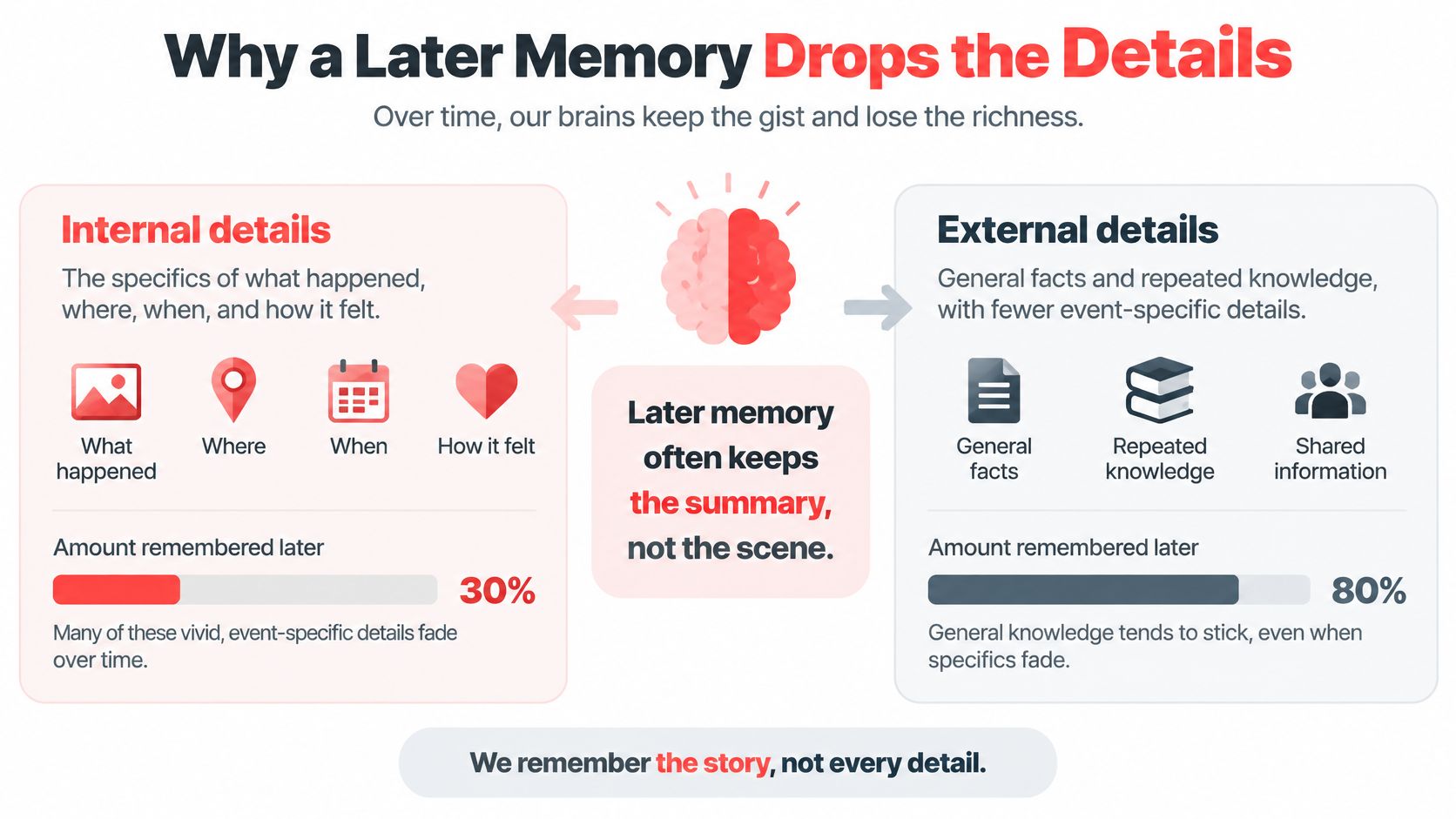
Researchers distinguish internal details, the specifics of an event, from external details, such as general facts and repeated knowledge. Neither category is useless. The distinction matters because a general summary can't always answer a question about a particular experience.
What the comparison actually found
A 2023 meta-analysis of autobiographical specificity examined 34 studies involving 1,556 participants and found that older adults recalled substantially fewer internal details and more external details than younger adults. The pooled differences were Hedges' g = 1.007 for internal details and −0.799 for external details, with both statistically significant after adjustment for publication bias.
Those effect sizes describe differences between the groups studied. They aren't percentages of memories lost, predictions about an individual, or a countdown to forgetting.
The comparison supports a practical distinction:
- A general account might say that the early working years were busy.
- An event-specific record might name the colleague who helped with a difficult presentation and describe the walk home afterward.
- A later interpretation might explain why that support mattered, while remaining separate from the original event note.
What a weekly record can preserve
A journal gives you an external record to consult. You don't have to reconstruct the café name, the question you were worrying about, or the room's appearance solely from recollection if you've already saved those details.
That doesn't make the entry complete or infallible. You choose what to include, misunderstand conversations, and sometimes write while upset. Use wording such as I understood the conversation to mean when you're recording an interpretation rather than an independently established fact.
The defensible claim is preserved context, not improved brain health. The memory findings don't establish that journaling prevents dementia, restores lost memories, or changes the course of a neurological condition.
For a broader approach to organizing personal records, this guide to memory keeping can help you decide which materials deserve a lasting place. The useful question is whether a record helps you locate an experience, understand its context, and distinguish what happened from what you later came to believe about it.
What Writing Research Supports and Limits
Don't turn a writing habit into a promise of treatment. A University of California, Irvine summary of expressive-writing evidence describes an average health effect of about Cohen's d = 0.16 across more than 100 studies, a modest average effect rather than a dramatic or universal result.
Expressive writing is a structured research practice involving thoughts and feelings, not any act of keeping a journal. A weekly record of meals, journeys, and work events isn't interchangeable with a study task focused on distressing experiences.
What expressive-writing studies actually found
The Irvine summary describes the historical findings in the first rows below; the systematic review of expressive writing in breast-cancer patients supplies the final row, covering 11 randomized trials and 1,178 patients, with symptom effects observed during follow-up of up to three months.
| Evidence | Figure | Fair reading |
|---|---|---|
| Zinger review, summarized in 2017 | 146 studies; benefits varied by person and design | Writing can help, but not for everyone in the same way |
| Pennebaker and Beall, 1986 | 15 minutes on 4 consecutive days; health-center visits about half the control rate over 6 months | A short writing task, not a lifelong prescription |
| Later synthesis | Average health effect about Cohen's d = 0.16 across more than 100 studies | Modest; don't expect a dramatic health change |
| Breast-cancer review | 11 trials, 1,178 patients; negative somatic symptom scores reduced by 13.03 points with emotional prompts and 9.18 points with benefit-finding prompts, during follow-up up to 3 months | Time-limited physical-symptom findings, not reliable psychological improvement |
The breast-cancer findings concern a particular patient group and particular measures. They don't tell you how much better an ordinary weekly journal will make you feel, and the review didn't find reliable improvement in psychological outcomes.
Likewise, an earlier study's health-center visits aren't a general measure of recovery. A striking result from a specific experiment shouldn't become a promise attached to a journaling app.
Use prompts to clarify, not prescribe
A useful weekly prompt separates description from interpretation. Try these as writing choices, without expecting a health outcome:
- Event: What happened that I want to be able to place later?
- Response: What did I feel or think at the time?
- Meaning: What seems important about it now?
- Uncertainty: What am I not ready to explain?
Benefit-finding shouldn't mean inventing a positive lesson. You can record that something was painful, unresolved, or exhausting.
For more ways to structure a reflective habit, Be Your Best Self & Thrive Counseling, PLLC offers journaling techniques for daily self-care. Treat techniques as options, not obligations, and don't push yourself to write detailed trauma narratives to make an entry count.
A mood label isn't a treatment. If writing intensifies distress, stop or choose a less demanding subject, and seek appropriate clinical support when you need care.
Choose a Private Place and Record This Week
Choose storage before adding sensitive material. Ask who can open the record, whether images and their metadata are encrypted, what export and permanent deletion include, and whether an automated feature will analyze your writing.
A 2025 mobile expressive-writing study found that participants preferred keyboard input over voice messages partly because text felt more private and reflective, with particular hesitation about speaking sensitive emotions aloud in public. Richer input isn't automatically better when it makes disclosure easier.
Where a life journal can live
| Place | Access | Export or delete | Main exposure |
|---|---|---|---|
| Paper notebook | Anyone holding it | No digital export; the only copy can be lost | Someone finding and reading the book |
| Phone notes app | Device and often a synced account | Check app controls; backups may remain | Cloud copies and shared logins |
| Weekly life app | Account holder; check sharing | Confirm export, permanent deletion, and encryption coverage | Photos, metadata, and possible automated analysis |
| Voice note | Device plus anyone nearby | Recording file may sync | Sensitive feelings spoken in public |
Paper avoids account access, but needs a safe physical location. With a notes app, inspect synced devices and shared accounts rather than assuming a locked phone protects every copy.
For digital tools, ask whether deletion covers attachments and backups, not just the visible entry. If the policy doesn't answer a question, leave sensitive material out until you understand the arrangement.
Keep only the detail you need
BlokNotes' guide to which planner features actually matter offers a useful feature-selection starting point, but personal records also need privacy checks. This guide to a mood tracker journal can help you decide whether emotional labels belong in your record.
At Life Calendar, we use your birthday to generate a life-in-weeks grid, with each week shown as a box; you can add colors, notes, images, mood, and tags. Our app is available on the App Store and Play Store, although Android currently offers the older version and some newer features may differ.
Privacy questions can be sent to support@lifecal.me. Before saving a health note or identifying photograph, make sure you're comfortable with the answers, and remember that omitting a detail is a valid privacy choice.
Life Calendar offers a weekly grid for keeping experiences alongside notes, images, moods, and tags. Visit Life Calendar to explore the format, then record the week just finished with a concrete event, an optional image, and a brief reflection on what mattered.